 |
|  |

|
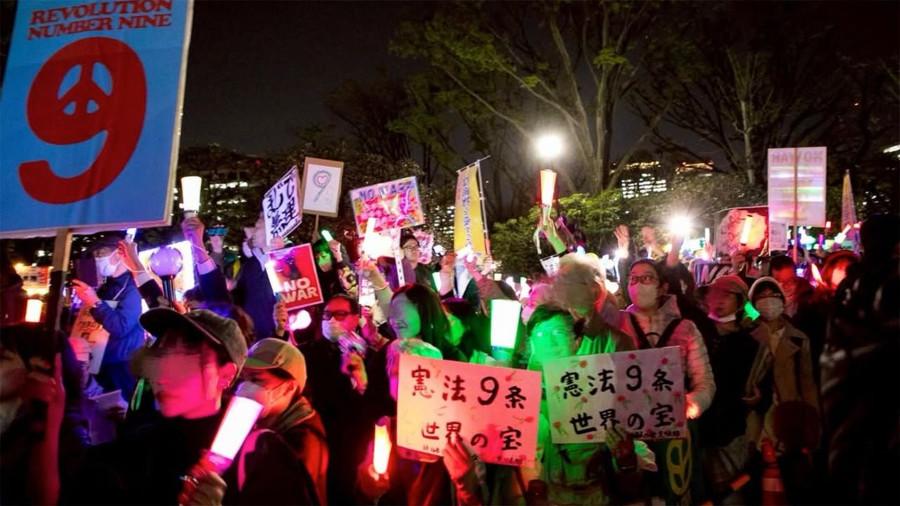
Mass protests in Japan against war and remilitarisation Gohta Hashimoto, a 22-year-old university student, told the Guardian: “I always thought of politics as something for older people, but that feels like turning over my future to someone else… Until now I’d never thought of the constitution as something young people needed to fight for.” In reality, Japan’s post-war constitution—including Article 9—has been systematically undermined by successive governments. That has taken place ever since, under pressure from the US, Japan re-established its so-called Self Defence Forces in 1954 after signing the US-Japan Security Treaty in 1951. Japan now has a substantial army, navy and air force armed with offensive weapons. Under Takaichi, military spending is being doubled, Japan’s southern islands are being militarised in preparation for war against China and restrictions on the export of lethal weaponry were further eased last month. The LDP’s longstanding campaign to change the constitution aims to legitimise the existence of the Japanese armed forces, which stands in glaring contradiction to Article 9, and further undercut any legal or constitutional constraints on military deployments in the pursuit of the interests of Japanese imperialism. Article 9 consists of two paragraphs. The first forever renounces “war as a sovereign right of the nation and the threat or use of force as means of settling international disputes.” The second declares that “land, sea, and air forces, as well as other war potential, will never be maintained. The right of belligerency of the state will not be recognised.” Takaichi has yet to announce a specific amendment, but the discussion within the LDP has centred on changing or supplementing the second paragraph to legitimise the Self Defence Forces. Her allies in the far-right Japan Innovation Party advocate the complete deletion of the second paragraph and explicit recognition of a “national defence force.” Takaichi’s cautious approach to amending Article 9 stems from the deep-seated opposition to war, particularly in the working class, which was brutally suppressed by Japan’s militarist regime in the 1930s and 1940s. The revision of the US-Japan Security Treaty in 1960, to allow permanent US military bases in Japan as part of a formal alliance, provoked massive protests that forced the cancellation of US President Dwight Eisenhower’s scheduled visit. The post-war constitution has never been revised. Any change requires a two-thirds majority in both houses of the Japanese Diet and a simple majority in favour in a referendum. Takaichi holds a two-thirds majority in the lower house after calling a snap election in February, but not in the upper house. A recent Yomiuri Shimbun poll indicated that 80 percent of people opposed any change to the first paragraph of Article 9 while opinion on changes to the second was closely divided. Since taking office last October, Takaichi has made constitutional change as a top priority for her government. In a pre-recorded video message on Sunday, she insisted that the constitution had to be updated to reflect today’s international environment and security realities. “Debate cannot be for debate’s sake. To meet the responsibility entrusted to us by the public, politicians must engage in discussions that lead to decisions,” she said. Takaichi, who was in Vietnam at the time, sent her video message to the ultra-nationalist organisation, Nippon Kaigi, which is an unabashed defender of the remilitarisation and the war crimes of Japanese imperialism during the 1930s and 1940s. Its views are widely supported in the Japanese ruling class, which has always chafed on the restrictions imposed by the post-war constitution drawn up by the US occupation. While successive governments have justified remilitarisation by claiming that China, in particular, poses a threat, Japan has closely aligned itself with Washington’s advanced preparations for military conflict with China, of which the US war against Iran is a component. Just as the US is using its military might in a desperate attempt to reverse its historic decline, so Japanese imperialism is seeking to rebuild militarily as its global position has slipped from the world’s second largest economy in 2010 to the fourth largest. Significantly, while public discussion has been focussed on Article 9, the government is also considering the insertion of a profoundly anti-democratic state-of-emergency clause into the constitution, which could be used in the event of foreign invasion or supposed “domestic rebellion.” Cabinet orders during such a so-called emergency declaration would be considered law while the terms of lawmakers would be extended without elections. A proposal contained within the LDP’s 2012 revised constitution draft would allow the military to be deployed on the streets to “maintain public order.” A process of radicalisation—which is already evident in the growing mass anti-war protests—will only deepen as the implications of the criminal US war on Iran, its economic impact on the working class and the unfolding of a wider global conflict become apparent. The turn by Japanese imperialism to war will not be halted by constitutional restraints. Workers and youth in Japan, like their counterparts internationally, need to fight for the only viable solution—the building of a unified anti-war movement of the international working class based on a socialist program to abolish the source of war, the capitalist system. https://www.wsws.org/en/articles/2026/05/06/weui-m06.html Back |
|
||||||
|
|||||||