 |
|  |

|
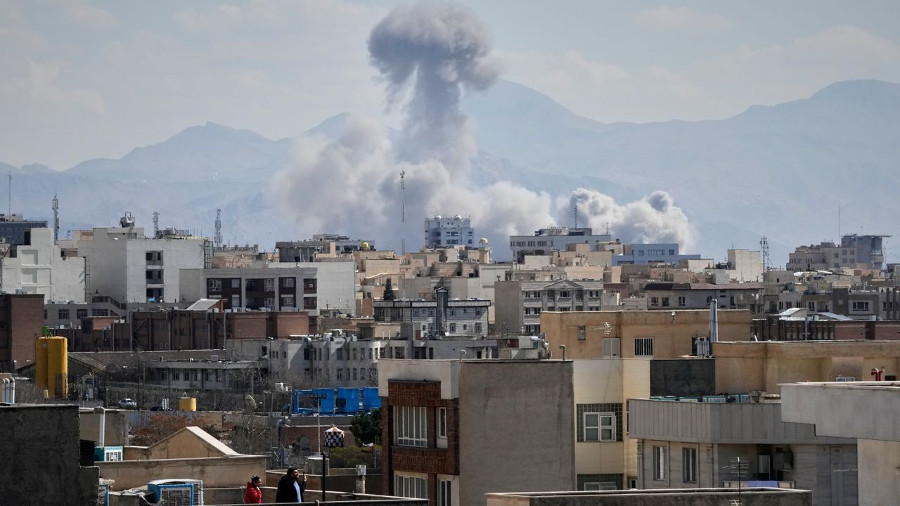
Tensions in the Middle East have escalated And at this stage, with so much weaponry in place and with the Israelis in such a strong and aggressive position, one has to ask whether Donald Trump has really given up sort of US sovereignty. And many people in the US are doing so, and maybe the most heartening thing is that only 25% of the US population is supporting him. And we're seeing major gaps open up within Trump's own Make America Great Again coalition, especially the right-wing commentator Tucker Carlson asking some very tough questions. So things are very fluid and it doesn't look like the war will end in coming days. Maybe it'll take more than weeks. It'll be months. SABC: So South Africa is not that heavily impacted. But what about the other African economies? How are they likely to feel the impact, especially those who are reliant on imported oil and gas? Patrick: Well, we all are, aren't we? I mean there is some oil produced in South Africa by squeezing coal. That's the Sasol operation in Secunda. So we have about 20% of our liquid petroleum coming from that source. It's also the world's number one point source of CO2 emissions, we have to remember. So it's not a particularly good way to get oil. But yeah, on the rest of the continent, will see some oil exporters – Angola, Nigeria and some of the North African countries - have a boom because oil is already up about 14% since the bombing began on Saturday. And the closure of the Strait of Hormuz, as you've pointed out, does mean 20% of world oil will stop. And there was a huge fire at the probably the largest of the Gulf refinery complexes in Saudi Arabia. It's not too sure who started that fire. The Iranians deny it. They obviously don't want to see oil infrastructure affected in this process. But the Qataris have had a couple of bombings at their big natural gas facilities and they've closed them. Now, Tucker Carlson, whom I mentioned, is the far-right voice of anti-war sentiment in the US, he's actually just made the allegation that the Qataris and the Saudi governments have captured Mossad agents. So we may learn actually that some of the sabotage that's going on isn't actually coming from Iran. But as part of the general confusion in the area and the weakening of the Gulf Cooperation Council and Arab states, it may well be - if Carlson is correct - that this is connected to Israel's desire to generally shake things up and become the strongest. Israel is also signaling that it would now see Turkiye as the next target, after a regime change that it hopes will happen in Iran. So things are very fluid, but I think for most of Africa, we're going to always ask the question, are we too addicted to international imports, whether those be manufactured goods, or of course oil and gas? And the dilemma of trying to have a just energy transition, when Africa has such great hydro and wind and solar potential, is that we've been doing that far too slowly. SABC: Right. Also, key shipping lanes through the Strait of Hormuz have been disrupted after Iran continued their missile and drone attacks on Gulf states. So, how might that particularly affect global energy markets and supply? Patrick: Yes, of course, that's where so much of the oil and gas comes through. So, that's the main reason for the 20% well, people are even expecting - JP Morgan, for example, world's biggest bank - up to $120 a barrel. So that would be about an 80% increase, if indeed that transpires, once the implications, once stocks run down and those ships are stuck in the Gulf or can't get in to refuel. I might add that there's another area of shipping that the South Africa certainly benefited from being closed: that was the Red Sea, because the Houthis can now bring out their disruptive capacities. They haven't really done it quite yet, except if they identify ships going through the Red Sea via the Suez Canal to Israel. So that's been their main target. But I can certainly imagine that in solidarity with Iran, very soon, the Houthis would stop the Suez Canal. That's about 12% of world shipping. It's mostly the container ships. So we're going to see, around the Horn of Africa, quite a bit more traffic. South Africa doesn't really benefit. Tthose are ships that are just circling around, and it takes an extra two weeks. But they don't do much in way of refuelling or stopping in South Africa. And it just shows that the terrain of geopolitics - the inability of the rest of the civilized world to get some sort of resistance to Trump, and to his ability, one day, to kidnap a president of Venezuela, and the next to threaten takeover of the Panama Canal or Greenland, and the next to bomb Iran, unilaterally alongside Israel. This reflects the complete failure of systems like the UN Security Council, or what he's now also set up, as a ‘Board of Peace,’ which forces all the countries to take sides. In Africa, because only Egypt and Morocco joined the Board of Peace, there were no other African countries invited, no Sub-Saharan African countries. And that does split the BRICS right in half. So Brazil, Russia, India, China, South Africa had existed from 2009 to 2023 and then expanded to include five others and those included Iran but also, across the Strait, its new enemy UAE, as well as Egypt. Saudi Arabia thought it would join. And also Indonesia, a Muslim-dominated country, but yet one that has been in the US orbit, and also as part of the Board of Peace. India is the host of the BRICS this year, and I've just named about five of those - aside from Iran, of course - which will line up with the United States and Israel. Ethiopia we'd add to that. And then we'd look at, as another force, particularly Brazil and South Africa as the main democracies, trying especially, in the Hague Group later this week - that is the group that South Africa co-chairs with Colombia - to try to get international rule of law re-established. And maybe there's a chance, but these are very small countries: South Africa, Colombia, Malaysia being the biggest. And then you've got the other big factor, which would be China and Russia. So far they've stood aside. It may be that the Russians have helped the Iranians recover: they did that in the June 2025 war when the grid went down. But don't forget that Russia has, as Vladimir Putin himself has said, about 2 million of its own citizens, that is Jewish Russians, who moved to Israel. And they’re of course in the Israeli Defense Force. And they're also involved, Russia, with some of the coal and oil trade to Israel. South Africa is the number one coal supplier to Israel. China having about $32 billion of trade with Israel this last year, including drones, the ones that are so devastating in Gaza, where the genocide is still underway. Brazil supplies 9% of the oil. India and Israel are very interconnected, and prime minister Modi was just in Israel addressing the parliament. And I could go on, of course. Egypt and Ethiopia with its troops in the IDF. The UAE very tight with the Abraham Accords. Except now, maybe, tensions are rising because of Israel's very destructive role. But what it means, is that what we'd hope to see is a sort of counterbalancing or multi-polar world. The BRICS had some rhetoric about supporting systems in which more just multilateral institutions would emerge and peace would prevail. Well, that's certainly not happening. And the BRICS didn't really present any counterweight or any threat to the US and Israel or to their friends in Europe. I must say, though, that one ray of hope is that the European citizens and the US citizens are so strongly against the war, that it'll be hard for their own politicians to keep pretending that this is a public-interest war. It's obviously a war for very particular interests, and when you see only 25% of the US supporting this war - which I think is quite remarkable, having lived there and gone to university there. And when you see some governments in Europe, like Spain, denying the US its bases to use to launch attacks on Iran. And when you see Ireland and Norway and Switzerland and Serbia beginning to break away from the pro-US, pro-Israeli bloc, the so-called Axis of Genocide in the West, this is encouraging. So there may be some very interesting splits and even if the BRICS don't stand up, as what people had hoped for - that is a major countervailing force - because they're I think too tightly intertwined with Israel, we do see a chance for the world to say, ‘this isn't right, and our politicians better watch out otherwise election time they'll be punished.’ SABC: Right Professor Bond, thank you so much again for your very insightful analysis, we appreciate your time this morning. Patrick: Thanks Asanda, good to be with you. Thank you. SABC: Professor Patrick Bond is a political economist and distinguished professor of sociology at the University of Johannesburg here in South Africa. https://youtu.be/lDHjzIWpYpE?t=44 Back |
|
||||||
|
|||||||