 |
|  |

|
Regarding the assassination of El Mencho and the drug blockades
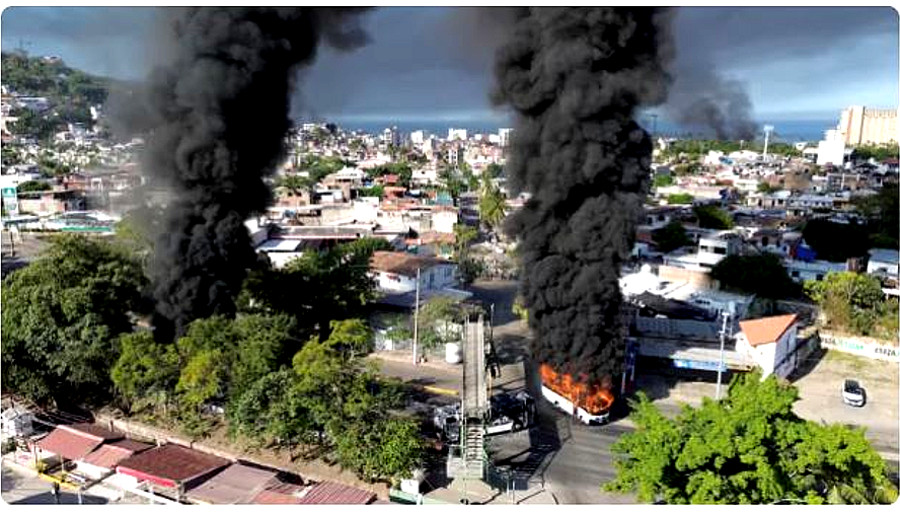
So far, blockades and clashes have also been reported in 13 municipalities in Michoacán. Drug cartel blockades have been reported in Colima, as well as in the state of Guanajuato, where Oxxo convenience stores and pharmacies have been burned in six municipalities. A blockade on federal highways has been reported in Aguascalientes. Fires set by criminals have been reported in Nayarit. There are other blockades in states such as Puebla, Quintana Roo, and Oaxaca. Everywhere, the response is the same: security task forces are being established, and people are being urged to stay home and remain calm. The federal government's policy to combat organized crime Once the objective was achieved—the arrest and killing of El Mencho—federal forces withdrew. This near-paralysis of federal forces is driven by a political decision and by a far-reaching process of degeneration of the Mexican state in some regions of the country. The government does not want a direct confrontation with armed groups, not due to a lack of military power, but because its policy is geared toward stabilizing the country to attract foreign investment. A policy of direct confrontation discourages investment, so the government is not interested in that approach. Instead, it seeks to conduct intelligence operations that will allow it to reach the leaders with the fewest possible casualties. The action by federal forces where Mencho was killed breaks this line and, although information is flowing, the statement released by the army says: “It should be mentioned that, for the execution of this operation, in addition to the work of central military intelligence, within the framework of bilateral coordination and cooperation with the USA, complementary information was obtained from authorities of that country.” At the same time, former US Ambassador to Mexico Christopher Landau posted on his social media: “This is a great step forward for Mexico, the United States, Latin America, and the world. There are more good people than bad. Congratulations to the law enforcement agencies of the great Mexican nation.” Everything seems to indicate that this operation is the result of pressure from U.S. imperialism and yet another capitulation by the Mexican government to this pressure. We believe this because recent events show a growing instability, which runs counter to the government's general policy, just months before the World Cup. Since the government's stability policy stems from the government's focus on capital (protecting investments), it fails to consider the brutal degradation that occurs in society for the poorest sectors of society, the working-class and peasant families. While graphs insist that violence is decreasing, the situation in the neighborhoods is suffocating; the violence beneath the surface continues unabated: disappearances, extortion of small businesses, femicides, etc. All of this is an everyday occurrence. The federal government's policy cannot fundamentally solve the security problem faced by the working class, women, and youth of our class, because its vision and policy are class-based and they respond to the interests of big capital. Right now, the army, the national guard, and the navy should be fulfilling the duty assigned to them by the bourgeois regime: to stop the violence, arrest these criminal groups, and protect the safety of the young people and workers who live at the epicenter of the violence. Far from it, what they are doing is creating a buffer zone, withdrawing from various areas to avoid direct confrontations, but leaving the population living there at the mercy of organized crime. One of our slogans, in Jalisco and other states where violence is more prevalent, should be: no one to work, no one to schools until there is security for the working class and their families. At the same time, we must form neighborhood committees—they could start with groups on social media or WhatsApp—that can coordinate assistance if a neighbor is attacked and, if necessary, mobilize to defend their safety. Links between the State and organized crime Another reason why there is no stronger response to defend the working class and their families is the link between organized crime and state governments and their different government structures, for example, the police, federal army commanders, local deputies, councilors, etc. Particularly in Jalisco, accusations of corruption, links to organized crime, political ruptures, and so on have been a constant source of scandal. This has not gone unnoticed by the United States, which accuses, for example, former governor Enrique Alfaro of having ties to organized crime. The corruption exists at all levels, from the governor down to municipal, state, and federal police officers. There's a lot more to this story; a quick search would reveal an enormous list. What we're talking about is that part of the state has been co-opted by organized crime, regardless of political affiliation. The cartel has achieved this in various ways: through economic benefits (corruption), threats, and so on. These government officials, who claim to "work" for the benefit of the people, have double salaries and actually serve the interests of criminal groups. Without this collaboration, it would be impossible to manage the sheer volume of drugs, weapons, disappearances, and criminal structures that exist. We're talking about drug trafficking being the fifth largest employer nationwide and handling enormous sums of money, which is laundered through the national and international banking system. What will happen now? The public's response so far has been one of uncertainty, shock, and fear regarding the attacks. We don't have a crystal ball to predict what will happen next, but we can draw on past experiences when a leader of a criminal group is killed or arrested. The first thing we're going to see is an internal reorganization within the criminal group, which won't necessarily be peaceful. We'll likely see some internal fractures and the creation of new groups that will fiercely fight for routes and territories. We can't expect that the killing of El Mencho will bring peace to the states where the Jalisco Cartel has a presence. The most drastic thing that could happen is what's happening in Sinaloa after Mayo Zambada's betrayal and surrender. There are other examples that can serve as a reference, though not reaching the level of Sinaloa: Michoacán, Guerrero, or Tamaulipas, where different cartels are fighting for control; this will be the most likely scenario. This can only be prevented if the majority faction can impose its authority through violence and bloodshed. The CJNG is not only a military force, but also an economic one. Its finances are linked to state-owned and national companies. As we mentioned earlier, this connection to the government also implies the weakening of political movements or parties that were receiving money from the criminal group if it is weakened by internal conflicts or clashes with other groups. The working class and youth should also have a say in this situation; however, this will depend on their level of organization. Some spontaneous mobilizations in certain more politicized sectors are not out of the question, but it is unlikely that these will have a general impact on the overall balance of the class struggle. Only a mass mobilization with clear objectives—for example, overthrowing the narco-government, disbanding the police, and replacing them with armed people's committees—will be key to having a real impact on the situation. We must point out the complexity of the situation; mobilizations are not very common in these cases because there is real fear of both the drug cartels and the government. Only if the masses are able to overcome this fear can the situation change drastically. It goes without saying that we stand with the working people and their families, with youth, women, poor farmers, and so on. The attacks we see today are the product of a rotten system and a government that does not look after the interests of the working class. We maintain that the only way to combat drug trafficking and criminal groups is by fighting for a completely different society, a socialist society. We immediately endorse the following slogans: *Clarify whether the operation was due to imperialist pressure! *The government cannot provide security for the working class; only an organized and armed people can guarantee it! *If the goal is to eliminate the CJNG, then seize its fortune invested in businesses and the banking system! *No worker, nor student, will go to factories and schools if there is no security! *For the formation of solidarity and security committees in every neighborhood to defend themselves against drug cartel attacks! https://marxismo.mx/que-somos-y-que-defendemos/? Back |
|
||||||
|
|||||||