 |
|  |

|
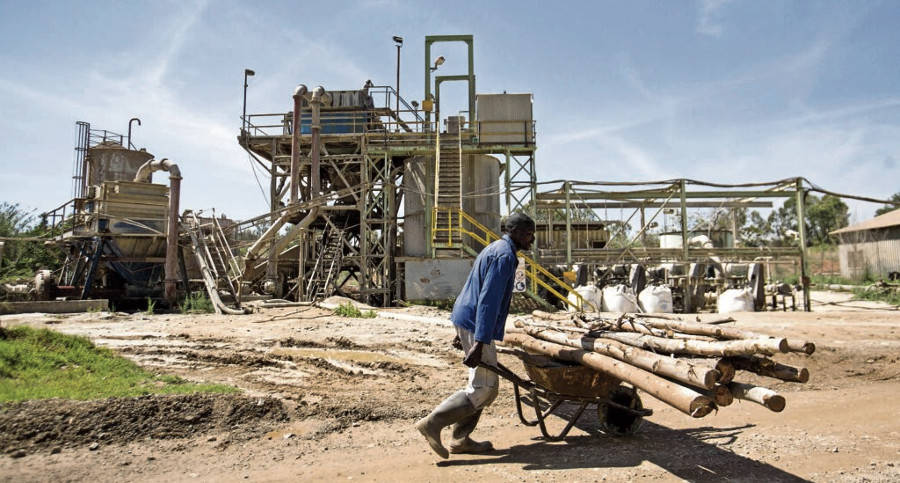
Record Gold Price fuels criminal syndicates as state fails to act Hundreds of derelict and care-and-maintenance gold and platinum mines are not lying fallow; they are being aggressively taken over or hijacked with the support of corrupt elements with the mining and state security apparatus by sophisticated, violent organised criminal syndicates. While the state dithers, these syndicates are consolidating their control over idle shafts that are abandoned and placed under prolonged Care and Maintenance Plans by big mining corporations, building vast networks for terror and violence for ruthless exploitation of artisanal miners and illicit trading on their minerals. The socio-ecological damage is stunning, and goes far deeper than the hijacking of strategically-located neighbourhoods. Artisanal miners are dying by the dozens, as their bosses are encouraging them to mine residual gold left in the pillars that hold up the tonnes of rock. And pollution of the water table as well as surface water is being experienced, especially as dangerous radioactive uranium that is interspersed with gold is infiltrating our water, land and air. By no means does this position concede any ground to the scapegoating of artisanal miners, who labour to survive, under conditions not of their own choosing. It only means we also stand in unshakeable solidarity with the communities that are up in arms against wanton criminality and environmental degradation orchestrated by organised syndicates responsible for the chaos and violence in their areas. There is a solution, however. We demand the immediate expropriation of hundreds of abandoned and care-and-maintenance gold and platinum mines, and their recapitalisation under genuine public ownership and democratic workers' and community control. In many areas of the gold belt, we know that artisanal miners and long-term community residents have a symbiotic relationship, and these social relations must be built on, to ensure a genuinely Just Transition out of the current chaos. Nationalisation would be an essential, decisive step to confront the triple crises of mass unemployment, economic stagnation, and deindustrialisation that are crushing the country, entrenching its legacy of poverty, inequalities and neocolonialism. It would allow a rational depletion of the non-renewable resource so that future generations will benefit from reinvestment, instead of the smash-and-grab approach to looting of the extractive monopolies. Soaring Prices The global gold price has smashed through the historic barrier of $5,100 per ounce, a staggering 85% increase from the same time last year. This price surge, driven by global uncertainty and safe-haven demand, represents a historic opportunity for the country worth hundreds of billions of rands. To put this into historic perspective, the new prices are double the historic heights of 1979-80, when they reached $850 per ounce, over $2500 when adjusted to inflation. That price hike was due to the U.S. Federal Reserve’s relaxed 1970s policy on inflation, which undermined trust in the dollar. The result was a ‘Volcker Shock’ when, in the 1980s, interest rates soared due to a new Fed chair, Paul Volcker, who kicked off the Third World debt crisis. Back then, the country was the largest producer of gold, responsible for 70% of the global supply at 1000 tonnes of gold production annually, and employing 667, 000 workers. At its peak in 1970, the gold dug up from under the Witwatersrand and in reserve represented half the world’s historic supply. Since then, the industry has been in free fall globally and domestically, falling to a mere 3% of global supply, with 700 closed gold mines and formal employment in the sector falling by over 80%, to less than 100 000 today. There are still an estimated 40 000 tonnes of gold in South Africa (after around 80 000 were extracted by White Monopoly Capital since the late 19th century). However, they are found ever deeper and in more difficult crevices, so the seams are harder to mine. Unlike the 1980s when the gold price crashed due to the high U.S. interest rates, down to $250/ounce – contributing to the 1985 debt crisis and PW Botha’s $13 billion default (immediately catalysing white capital’s attempts to coopt the ANC) – this price spike is not likely to subside anytime soon. The chaotic President Donald Trump wants quick interest rate cuts so that he does not lose the November mid-term election; he also seeks a lower-valued dollar to improve U.S. export competitiveness; and he intends to impose an obsequious chair on the Federal Reserve, a man whom he will appoint to replace Jerome Powell in May, if not earlier. These conditions, plus the AI bubble in Wall Street – which may need bailing out with yet another round of frantic ‘Quantitative Easing’ money printing by central banks – mean that demand for gold will likely continue rising. The Consequence of State Abdication: Syndicates Fill the Vacuum In this context, the state’s failure to secure, nationalise and recapitalise these assets, or rehabilitate and repurpose the land and regularise and allocate them for artisanal mining, has created a chaotic and extremely violent frontier. The zama zamas, operating in these spaces, are more often than not ruthlessly exploited and extorted by organised criminal enterprises. These syndicates are not informal diggers; they are transnational networks implicated in: ● Violent Turf Wars: Syndicates, often linked to violent gangs, fight for control of mining turf, with violence spilling over into the communities, resulting in massacres, terror and displacements like those in Sporing. ● A Massive Illicit Economy: The illegal gold trade fuels a vast underground economy, laundering profits and contributing to corruption of the financial system, a key reason South Africa was placed on the global FATF "grey list". Above all, the whole illicit trading networks dominated by licensed mining corporations costs the country trillions of rands. Working-class Alternatives: Expropriation, Recapitalisation, Democratic Control We reject the myth that there is no alternative to this decay. The soaring commodity prices present a historic opportunity to fund a new future. We demand a program of A Democratic and Just Public Mining for Jobs and Reindustrialisation: 1. IMMEDIATE EXPROPRIATION: The state must use its constitutional and legislative powers to reclaim all abandoned and care-and-maintenance gold and PGM mines, without compensation for historical plunder and dereliction of legal duties to advance communities and protect the environment. 2. RECAPITALIZATION FOR JOBS & REINDUSTRIALISATION: The state must mobilise capital to invest in the recapitalisation of these mines. This will: ● Create Hundreds of Thousands of Jobs: directly in revived mining operations, reversing decades of decline. ● Stimulate Demand and Reindustrialise: by linking mine output to local manufacturing, from machinery to PPE, creating millions of downstream jobs. ● Drive Beneficiation: the country's minerals must be the foundation for its industrialisation, as it was in the past. We must rebuild smelters, refineries, but also factories for manufacturing here, capturing the full value chain and ending the country's colonial role as a mere exporter of raw materials. 3. DEMOCRATIC CONTROL—NOT STATE BUREAUCRATISATION: Public ownership must mean real power for the working class. We reject a mere swap of private bosses for bureaucratic bosses. Management must be subject to: ● Workers' Control: Through elected worker councils with substantive power over production, safety, investment, and hiring. ● Community Control: Through mandated community representatives elected to the boards that direct social investment, local procurement, and environmental rehabilitation. ● Transparent Governance: All financial data, plans, and impact assessments must be open to public scrutiny. Legalise, Support, and Integrate Artisanal Miners The current approach of criminalising poverty – in part by fueling xenophobia – has not only failed to work. It has been catastrophic for artisanal miners and communities, without any proven effectiveness in combating organised criminal syndicates and their terror. Tens of thousands of artisanal miners risk their lives in deadly, informal work because of catastrophic levels of unemployment and the state's failure to offer any alternative. For those mines which can no longer be mined on an industrial scale, we therefore demand a programme to: ● Legally formalise artisanal mining cooperatives. ● Provide direct state support with safety equipment, a state buyer to facilitate market access, and technical training. ● Offer pathways for these co-ops to work lawful, rehabilitated sections of public mines or to transition into the formal mining workforce. This dual strategy attacks the syndicates from both sides: it reclaims the means of production for the people while offering a lifeline to the vulnerable artisanal miners syndicates exploit. The Stakes: Jobs vs. Terror The figures are undeniable. Gold mining employment has been slaughtered, and still today, jobs are scarce across the Witwatersrand, whilst prices are soaring and gold mining has become lucrative again. Every day the ‘Government of National Unity’ delays to act – because it is hopelessly tied to the neoliberal orthodoxy that the state should never involve itself in production – we observe more decay: syndicates grow stronger, entrenching a parallel economy, alongside violent extortion of artisanal miners and terror against them, their families and communities. The abandoned mines are not just physical holes; they are sinkholes of any form of order, dragging whole layers of desperate artisanal miners into criminality and despair. The only authority left to reign is syndicates who do not care about workplace safety and health, and the rights of workers, let alone those of communities impacted by their dangerous mining activities. The criminal syndicates operating these mines do not create communities; they destroy them. Like big corporate mining, they leave behind a toxic legacy of acid mine drainage that poisons water and death traps that have already claimed countless lives. They deplete a non-renewable resource, leaving our future generations without the mineral legacy – or reinvested proceeds – and thus reproduce White Monopoly Capital’s model of underdeveloping South Africa. A Call to Mobilise GIWUSA calls on every worker, every community under the shadow of these syndicates, and every true ally within the labour movement: We must organise to resist and force the state to act. Join Saftu’s campaign against mines and factory closures, job losses, and deindustrialisation. Above all, we need a grassroot campaigns for miners and community occupations of these shafts as part of the rolling mass actions and coordinated national campaign to reclaim the mines, jobs and force the state to recapitalise them and regularise artisanal mining. We absolutely reject the brutal police clampdowns on desperate zama zamas, and we call for the expropriation of the assets that feed the kingpins and the creation of a legal, miners-controlled alternative. The $5,100 per ounce gold price can be the seed capital for this new future. We must seize it, or the criminal networks will continue to harvest the wealth and security in our communities. MAYIBUYE! Issued by: The National Executive Committee General Industries Workers Union of South Africa (GIWUSA) For comment call: Mametlwe Sebei – GIWUSA President 081 368 0706 / mametlwesebei@gmail.com https://www.giwusa.org.za/ Back |
|
||||||
|
|||||||