Argentina: Despite paying US$11 billion in October, public debt grew by US$3 billion.

The Left Daily 22 November 2026
Under Milei and Caputo, the debt jumped by US$64.078 billion, a 15% increase compared to November 2023, despite massive payments to international organizations and private creditors. In 2027, dollar-denominated debt maturities total approximately US$25 billion. It is essential to sovereignly repudiate this odious debt and sever ties with the IMF to break the cycle of indebtedness, capital flight, and the surrender of the country.
The gross public debt of the Central Administration registered an increase in October equivalent to US$3.007 billion compared to September, going from US$486.628 billion to US$489.634 billion , according to official data from the monthly bulletin of the Ministry of Finance .
This new surge in debt occurred despite the Treasury making substantial payments during the month, totaling the equivalent of US$11.185 billion , primarily for principal and in pesos. Of the total repaid, US$10.927 billion corresponded to principal amortization and US$258 million to interest, with 96% paid in local currency (US$10.750 billion) and 4% in foreign currency (US$435 million) .
The largest increase was also in peso-denominated debt , which rose by the equivalent of US$3.326 billion (from US$238.467 billion to US$241.793 billion), more than offsetting the US$307 million reduction in foreign currency debt (which fell from US$245.658 billion to US$245.350 billion). The issuance of new bonds, debt swaps, the capitalization of interest—as in the case of Boncap bonds —and valuation adjustments on instruments indexed to inflation (CER) and the exchange rate explain why the final debt stock increased again.
In terms of composition, the debt in good standing is divided almost equally between local and foreign currency: 49.6% is denominated in local currency and the remaining 50.4% in foreign currency. Furthermore, by type of instrument, 78.1% corresponds to Treasury Bonds and Notes, 20.1% to official external creditors, 0.5% to Temporary Advances from the Central Bank, and 1.3% to other liabilities.
Serial debtor Caputo did it again
October was not an isolated case. Looking at a longer timeframe, the gross debt stock accumulated an increase of US$34.557 billion in the first ten months of 2026, compared to the US$455.077 billion recorded at the end of December 2025. Likewise, compared to November 2023—the start of the current administration —the debt jumped US$64.078 billion , after starting from US$425.556 billion at that time.
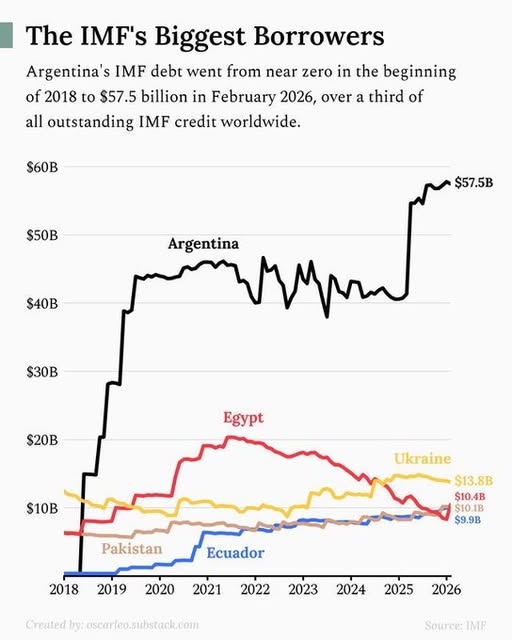
Among the main factors explaining the surge in debt during Milei's administration is the debt owed to international financial institutions. This increased from US$73.683 billion to US$95.326 billion, driven by the rise in debt to the International Monetary Fund (IMF) from US$41.467 billion to US$56.914 billion .
It should be noted that these statistics from the Central Administration do not include the liabilities of the Central Bank, the provinces or the municipalities, and are expressed in dollars at the exchange rate of the last business day of the period as the standard unit of account.
Stop the scams
The current public debt has a spurious origin in the last genocidal military dictatorship, where it increased fivefold to favor a speculative business model. It is an odious, illegitimate, and illegal debt that functions as a mechanism for transferring resources to financial capital and that subordinates social needs to the interests of creditors.
The resources currently allocated to debt repayment should be used to address the needs of the working majority: education, health, the scientific system, wages, and the development of productive forces, through democratic planning under the control of the working class.
The strategy of "renegotiating to keep paying" has repeatedly failed throughout history, deepening the country's productive backwardness and dependence. Therefore, a sovereign repudiation of the debt and a break with the IMF, driven by the broadest popular mobilization, is necessary.
This proposal is complemented by other measures to prevent dollars from fleeing the country again: nationalizing the banking system, creating a state entity that directs credit according to popular needs, and establishing a state monopoly on foreign trade under workers' control, so that export revenues do not end up in the hands of banks, speculators, and large economic groups.
https://www.laizquierdadiario.com/Pese-a-pagar-U-S-11-000-millones-en-octubre-la-deuda-publica-crecio-U-S-3-000-millones?
Back
|
|

|
Thanks for visting the G20 From Below Website. If you want something published here or other enquiries mailto:Brics-from-below@protonmail.com
Please Visit the BRICs from below website. The BRICs from below website was established in 2016 to news and analysis on worker and community protests in the BRICS countries and against the activities of BRICS based multinationals especially in Africa. The G20From Below website was set up in to 2025 to extened this work to the G20 countries.

Introducing BRICS from above, BRICS from the middle and BRICS from below
BRICS FROM ABOVE
Heads of state, Business Forum, elite allies
*BRICS as anti-imperialist (ANC & Pretoria rhetoric – “Talk Left, Walk Right”, e.g. national-liberation tradition, foreign ministry on global geopolitics, finance minister on IMF reform, sports minister on FIFA)
*BRICS as sub-imperialist (Pretoria relegitimising world capitalism, lubricating neoliberalism in - and exploiting - Africa, intensifying class war against SA’s poor/workers/women/nature on behalf of global/local capital, ensuring maximum greenhouse gas emissions alongside BASIC/US no matter local/continental/global consequences, and playing “deputy sheriff” role to imperialism)
*BRICS as inter-imperialist (Pretoria's potential support for a new internet delinked from US, promotion of Putin v Obama in September 2013 at G20, and mainly backing Russia in Crimea/Ukraine conflict - as well as earlier episodes where SA lined up with China in UN e.g. in relation to Burma)
BRICS FROM THE MIDDLE
Academic Forum, trade unions, NGOs
BRICS advocates (most of Academic Forum, Johannesburg & Pretoria “think tanks” and others who suffer persistent “failure of analytical nerve”)
*wait-and-see (most NGOs and trade unions - as well as “Third Worldist” intellectuals - who wish for BRICS to become “anti-impi” at UN, Bretton Woods Institutions, Development Bank, Contingent Reserve Arrangement, etc)
*critics (those associated with brics-from-below network who consider BRICS to be “sub-impis” and sometimes also “inter-impis”)
BRICS FROM BELOW
Grassroots activists whose visions run local to global
*localist (stuck within local or sectoral silos, including myriad “popcorn protests” - even some against BRICS corporations or projects - that are insurgent, unstrategic, momentary, at constant risk of becoming xenophobic, and prone to populist demagoguery)
*nationally-bound (most activists who are vaguely aware of - and hostile to - BRICS yet so overwhelmed by local, national and sectoral battles, they fail to link across borders - even BRICS hinterlands)
*solidaristic-internationalist (“global justice movement” allies aspiring for joint campaigning against common BRICS enemies such as Vale, China Development Bank, DBSA, Transnet/mega-shipping, fossil fuel corporations and other polluters, coming BRICS Development Bank)
JEALOUS PRO-WEST CAPITALISTS
Most white organic intellectuals of capital connected to Old Money, multinational-corporate branch plants, Business Day, northern-centric big biz, Democratic Alliance and their ilk.
|