Young people took to the streets again in Europe against militarization and the high cost of living.
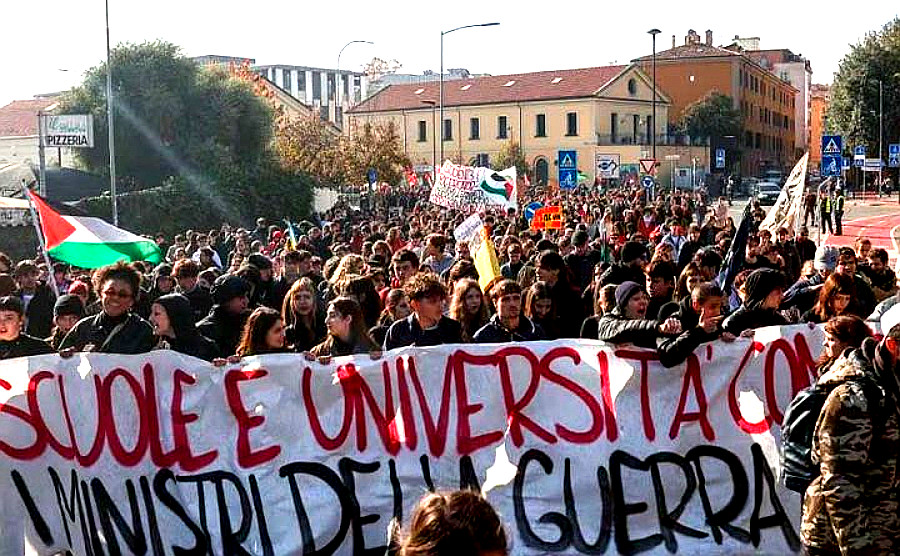
The Left Daily 20 November 2026
This Friday, November 20th, saw an international day of student strikes and youth mobilizations across Europe and other parts of the world. In Italy, the student protests coincided with a massive general strike that mobilized over a million people.
This Friday, November 20, thousands of high school and university students, along with young workers, participated in an international day of strikes and protests under the common slogan “For our future, not for their wars!” (organized by dozens of youth and student organizations in more than 25 countries). The day focused on rejecting the escalating militarism, imperialist rearmament, and austerity measures with which governments seek to shift the burden of the crisis onto the majority of society. Furthermore, in Italy, where the mobilizations were largest, along with those in Germany, the day coincided with a general strike called by the CGIL, the main trade union federation.
The map of actions and participation by country
The epicenter of the day was in Europe, with varying levels of mass participation and convergence with the labor movement depending on the country:
Italy : This was the peak of the day's events. Student strikes and occupations converged with the general strike called by the CGIL (General Confederation of Italian Workers). According to the unions, more than a million workers and students took to the streets in over 100 cities across the country. In several cities, grassroots or autonomist organizations held their own separate demonstrations, distinct from those of the CGIL, while in cities like Florence, a joint march took place, but with an independent contingent that challenged the conciliatory stance of the union leadership, which had recently approved a minimal wage increase negotiated with industrial employers and the Meloni government.
For months, young Italians have been fighting in their schools and universities against education cuts, as well as against the government's rearmament and militarism.
Germany : Driven by youth groups such as the Gen Z regelt platform, the protests were centered in Berlin—where an estimated 15,000 participants gathered, with a strong presence of left-wing groups and pro-Palestinian solidarity groups—and continued in the afternoon in the Kreuzberg district against Chancellor Friedrich Merz. Smaller gatherings of a few hundred young people also took place in cities like Frankfurt amidst a heavy police presence and adverse weather conditions.
Switzerland : Driven by student groups and left-wing youth, strikes and demonstrations took place in the country's main cities, including Geneva, Zurich, Basel and Bern, bringing together hundreds of protesters throughout the day.
Other countries : The call also included actions, assemblies and mobilizations in France, Spain, the United Kingdom, Belgium, Portugal, Sweden, Ireland, Luxembourg, Croatia, Romania and Malta, in addition to expressions of international solidarity outside the European continent.
The main demands of young people
Beyond the specific demands of each region, the international manifesto of November 20th articulated a common program against war and the precariousness of life: Down with rearmament and military spending, No to compulsory military service, Education free from war interests and solidarity with Palestine, Against the high cost of living and precariousness, Stop the far right and defend democratic freedoms.
As our comrades from the youth of our international organization, the Permanent Revolution Current, point outRegarding the need to unite the radicalism expressed by youth in the streets with the strength of the working class to paralyze strategic activity that would allow governments to be challenged, but knowing that union leaderships today are playing an openly conciliatory role to obstruct this perspective: "A general strike is not simply a call to strike for different sectors; it is the main political tool to paralyze power and the economy, and to inflict defeat on our governments and the bourgeoisie. Therefore, as revolutionary communist youth organizations, we believe that mobilized youth have an immense responsibility to unite with the workers' movement, with unionized and non-unionized workers, to collectively defeat its leadership, which seeks to collaborate with the state and employers. This requires organized activists within revolutionary parties in workplaces, neighborhoods, schools, and universities.
Militants from our Permanent Revolution Current are working everywhere to foster solidarity between workers and students and the democratic coordination of sectors in struggle. For example, in France, We opened our universities for interprofessional assemblies that brought together union activists, university and high school students to give an active character to the strike days. Similarly, in the Spanish State, we established unified strike committees responsible for maintaining picket lines and carrying out blockades alongside the strikers on November 11. Union bureaucracies serve as a conduit for capitalist policies within our class.
They promote militarization as a source of employment, pitting workers against each other in different countries by defending "national" production alongside their respective employers. The struggle against these bureaucracies is fundamental: without evading them or blindly following them, young people must contribute their radicalism to the workers' movement and fight alongside them. This is the only way for the workers' movement to consolidate itself as a class alternative in the face of the capitalist crisis. Otherwise, the far right will exploit the situation, relying on nationalism, its social demagoguery in the face of the social attacks from traditional parties, and the feeling of powerlessness in the face of the The ruling class.
Reformist parties that offer moderate militarization and some social progress through illusory compromises with business owners—and which are the electoral counterpart to the policies of the union leadership—only promise to perpetuate the cycle of electoral co-optation of struggles that leads to demobilization and disillusionment, a cycle that feeds the international far right.Building a powerful revolutionary movement is today the only solution to stop the rise of the far right and the march towards war!
https://www.laizquierdadiario.com/En-vivo-huelga-juvenil-europea-y-huelga-general-en-Italia
Back
|
|

|
Thanks for visting the G20 From Below Website. If you want something published here or other enquiries mailto:Brics-from-below@protonmail.com
Please Visit the BRICs from below website. The BRICs from below website was established in 2016 to news and analysis on worker and community protests in the BRICS countries and against the activities of BRICS based multinationals especially in Africa. The G20From Below website was set up in to 2025 to extened this work to the G20 countries.

Introducing BRICS from above, BRICS from the middle and BRICS from below
BRICS FROM ABOVE
Heads of state, Business Forum, elite allies
*BRICS as anti-imperialist (ANC & Pretoria rhetoric – “Talk Left, Walk Right”, e.g. national-liberation tradition, foreign ministry on global geopolitics, finance minister on IMF reform, sports minister on FIFA)
*BRICS as sub-imperialist (Pretoria relegitimising world capitalism, lubricating neoliberalism in - and exploiting - Africa, intensifying class war against SA’s poor/workers/women/nature on behalf of global/local capital, ensuring maximum greenhouse gas emissions alongside BASIC/US no matter local/continental/global consequences, and playing “deputy sheriff” role to imperialism)
*BRICS as inter-imperialist (Pretoria's potential support for a new internet delinked from US, promotion of Putin v Obama in September 2013 at G20, and mainly backing Russia in Crimea/Ukraine conflict - as well as earlier episodes where SA lined up with China in UN e.g. in relation to Burma)
BRICS FROM THE MIDDLE
Academic Forum, trade unions, NGOs
BRICS advocates (most of Academic Forum, Johannesburg & Pretoria “think tanks” and others who suffer persistent “failure of analytical nerve”)
*wait-and-see (most NGOs and trade unions - as well as “Third Worldist” intellectuals - who wish for BRICS to become “anti-impi” at UN, Bretton Woods Institutions, Development Bank, Contingent Reserve Arrangement, etc)
*critics (those associated with brics-from-below network who consider BRICS to be “sub-impis” and sometimes also “inter-impis”)
BRICS FROM BELOW
Grassroots activists whose visions run local to global
*localist (stuck within local or sectoral silos, including myriad “popcorn protests” - even some against BRICS corporations or projects - that are insurgent, unstrategic, momentary, at constant risk of becoming xenophobic, and prone to populist demagoguery)
*nationally-bound (most activists who are vaguely aware of - and hostile to - BRICS yet so overwhelmed by local, national and sectoral battles, they fail to link across borders - even BRICS hinterlands)
*solidaristic-internationalist (“global justice movement” allies aspiring for joint campaigning against common BRICS enemies such as Vale, China Development Bank, DBSA, Transnet/mega-shipping, fossil fuel corporations and other polluters, coming BRICS Development Bank)
JEALOUS PRO-WEST CAPITALISTS
Most white organic intellectuals of capital connected to Old Money, multinational-corporate branch plants, Business Day, northern-centric big biz, Democratic Alliance and their ilk.
|