 |
|  |


|
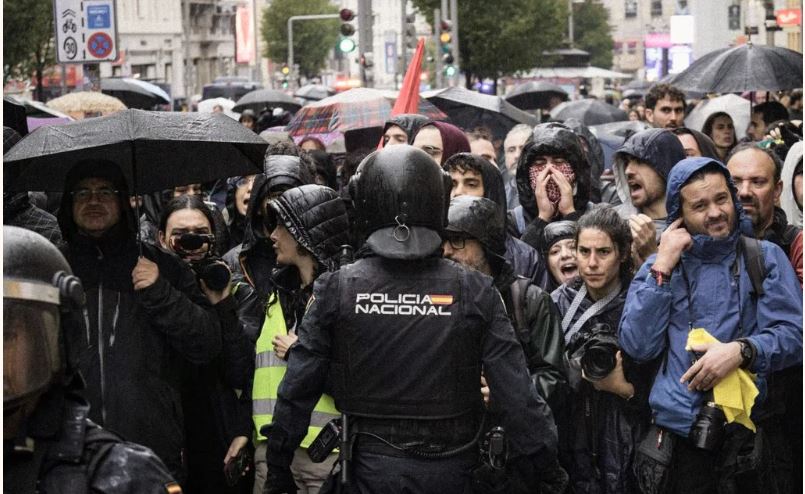
Millions join Spanish general strike to protest housing crisis Under enormous pressure from below and somewhat reluctantly, the trade union bureaucracy of the main unions, CCOO and UGT, were forced to call for a general strike. But they chose a date as far away from the mass movement as possible, in the hope that the pressure would dissipate. Part of their calculation was also that the general strike would serve to mobilise the vote for the ruling PSOE, the party of Pedro Sánchez, which had called early elections to be held on 29 November. As the day of the general strike approached, neither CCOO nor UGT had done what was required to ensure the success of the strike. There were no clear demands, just a vague and general wish list. Very few shop stewards’ assemblies and even fewer workplace meetings were held One comrade in Barcelona reported that in his workplace there had been a mass meeting, and that the union reps explained the reasons for the strike… but no vote was taken. The argument was that “this was already a legal general strike; it did not require the workers at that workplace to back it with a vote”! Added to this was the fact that in many sectors, the leaders of CCOO and UGT are hated, having signed bad deals in the past without consulting the workforce. A whole series of strikes have taken place directly against and in defiance of the union bureaucracy in the recent period, such as the metal workers in Cádiz, Murcia, and now Tarragona, the teachers in Catalonia, and the Airbus workers. Furthermore, the last time the union leaders had called a general strike was back in 2012, 14 years ago. Many of them probably cannot even remember what is required to organise one! In the lead-up to the strike, it was not clear how successful it would be. There was undoubtedly a very angry mood, and widespread support for the demand for affordable housing. It was also clear that there was a militant mood amongst the youth, as well as the renters’ unions and other smaller, more militant unions. But that is not always enough to create the necessary dynamics for a successful strike. A show of strength But in the end, there was a massive response to the strike. The main unions could not be seen as failing, and mobilised their industrial muscle in the largest workplaces and key sectors. That, added to the aforementioned factors, guaranteed the strike’s success. Car factories came to a standstill, with over 90 percent of the workers participating in the strike. Thousands of pickets mobilised from before midnight to guarantee night shifts would stop, transport would not run, and logistics centres and transport hubs would be paralysed. Despite the government’s scandalous abuse of ‘minimum service’ requirements, participation was significant everywhere. Whilst the strike did not cover all sectors, it was certainly a show of strength. Perhaps one of the most significant features of the strike was the massive participation of the youth. There is a whole generation which has never lived through a general strike, and so this was a steep learning curve for them. There was police violence, baton charges and arrests throughout the country, particularly when pickets mobilised to shut down large retail centres, like the Corte Inglés in Valencia. Let us remember that the National Police in Spain is under the authority of Interior Minister Marlaska from the Pedro Sánchez PSOE/United Left government. The government feigned support for the strike, but the police attacked the pickets all the same. The Basque and Catalan police acted in a similar manner, as was to be expected. By the end of the day, huge crowds came out across the country, in the main cities but also in small towns. In Barcelona, the whole of Passeig de Gràcia was packed with demonstrators – the organisers gave the figure of 400,000. In Madrid, torrential rain did not deter protestors, who packed four different routes and could not even reach the final point as riot police decided to charge against a completely peaceful demonstration. Some have put the figure here at 600,000, though it is difficult to gauge the size of such a crowd. The working class of the oppressed nationalities came out en masse in a joint day of struggle across the whole of the Spanish state. There were huge demonstrations across the Basque country, as well as in Galicia, in Asturias, in Zaragoza, País Valencià and many others. In Andalucia, a named storm did not prevent very large demonstrations in Seville, Malaga and other cities. Once again, the power of the working class was revealed for all to see. Not a light bulb shines, not a wheel turns, without the kind permission of the working class, as Ted Grant liked to repeat. The strike went beyond what the trade union leaders of CCOO and UGT had wanted, though they never lost control of it. The massive show of strength will undoubtedly have the effect of increasing the confidence of workers in their own forces, their ability to struggle, and their willingness to take direct action to improve their conditions. National election The impact of the strike will also be felt in the upcoming national election on 29 November, in the form of an increased vote for the PSOE, and to a lesser extent, potentially for the Frente Amplio coalition. Many in Spain are fearful of the implications of a right-wing PP/Vox government coming to power and will vote to stop it. We must be clear: the fact that the reactionary right-wing demagogues of Vox have gone up significantly in the opinion polls since the last election (mostly at the expense of the traditional right-wing PP), and that a right-wing coalition may yet get enough seats to rule, is the direct responsibility of the meek halfway measures of the Pedro Sánchez government. The PSOE in power, backed by an unstable parliamentary majority, has not even implemented its electoral promises in full. While claiming to be the ‘most progressive government in history’ and pandering to the left on issues like the genocide in Gaza, the government has only mildly reversed legal attacks carried out by the previous right-wing PP government (regarding labour and democratic rights), and has presided over a massive increase in business profits. marxist.com/millions-join-spanish-general-strike-to-protest-housing-crisis? Back |
|
||||||
Thanks for visting the G20 From Below Website. If you want something published here or other enquiries mailto:Brics-from-below@protonmail.com
|
|||||||