Political crisis and protests in Indonesia
Samuel Karlin The Left Daily 9 November 2026
Southeast Asia's largest country has been rocked by a phone-hacking scandal, as Indonesians grow increasingly dissatisfied with Prabowo's administration.
Indonesia, which in recent years has achieved middle-power status, could soon be rocked by a major political crisis. Following the wiretapping scandal involving the country's president, Prabowo Subianto, the government deployed tens of thousands of troops in Jakarta. It also arrested three high-ranking police generals, including the former national police chief, Listyo Sigit Prabowo (no relation to President Prabowo).
Despite the massive military deployment, a Bloomberg report suggests that the situation in Jakarta appears to be proceeding normally, with the military presence going largely unnoticed. However, the same report explains that behind these events lies a broader conflict between President Prabowo and former President Joko Widodo, who had appointed Listyo as head of the national police. This conflict between the current and former presidents reflects a deeper dispute between the country's armed forces, in which Prabowo was a high-ranking general, and the police, an institution that maintains close ties with Widodo.
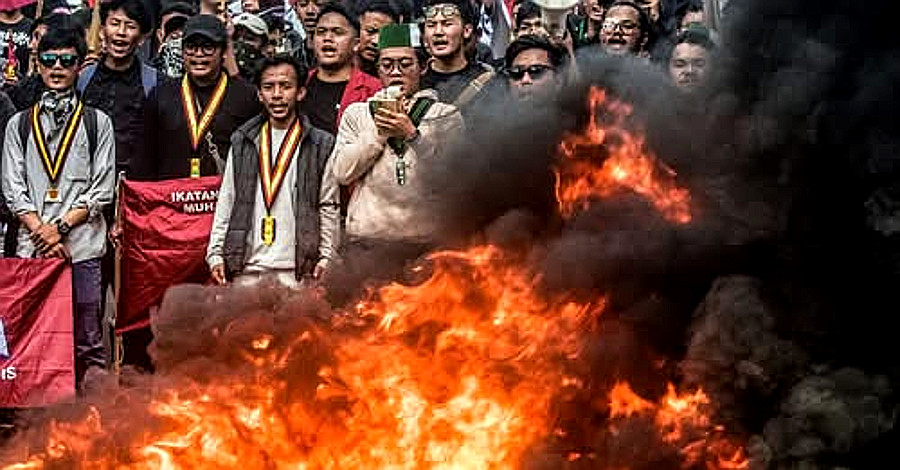
The internal conflict arises at a time when Indonesians are increasingly dissatisfied with Prabowo's presidency. In recent weeks, students and social organizations have protested in Jakarta against the government's handling of the forest fires ravaging the country. The protesters allege that these fires were caused by the clearing of sensitive land for oil palm plantations.
Furthermore, miners have begun a sit-in at the world's largest nickel mine to demand a fair contract. A cornerstone of Indonesia's geopolitical importance is that it holds the world's largest nickel reserves. Besides being used in many everyday products, nickel is a key component of rechargeable batteries, giving Indonesia a strategic advantage in the electric vehicle industry. This also makes Indonesian miners a strategic sector of the Asian working class, and it will be important for workers around the world to show solidarity with their struggle.
Most of the protests in Indonesia have been moderate in scale, especially compared to the student demonstrations that have swept across Europe and even emerged in countries in Asia and Latin America. However, they reflect widespread discontent with Prabowo. After two years in power, his approval rating currently stands at a low of 44.5%, the lowest recorded for any president since polling began in Indonesia. This comes against a backdrop of economic stagnation and the risk of a credit rating downgrade in the stock market, which could trigger a currency crisis.
Indonesians have also criticized Prabowo for the failure of his multi-billion-dollar food program, a flagship policy intended to combat malnutrition. The program, a popular issue during his election campaign, has been marred by allegations of corruption and thousands of cases of young people being poisoned or served rice containing glass and worms. The government has also faced harsh criticism for strengthening the role of the armed forces in government and restricting civil liberties.
During his time as a general, Prabowo led the violent persecution of pro-democracy activists under the brutal military dictatorship that gripped the country in 1998.
However, during his 2024 presidential campaign, Prabowo managed to project an affable and paternal image. Another key factor in his electoral victory was the support he received from Widodo. The former president left office as one of Indonesia's most popular leaders, having played a pivotal role in the country's rise to middle-power status. While the constitution barred him from running for reelection, he struck a deal to back Prabowo in exchange for cabinet positions for his political allies. This agreement is now unraveling amid the wiretapping scandal, foreshadowing an even deeper crisis for Prabowo's regime.
However, regardless of the strategies adopted by the various factions within the Indonesian government, none of the political blocs truly represents the country's students and workers, who are beginning to mobilize against air pollution, exploitation, and attacks on democratic rights, among other issues. It remains to be seen what role the country's workers and popular sectors will play in the event of further political instability.
https://www.laizquierdadiario.com/Crisis-politica-y-protestas-en-Indonesia?
Back
|
|

|
Thanks for visting the G20 From Below Website. If you want something published here or other enquiries mailto:Brics-from-below@protonmail.com
Please Visit the BRICs from below website. The BRICs from below website was established in 2016 to news and analysis on worker and community protests in the BRICS countries and against the activities of BRICS based multinationals especially in Africa. The G20From Below website was set up in to 2025 to extened this work to the G20 countries.

Introducing BRICS from above, BRICS from the middle and BRICS from below
BRICS FROM ABOVE
Heads of state, Business Forum, elite allies
*BRICS as anti-imperialist (ANC & Pretoria rhetoric – “Talk Left, Walk Right”, e.g. national-liberation tradition, foreign ministry on global geopolitics, finance minister on IMF reform, sports minister on FIFA)
*BRICS as sub-imperialist (Pretoria relegitimising world capitalism, lubricating neoliberalism in - and exploiting - Africa, intensifying class war against SA’s poor/workers/women/nature on behalf of global/local capital, ensuring maximum greenhouse gas emissions alongside BASIC/US no matter local/continental/global consequences, and playing “deputy sheriff” role to imperialism)
*BRICS as inter-imperialist (Pretoria's potential support for a new internet delinked from US, promotion of Putin v Obama in September 2013 at G20, and mainly backing Russia in Crimea/Ukraine conflict - as well as earlier episodes where SA lined up with China in UN e.g. in relation to Burma)
BRICS FROM THE MIDDLE
Academic Forum, trade unions, NGOs
BRICS advocates (most of Academic Forum, Johannesburg & Pretoria “think tanks” and others who suffer persistent “failure of analytical nerve”)
*wait-and-see (most NGOs and trade unions - as well as “Third Worldist” intellectuals - who wish for BRICS to become “anti-impi” at UN, Bretton Woods Institutions, Development Bank, Contingent Reserve Arrangement, etc)
*critics (those associated with brics-from-below network who consider BRICS to be “sub-impis” and sometimes also “inter-impis”)
BRICS FROM BELOW
Grassroots activists whose visions run local to global
*localist (stuck within local or sectoral silos, including myriad “popcorn protests” - even some against BRICS corporations or projects - that are insurgent, unstrategic, momentary, at constant risk of becoming xenophobic, and prone to populist demagoguery)
*nationally-bound (most activists who are vaguely aware of - and hostile to - BRICS yet so overwhelmed by local, national and sectoral battles, they fail to link across borders - even BRICS hinterlands)
*solidaristic-internationalist (“global justice movement” allies aspiring for joint campaigning against common BRICS enemies such as Vale, China Development Bank, DBSA, Transnet/mega-shipping, fossil fuel corporations and other polluters, coming BRICS Development Bank)
JEALOUS PRO-WEST CAPITALISTS
Most white organic intellectuals of capital connected to Old Money, multinational-corporate branch plants, Business Day, northern-centric big biz, Democratic Alliance and their ilk.
|