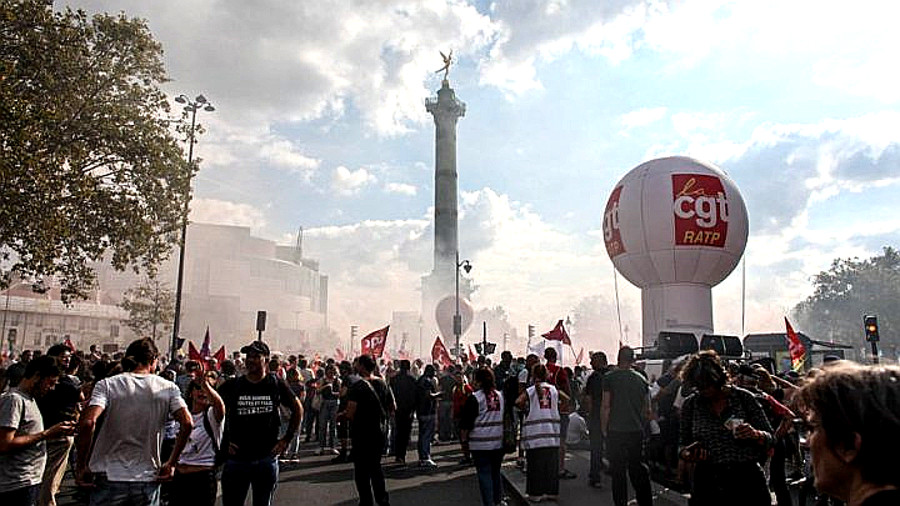
France: 1,600,000 mobilized across the country in a massive day of action.
The Left Daily 5 November 2026
The mobilization was massive across the country, the largest since the movement began, driven by high school students, overflowing cities and towns despite the enormous repressive deployment. This massive turnout demonstrates that there is strength to intensify the fight against Macron's austerity measures, militarism, and attacks on education. It is necessary to strengthen organization and coordination from workplaces and schools.
More than a month after the start of the movement, spearheaded by high school students, the national strike called by the inter-union organization that brings together the country's main unions was massive. 1,600,000 people mobilized across France, with Paris standing out with 350,000 people who remained in the streets well after dark, when the police deployed force to disperse those still in the streets and squares. It is worth noting that, due to the persistence of the mobilization, the march route was ultimately from Bastille to Nation, in the center of Paris, despite the government's attempts to prevent it from passing through the city center.
Meanwhile, there were 150,000 people in Marseille, 120,000 in Bordeaux, 100,000 in Lille, 80,000 in Toulouse, 55,000 in Lyon, and 35,000 each in Nantes and Rennes, and 26,000 in Strasbourg, to name just a few places. Small towns and cities in the interior also saw all kinds of actions, including street blockades and demonstrations.
In turn, participation in the strike was very significant in sectors such as railways, where it reached over 80% on some lines, and in education where it was greater than 50%.
The repressive operation was massive, with over 70,000 officers deployed, 26 Centaur armored vehicles, and all manner of special forces, among other elements of the French imperialist police arsenal. In Toulouse, where the inter-union demonstration faced a ban on marching through the city center, there was heavy repression, as there was in Lyon. A total of 448 arrests were made throughout the day, according to the Interior Ministry.
Despite this, there was a convergence of events between the combative youth who have been leading the movement that took off after the revolutionary day of October 17th and the workers who took to the streets today. In this regard, the participation of the significant contingents of the "Interprofessional Assemblies," which have been self-organizing in various cities, bringing together workers and students to build a genuine general strike from the ground up that can overthrow Macron's entire austerity plan, is noteworthy.
For its part, the government, which despite the repression has failed to discourage the movement, announced, through Prime Minister Sebastian Lecornu, a "social conference" at Matignon on Monday, November 9. There, it seeks to bring together employee unions and employers' federations to "address issues of purchasing power and wages." This is yet another trap set by the cornered government, which is trying to buy time and offer crumbs, as it has been doing throughout these weeks regarding demands for education, public services, and the minimum wage demanded by the unions. In this regard, it is important to note that nothing good can come from sitting down with Macron and his government, as the union leaders will be attempting to do.
On the contrary, it is to take today as a new impetus to massify and radicalize the struggle, reinforcing this force in workplaces and schools and seeking to further develop the organization from below to advance in the coordination of the sectors in struggle and to impose and advance in intensifying and extending the strike, on the path to an interprofessional general strike.
Neither the police presence, nor the brutal repression, nor the ban on demonstrations managed to stop the mobilization.
Despite the government's deliberate strategy to discourage demonstrations and keep them out of city centers, 1.6 million protesters, including 350,000 in Paris, took to the streets across France today, according to the CGT union. Other demonstrations drew crowds of 150,000 in Marseille, 120,000 in Bordeaux, 100,000 in Lille, 80,000 in Toulouse, 55,000 in Lyon, and 35,000 each in Nantes and Rennes.
A figure not seen since the movement against pension reform in 2023!
Lecornu calls a social conference: the government is trying to deceive us to quell the anger!
While millions of people demonstrated across the country, Lecornu announced this afternoon the convening of a "social conference" at Matignon on Monday, November 9. The aim: to bring together employee and employer unions to "address issues of purchasing power and wages." The Minister of Labor is expected to "finalize the consultations he has been conducting for several days before Sunday," while the Minister of Public Action and Accounts continues his talks with representatives of civil servants.
No one is fooled: the government is trying to create another smokescreen to buy time and neutralize the mobilization. After weeks of contempt, repression, and attempts to divide the movement, Lecornu now intends to limit it to pointless negotiations. A typical Macron strategy to achieve a "restoration of calm" at minimal cost.
But we will not get our demands heard in the Prime Minister's office, especially since the government is already offering few concessions on the minimum wage. We will not obtain amnesty for all those repressed for their mobilization, nor the repeal of the Parcoursup law or university selection, nor the enormous resources needed for public services. These demands can only be achieved through a power dynamic based on strikes.
The only appropriate response to this mobilization is to build a dynamic of power capable of forcing the government to concede. The 1.6 million people in the streets demonstrate the immense potential strength of our movement: now we must materialize this strength in workplaces and schools, by developing cross-professional organizations and increasing the number of cross-professional general assemblies to coordinate the sectors in struggle. The goal is to impose a plan to intensify and extend the strike, and to prepare for a cross-professional general strike.
Enough with negotiations that impose crumbs on us and bury our demands: let's organize a general strike to impose them!
https://www.laizquierdadiario.com/Vivo-Francia-a-pesar-de-la-represion-la-jornada-es-masiva-y-confluyen-estudiantes-y-trabajadores?
Back
|
|

|
Thanks for visting the G20 From Below Website. If you want something published here or other enquiries mailto:Brics-from-below@protonmail.com
Please Visit the BRICs from below website. The BRICs from below website was established in 2016 to news and analysis on worker and community protests in the BRICS countries and against the activities of BRICS based multinationals especially in Africa. The G20From Below website was set up in to 2025 to extened this work to the G20 countries.

Introducing BRICS from above, BRICS from the middle and BRICS from below
BRICS FROM ABOVE
Heads of state, Business Forum, elite allies
*BRICS as anti-imperialist (ANC & Pretoria rhetoric – “Talk Left, Walk Right”, e.g. national-liberation tradition, foreign ministry on global geopolitics, finance minister on IMF reform, sports minister on FIFA)
*BRICS as sub-imperialist (Pretoria relegitimising world capitalism, lubricating neoliberalism in - and exploiting - Africa, intensifying class war against SA’s poor/workers/women/nature on behalf of global/local capital, ensuring maximum greenhouse gas emissions alongside BASIC/US no matter local/continental/global consequences, and playing “deputy sheriff” role to imperialism)
*BRICS as inter-imperialist (Pretoria's potential support for a new internet delinked from US, promotion of Putin v Obama in September 2013 at G20, and mainly backing Russia in Crimea/Ukraine conflict - as well as earlier episodes where SA lined up with China in UN e.g. in relation to Burma)
BRICS FROM THE MIDDLE
Academic Forum, trade unions, NGOs
BRICS advocates (most of Academic Forum, Johannesburg & Pretoria “think tanks” and others who suffer persistent “failure of analytical nerve”)
*wait-and-see (most NGOs and trade unions - as well as “Third Worldist” intellectuals - who wish for BRICS to become “anti-impi” at UN, Bretton Woods Institutions, Development Bank, Contingent Reserve Arrangement, etc)
*critics (those associated with brics-from-below network who consider BRICS to be “sub-impis” and sometimes also “inter-impis”)
BRICS FROM BELOW
Grassroots activists whose visions run local to global
*localist (stuck within local or sectoral silos, including myriad “popcorn protests” - even some against BRICS corporations or projects - that are insurgent, unstrategic, momentary, at constant risk of becoming xenophobic, and prone to populist demagoguery)
*nationally-bound (most activists who are vaguely aware of - and hostile to - BRICS yet so overwhelmed by local, national and sectoral battles, they fail to link across borders - even BRICS hinterlands)
*solidaristic-internationalist (“global justice movement” allies aspiring for joint campaigning against common BRICS enemies such as Vale, China Development Bank, DBSA, Transnet/mega-shipping, fossil fuel corporations and other polluters, coming BRICS Development Bank)
JEALOUS PRO-WEST CAPITALISTS
Most white organic intellectuals of capital connected to Old Money, multinational-corporate branch plants, Business Day, northern-centric big biz, Democratic Alliance and their ilk.
|