 |
|  |


|
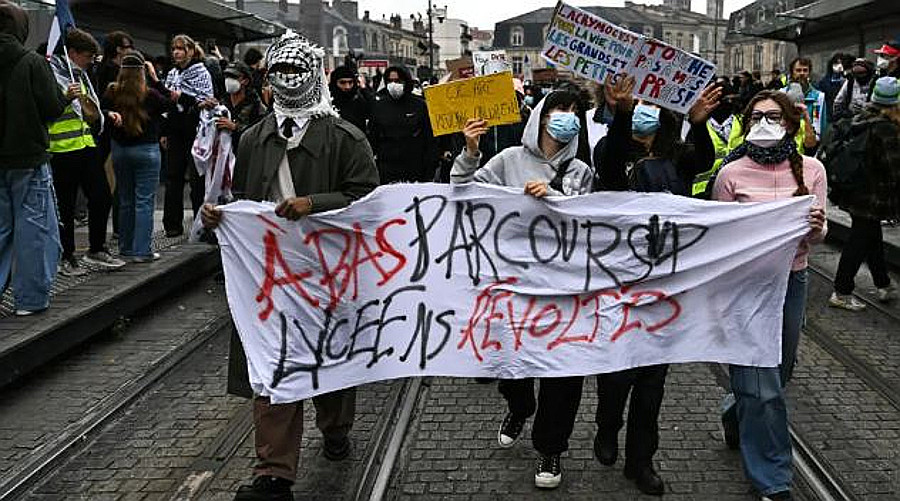
Some 320,000 demonstrators take part in largely peaceful protests across France "Security forces held their ground and protected city centres. Public order was maintained," Interior Minister Laurent Nuñez told reporters after the marches, adding that police had faced "a great deal of violence". He said authorities were now bracing for scattered unrest later in the evening, amid what he said were calls for insurrection on Halloween night. "The day is not over. We are ready for those looking for a fight tonight, and we will respond firmly," Nuñez added. The protests in France have inspired youth-led "Gen-Z" protests across Europe, with demonstrations in several German cities on Saturday. There were also protests in Italy. The marches brought together students – who began mobilising in September – with trade unions and a smaller contingent of anti-establishment Yellow Vest protesters, united by complaints over the cost of living, high fuel prices, rising inflation and President Emmanuel Macron's government. "The French economy is doing badly no matter what happens, because today we're being run by a group of incompetents who juggle billions, while families are struggling with a few cents," protester Jerome Rodriguez said during the Paris march. "That's why we're here, to keep shouting our demands louder and louder and hopefully get a response from the government, although that seems very unlikely." Far-left leader Jean-Luc Mélenchon, whose ratings have risen in recent weeks ahead of next April's presidential election, marched at the head of the Paris demonstration. France's top administrative court had upheld a ban on a march between the landmark Paris squares of Nation and Bastille, rejecting a challenge from unions. Authorities instead authorised a route along boulevards on the eastern edge of the capital, away from central shopping districts. Europe's wave of anger: How far will youth-led protests go? To display this content from YouTube, you must enable advertisement tracking and audience measurement. Turnout was lower than for the previous two Saturdays of protests, with 320,000 protesters nationwide, including 70,000 in Paris, the interior ministry said, while organizer's turnout estimates are nearly half a million. That compares with 410,000 the week before and 550,000 on October 17. The interior ministry said in a statement that "radical elements" intent on damage and looting had attempted to break away from marches in cities including Bordeaux, Toulouse, Lyon and Marseille, but were thwarted by security forces. It added that security checks at railway stations and roads had uncovered people carrying objects that could be used as weapons. Authorities have warned that Halloween masks could be used to conceal the identities of rioters. Nuñez has vowed to prevent a repeat of the October 17 violence, noting that existing laws allow police to prohibit face coverings when public order is threatened. The unrest comes at a delicate moment for the government. On Friday, ratings agency Fitch unexpectedly revised the outlook on French debt to negative, underscoring investor concerns over the country's finances. With public debt nearing 120 percent of economic output and borrowing costs rising, Macron's government faces mounting pressure to curb spending, limiting its room for manoeuvre. The US Embassy advised travellers to avoid areas where demonstrations or large gatherings were planned. Protests began with students The protests gathered momentum in late September as Macron's minority government opened talks on its 2027 budget. Students angered by the deteriorating state of schools, overcrowded classrooms and a university admissions system widely viewed as unfair have since been joined by trade unions and a resurgent Yellow Vests movement demanding action on living costs. The French government's promises to reform education and ease fuel costs have failed to calm discontent. Read moreFrench students vow to continue protests despite concessions from Macron govt "When I was little, I was told young people were the future," said Aaron Berthier de Grandry, a 15-year-old high school student in the Paris suburb of Nogent-sur- Marne, who was planning to join his third consecutive weekend of protests. "Well, if we, as the future of France, lack resources, that means France will end up collapsing." The unrest has handed a political boost to far-right leader Marine Le Pen, who leads opinion polls ahead of April's presidential election, while potential centrist successors to Macron remain divided. The troubles are the latest blow to an economy which data on Friday showed was already shrinking in the third quarter. The Chamber of Commerce estimates that losses to retailers during the three weeks of unrest has exceeded €1 billion ($1.1 billion). Other estimates put the total at double that when including uninsured damage and lost revenue. Along Paris' main shopping boulevards, early Christmas lights glowed around boarded-up windows and security grilles. Among the shops targeted in the unrest of previous weekends were outlets belonging to luxury brands including Hermès, Louis Vuitton and Burberry. https://www.france24.com/en/france/20261031-some-320-000-demonstrators-take-part-in-largely-peaceful-protests-across-france Back |
|
||||||
Thanks for visting the G20 From Below Website. If you want something published here or other enquiries mailto:Brics-from-below@protonmail.com
|
|||||||