 |
|  |


|
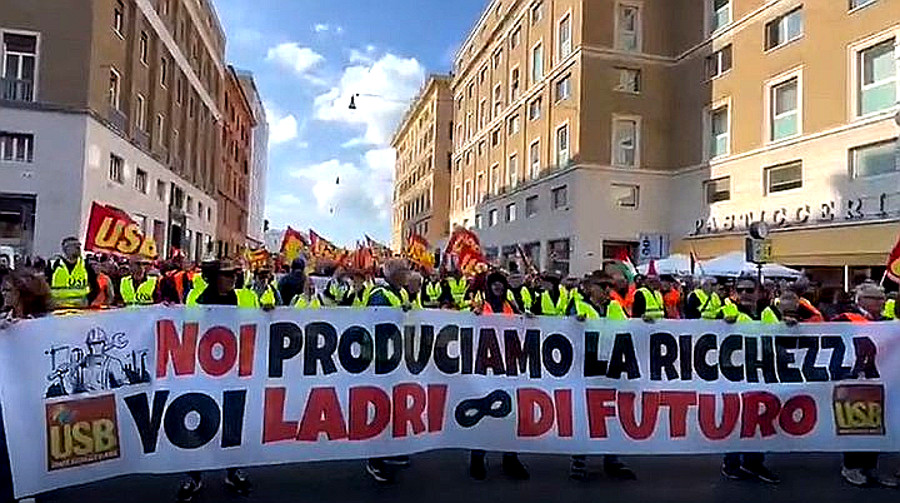
General strike and marches across Italy against rearmament and the high cost of living Right-wing Transport Minister Matteo Salvini tried to stop the strikes by fining the unions, but the USB rejected the threats and continued the strike and the day of mobilizations. Despite police provocations in Turin and Bologna, the demonstrations were massive in the main cities. According to the USB, 1.5 million people participated in the demonstrations in more than sixty squares, while at least one million workers are said to have joined the strike. Our colleague Scilla Di Pietro from La Voce Delle Lotte, part of the International Network of Left Daily, sends a report from the port of Naples. A crowd in the port of Livorno In Livorno , one of the main ports, which had been the epicenter of the protests against the genocide in Gaza and in solidarity with the Sumud Global Flotilla last year, the day began early with blockades at the port terminals organized by USB and the Autonomous Group of Workers of the Port of Livorno. 100,000 in Rome In the capital, the march began in Piazza dei Cinquecento, in front of Termini Station, and reached the area of the Colosseum and the Imperial Forums. The USB claimed the presence of at least 100,000 demonstrators. From the vehicle leading the march, the organizers announced their intention to remain at the Forum until Sunday, setting up tents and organizing a national assembly together with the Lotta per la Casa (for housing) coordination group, inspired by the Puerta del Sol encampment in Madrid. More than 70,000 in Milan In Milan , more than 70,000 people marched along the ring road, which had been blocked to traffic. The massive protest march, organized by USB and Milanese students in support of the general strike, proceeded along the section near Via Palmanova and Cascina Gobba. The demonstrators' stated objective was to reach the Milan ring road and completely block it. Turin: "We can paralyze everything" "We are more than 50,000," was heard from the loudspeakers at the Turin march . A banner was also displayed at the demonstration in support of the mobilization launched in recent hours by dockworkers in 22 countries. "Dockworkers don't work for war." The dockworkers' strike, the demonstrators declared, "frightens governments because when weapons aren't transported, the movement of goods comes to a standstill, and the workers demonstrate their full strength. Today we show that united workers, if they fight together, can change the course of events; they can demonstrate that there is a consciousness that says no to genocide, oppression, and rearmament, and that says yes to education, work, healthcare, and the future." When the mass mobilizations reached Piazza Castello, the police charged students and workers with a water cannon truck and repression from the Prefecture. In the hours leading up to the strike, two containers of manure were overturned in front of Turin's city hall before the general strike demonstration began. The demonstration started in Piazza Palazzo di Città. "They've tried everything to stop this strike," said the spokesperson from the van leading the march, "but today this square, along with dozens of others across Italy, rejects their attempts to repress us. And to the shitty future they want to give us, we'll respond with more shit..." Naples: from the port to the square In Naples , students and workers began the day at the port blockades before marching to the city center. Several thousand people gathered in Naples' Piazza Mancini, a few meters from the central train station in Piazza Garibaldi, where a demonstration against the high cost of living and the rearmament policy had just begun. The demonstration coincided with the general strike called by the USB union. University students and delegations from Naples schools attended, along with workers and numerous families with children. On October 30, more than 100 ports around the world woke up totally or partially paralyzed by the actions of various unions fighting against rearmament, militarism, and the transport of weapons used by Israel for the genocide in Gaza. Italy is the epicenter of the day's events, where dockworkers organized in the USB (Unione Sindacale di Base) and ORSA Porti had coordinated a shutdown of the country's main ports, including Genoa, Livorno, Trieste, and Naples. Throughout the rest of the country, this coincided with the cross-sectoral general strike called by the USB itself, which paralyzed rail transport, logistics, highways, and large sectors of public services and education, uniting workers and students in the streets of major cities. Workers and students are directly confronting the militarism and rearmament promoted by Giorgia Meloni's government and rejecting austerity budgets that cut healthcare and education to finance defense. In addition to demanding a halt to military spending, they are calling for emergency wage increases to mitigate the rapidly rising cost of living. Right-wing Transport Minister Matteo Salvini tried to stop the strikes by fining the unions, but the USB rejected the threats and continued the strike and the day of mobilizations. Despite police provocations in Turin and Bologna, the demonstrations were massive in the main cities. According to the USB, 1.5 million people participated in the demonstrations in more than sixty squares, while at least one million workers are said to have joined the strike. Our colleague Scilla Di Pietro from La Voce Delle Lotte, part of the International Network of Left Daily, sends a report from the port of Naples. A crowd in the port of Livorno In Livorno , one of the main ports, which had been the epicenter of the protests against the genocide in Gaza and in solidarity with the Sumud Global Flotilla last year, the day began early with blockades at the port terminals organized by USB and the Autonomous Group of Workers of the Port of Livorno. Later they joined tens of thousands of protesters in Republic Square in the center of Livorno. 100,000 in Rome In the capital, the march began in Piazza dei Cinquecento, in front of Termini Station, and reached the area of the Colosseum and the Imperial Forums. The USB claimed the presence of at least 100,000 demonstrators. From the vehicle leading the march, the organizers announced their intention to remain at the Forum until Sunday, setting up tents and organizing a national assembly together with the Lotta per la Casa (for housing) coordination group, inspired by the Puerta del Sol encampment in Madrid. More than 70,000 in Milan In Milan , more than 70,000 people marched along the ring road, which had been blocked to traffic. The massive protest march, organized by USB and Milanese students in support of the general strike, proceeded along the section near Via Palmanova and Cascina Gobba. The demonstrators' stated objective was to reach the Milan ring road and completely block it. Turin: "We can paralyze everything" "We are more than 50,000," was heard from the loudspeakers at the Turin march . A banner was also displayed at the demonstration in support of the mobilization launched in recent hours by dockworkers in 22 countries. "Dockworkers don't work for war." The dockworkers' strike, the demonstrators declared, "frightens governments because when weapons aren't transported, the movement of goods comes to a standstill, and the workers demonstrate their full strength. Today we show that united workers, if they fight together, can change the course of events; they can demonstrate that there is a consciousness that says no to genocide, oppression, and rearmament, and that says yes to education, work, healthcare, and the future." When the mass mobilizations reached Piazza Castello, the police charged students and workers with a water cannon truck and repression from the Prefecture. In the hours leading up to the strike, two containers of manure were overturned in front of Turin's city hall before the general strike demonstration began. The demonstration started in Piazza Palazzo di Città. "They've tried everything to stop this strike," said the spokesperson from the van leading the march, "but today this square, along with dozens of others across Italy, rejects their attempts to repress us. And to the shitty future they want to give us, we'll respond with more shit..." Naples: from the port to the square In Naples , students and workers began the day at the port blockades before marching to the city center. Several thousand people gathered in Naples' Piazza Mancini, a few meters from the central train station in Piazza Garibaldi, where a demonstration against the high cost of living and the rearmament policy had just begun. The demonstration coincided with the general strike called by the USB union. University students and delegations from Naples schools attended, along with workers and numerous families with children. After midday, a massive march, estimated at between 30,000 and 50,000 people, broke through the police lines and managed to enter the port. Genoa, port blockade since morning The workers blocked the port entrances and later joined a march in the city center organized by university and high school students. Our colleague Leonardo from La Voce Delle Lotte in Italy, part of the La Izquierda Diario International Network, reports from the port: "We are in the port of Genoa, where the international port strike is intertwined with the general strike in Italy. The blockade continues at the port entrances, with the CALP dockworkers at the forefront. A student march set out from the university and is now arriving at the port before blocking the entire city center." Bologna: student blockades and mobilization In Bologna , entrances to several secondary schools were blocked. The strike day protest began in Bologna with the blocking of entrances to several schools. Student groups blocked the entrances to the Copernico, Minghetti, Fermi, Arcangeli, Laura Bassi, and Righi high schools, as well as the Serpieri Agricultural Institute. In Galvani, on Via Castiglione, garbage containers were placed in front of the entrances. Marches then began from some educational centers, joining the column organized by the grassroots unions in Piazza Maggiore. The internationalist day of October 30th does not occur in a vacuum. It is fully embedded in an international and European context marked by social discontent, where the governments of the major powers have been implementing harsh austerity measures affecting health, education, and wages in order to finance record defense budgets and escalate their war economy. Faced with the attempt by the ruling classes to push the people into a logic of imperialist rearmament and subordination to NATO, the collective action of the dockworkers, as well as the growing protests among young people in France, Italy, and Germany who openly denounce the rearmament policy of their imperialisms, show the combination of forces between young people and workers that have the potential to paralyze the nerve centers of capital. Blocking the supply chains of the machinery of death in over 100 ports is the clearest demonstration that the struggle against the Palestinian genocide, militarism, and attacks on living conditions is one and the same fight. International workers' coordination in the ports this October 30th outlines the necessary perspective: that the capitalists pay for the crisis and the war. https://www.laizquierdadiario.com/Huelga-general-y-marchas-en-toda-Italia-contra-el-rearme-y-el-alto-costo-de-vida? Back |
|
||||||
Thanks for visting the G20 From Below Website. If you want something published here or other enquiries mailto:Brics-from-below@protonmail.com
|
|||||||