The opposition defeated Netanyahu – but its leaders are afraid to realize their victory
Maki (Communist Party of Israel) 28 October 2026
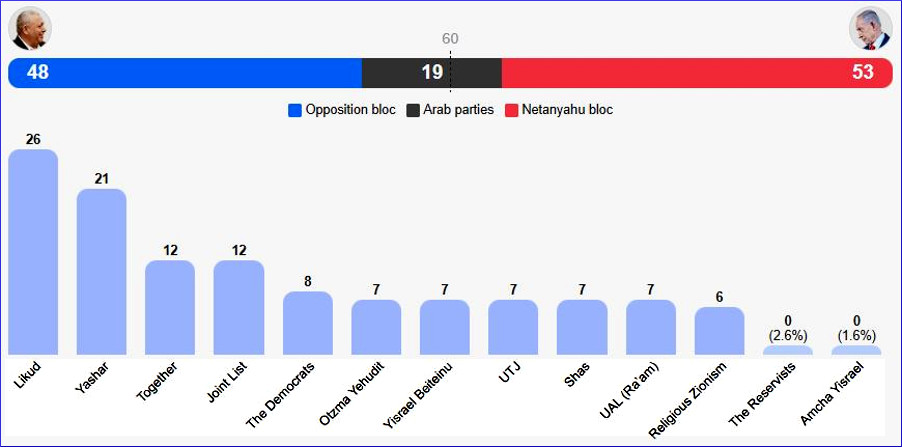
67 seats for the opposition, 53 seats for Netanyahu's bloc – these are the election results before the double envelopes are counted. The political conclusion is clear: Netanyahu has lost his majority in the Knesset and the public mandate. The bloc he leads has crashed from 68 seats in the outgoing Knesset to 53 now. But instead of celebrating the victory, many members of the Zionist opposition are walking around with sour faces and a sense of failure, as if Netanyahu had won the elections again.
This response stems from accepting the rules of the game dictated by Netanyahu, according to which the "Arab vote" is illegitimate and there is no legitimacy to form a government that relies on the support of the Joint List and the GNA. Netanyahu and his partners are very comfortable when the Arab votes are not counted, but it is not clear why the opposition continues to cooperate with the racist disregard for 20% of the citizens. Even after it became clear that the Zionist opposition parties won only 48 seats, Eisenkot and Bennett continue to talk about a "Zionist majority" and a "government of servants," as if they could somehow form a government purely of the bloc's parties. The opposition defeated Netanyahu at the ballot box, but some of its leaders are afraid to realize their victory.
This is a serious mistake. We must not accept Netanyahu's attempt to drive a wedge between the Jewish and Arab oppositions – the last line of defense of the extreme right-wing government. Eisenkot and Bennett must decide whether they prefer Netanyahu's continued tenure over a partnership with the elected representatives of the Arab-Palestinian public in Israel. They still have time to come to their senses – now is the time to pressure the leaders of the Zionist opposition to take the right step and open negotiations with the Joint List and the Ra'am.
As MK Ofer Kassif (Hadash) said following the announcement of the election results: "It's now or never: the removal of the malicious government and the beginning of a correction, or the continuation of the horrors of the last four years. We are committed to correction - will the change bloc rise to the occasion? The ball is in its court."
The election surprise
Many parties have claimed the crown of "election surprise" in recent weeks. But with the publication of the true results, the title was unequivocally awarded to the Joint List led by Prof. Youssef Jabarin, which won 12 seats in the Knesset. Together with RAAM, the parties representing the Arab public won a combined 19 seats. This is an unprecedented achievement by Arab citizens, who came out in droves to vote to oust the far-right government.
This is also an achievement of the Joint List and Hadash and Maki – the consistent leftist movements that lead it. The Joint List campaign was particularly effective in energizing voters and raising the voter turnout of Arab citizens to historic highs. Many leftists in the Jewish public also chose the Joint List and gave it many thousands of votes in Jerusalem, Tel Aviv, Haifa and other cities. Among the results published so far: The Joint List won 32,000 votes in Nazareth and 29,000 in Umm al-Fahm (over 90% of the votes in the city!); 16,000 votes in Haifa, 12,000 in Jerusalem and 9,000 in Tel Aviv-Yafo.
The central messages of the joint campaign – an end to the occupation, peace, national and civil equality, social justice, Jewish-Arab partnership and a promise to overthrow the right-wing government – resonated with broad audiences and swept hundreds of thousands who did not vote in the previous elections to the polls. This success is an important milestone in the building of an Arab-Jewish left that is fighting to change the reality in the country, for the sake of both peoples living in it.
https://maki.org.il
Back
|
|

|
Thanks for visting the G20 From Below Website. If you want something published here or other enquiries mailto:Brics-from-below@protonmail.com
Please Visit the BRICs from below website. The BRICs from below website was established in 2016 to news and analysis on worker and community protests in the BRICS countries and against the activities of BRICS based multinationals especially in Africa. The G20From Below website was set up in to 2025 to extened this work to the G20 countries.

Introducing BRICS from above, BRICS from the middle and BRICS from below
BRICS FROM ABOVE
Heads of state, Business Forum, elite allies
*BRICS as anti-imperialist (ANC & Pretoria rhetoric – “Talk Left, Walk Right”, e.g. national-liberation tradition, foreign ministry on global geopolitics, finance minister on IMF reform, sports minister on FIFA)
*BRICS as sub-imperialist (Pretoria relegitimising world capitalism, lubricating neoliberalism in - and exploiting - Africa, intensifying class war against SA’s poor/workers/women/nature on behalf of global/local capital, ensuring maximum greenhouse gas emissions alongside BASIC/US no matter local/continental/global consequences, and playing “deputy sheriff” role to imperialism)
*BRICS as inter-imperialist (Pretoria's potential support for a new internet delinked from US, promotion of Putin v Obama in September 2013 at G20, and mainly backing Russia in Crimea/Ukraine conflict - as well as earlier episodes where SA lined up with China in UN e.g. in relation to Burma)
BRICS FROM THE MIDDLE
Academic Forum, trade unions, NGOs
BRICS advocates (most of Academic Forum, Johannesburg & Pretoria “think tanks” and others who suffer persistent “failure of analytical nerve”)
*wait-and-see (most NGOs and trade unions - as well as “Third Worldist” intellectuals - who wish for BRICS to become “anti-impi” at UN, Bretton Woods Institutions, Development Bank, Contingent Reserve Arrangement, etc)
*critics (those associated with brics-from-below network who consider BRICS to be “sub-impis” and sometimes also “inter-impis”)
BRICS FROM BELOW
Grassroots activists whose visions run local to global
*localist (stuck within local or sectoral silos, including myriad “popcorn protests” - even some against BRICS corporations or projects - that are insurgent, unstrategic, momentary, at constant risk of becoming xenophobic, and prone to populist demagoguery)
*nationally-bound (most activists who are vaguely aware of - and hostile to - BRICS yet so overwhelmed by local, national and sectoral battles, they fail to link across borders - even BRICS hinterlands)
*solidaristic-internationalist (“global justice movement” allies aspiring for joint campaigning against common BRICS enemies such as Vale, China Development Bank, DBSA, Transnet/mega-shipping, fossil fuel corporations and other polluters, coming BRICS Development Bank)
JEALOUS PRO-WEST CAPITALISTS
Most white organic intellectuals of capital connected to Old Money, multinational-corporate branch plants, Business Day, northern-centric big biz, Democratic Alliance and their ilk.
|