The fight against water privatization in Guadalajara
Areli Aguilar (PCR Mexico) 14 October 2026
The water scarcity and pollution crisis in Guadalajara is not an accident or an isolated error in the management of public resources; it is the effect of a conscious administration with a well-defined priority: defending the interests of the bourgeoisie above human needs.
In early March 2026, the water pollution crisis worsened, an environmental and water infrastructure crisis that had been brewing for years despite the guarantee of former governor Enrique Alfaro, who in 2024 assured the supply for the next 50 years in the Guadalajara Metropolitan Area through a historic investment of more than ten billion pesos.
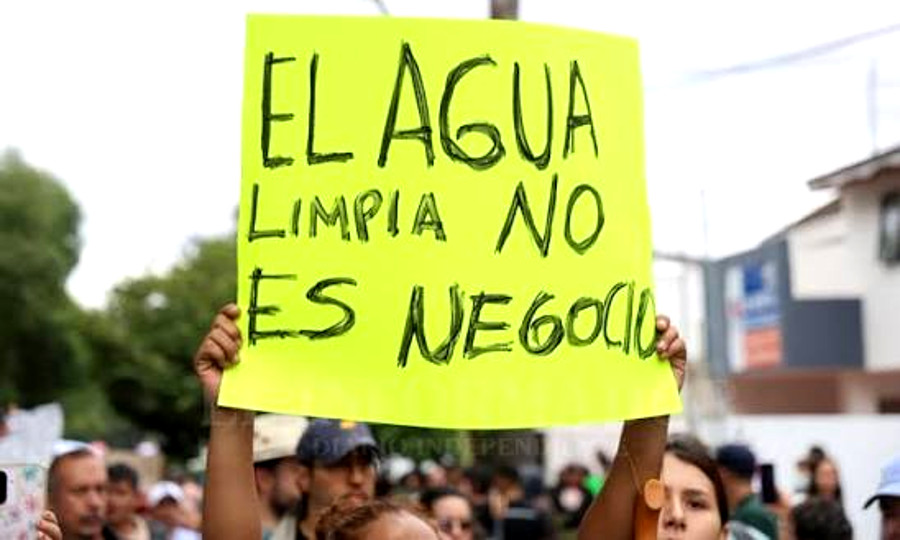
Currently, the state of water contamination is evident to the naked eye. Sampling conducted by the citizen initiative "The SIAPA We Want: Water for Life, NOT for Business" yielded even more alarming data. Through nine monitoring phases to assess the level of health risk, carried out between March and June of this year in 90 neighborhoods in the municipalities of Guadalajara, Zapopan, Tonalá, and Tlajomulco, a high risk of infection and chronic toxicity was identified due to the presence of biological pathogens and chemical elements such as lead and mercury, which affect brain/cognitive development in children, cause irreparable damage to the central nervous system, and severe kidney damage. The presence of fecal bacteria and high concentrations of fluorides and nitrogen compounds, which induce methemoglobinemia in infants and skeletal fluorosis, were also noted, among other general consequences.
On the government's side, we have once again empty promises, measures that seek to alleviate social tensions and dissipate discontent without addressing the underlying issues. In March, after a series of protests triggered by the results of citizen water samples and the complete lack of transparency regarding water quality from the Intermunicipal System of Potable Water and Sewerage Services (SIAPA), Lemus announced the departure of SIAPA's general director, Juárez Trueba, appointing Jáuregui Castañeda as the new head of the agency, pledging to take action in the face of this crisis. The protests subsided in the following months; however, in the last two weeks, discontent has intensified, and citizens have carried out a series of consecutive protests, blocking streets, avenues, and public transportation lanes.
Faced with this discontent, last Tuesday, October 6, the governor "acknowledged" the urgency of the problem and again made a commitment to take immediate measures, including and supposedly temporary (in his words) "less water to distribute among everyone, but it will be of better quality," assuring first that no concessions would be granted and days later declaring that he already had private companies interested in the "investment".
Popular discontent had been building, and on Sunday, October 13, the massive march for water took place. Various groups, organizations, and the general public gathered at the Minerva roundabout, heading towards Casa Jalisco (the governor's residence). The protest was intended to be a peaceful demonstration, and the governor had assured them that he had given "orders" to allow it to proceed with complete security. However, upon arrival, the riot police began with provocations, taunts, and shoving. When the demonstrators refused to back down, the violence escalated, unleashing what we now see as one of the most violent crackdowns in the last six years.
They indiscriminately deployed tear gas and water cannons, beat and arbitrarily detained more than 50 people, many of whom report being tortured during their detention. Furthermore, the authorities have refused to verify the lists of detainees and have brought false charges against them, including the murder of four protesters, who will be transferred to Puente Grande prison.
The violence perpetrated during this demonstration was not a defensive response to an offensive by "shock troops," as the governor and the bourgeois media narrative would have it. The facts are clear: the police and armed institutions serving the bourgeois state fulfilled precisely the function for which they were designed: to repress any expression of proletarian dissent that threatens the interests of the ruling class. The PCR categorically rejects the repression of the protest, the torture and arbitrary detention of the demonstrators, and the dismissal of all charges.
Those belonging to the armed wing of the state play a necessary role in capitalist social and production relations: the defense of the bourgeoisie's private property. "Here, once again, it is existence that determines consciousness. The worker, transformed into a policeman in the service of the capitalist state, is a bourgeois policeman and not a worker" (" What Now? Vital Problems of the German Proletariat ," Trotsky, 1932). Therefore, we maintain that the elimination of the bourgeois state is the only path to the elimination of state violence.
The mobilizations continue and there is a growing number of discontented people demanding freedom and clarification of the arrest processes. We are faced with yet another example of the barbarity and excessive use of violence that the bourgeois regime is capable of committing through the police force, as well as the cynicism of Governor Pablo Lemus, who makes it clear that he does not hesitate to give orders when it comes to defending his interests.
Given this, we reiterate that there is no effective response within the current mode of production, in which any demand for human dignity (be it good water quality, access to medicine, housing, or the right to due process free from violence) contradicts private property and the perpetuation of the capitalist mode of production. The demands continue, and a sector of the working class is beginning to draw revolutionary conclusions; the slogans have shifted from demanding the government's revocation to calling for revolution. These events have proven that the struggle for the planned management of natural resources by our class, without concessions to private interests, is the class struggle.
Now more than ever, it is essential to form a workers' organization that can offer an alternative to the offensives of the bourgeois class. We need a party of professional revolutionaries to lead the way. We cannot continue to rely on our oppressors to provide for our basic needs; only united will we have the strength to overcome this capitalist system and build a Guadalajara where everyone contributes according to their ability and everyone has what they need.
https://marxismo.mx/la-lucha-contra-la-privatizacion-del-agua-en-guadalajara/
Back
|
|

|
Thanks for visting the G20 From Below Website. If you want something published here or other enquiries mailto:Brics-from-below@protonmail.com
Please Visit the BRICs from below website. The BRICs from below website was established in 2016 to news and analysis on worker and community protests in the BRICS countries and against the activities of BRICS based multinationals especially in Africa. The G20From Below website was set up in to 2025 to extened this work to the G20 countries.

Introducing BRICS from above, BRICS from the middle and BRICS from below
BRICS FROM ABOVE
Heads of state, Business Forum, elite allies
*BRICS as anti-imperialist (ANC & Pretoria rhetoric – “Talk Left, Walk Right”, e.g. national-liberation tradition, foreign ministry on global geopolitics, finance minister on IMF reform, sports minister on FIFA)
*BRICS as sub-imperialist (Pretoria relegitimising world capitalism, lubricating neoliberalism in - and exploiting - Africa, intensifying class war against SA’s poor/workers/women/nature on behalf of global/local capital, ensuring maximum greenhouse gas emissions alongside BASIC/US no matter local/continental/global consequences, and playing “deputy sheriff” role to imperialism)
*BRICS as inter-imperialist (Pretoria's potential support for a new internet delinked from US, promotion of Putin v Obama in September 2013 at G20, and mainly backing Russia in Crimea/Ukraine conflict - as well as earlier episodes where SA lined up with China in UN e.g. in relation to Burma)
BRICS FROM THE MIDDLE
Academic Forum, trade unions, NGOs
BRICS advocates (most of Academic Forum, Johannesburg & Pretoria “think tanks” and others who suffer persistent “failure of analytical nerve”)
*wait-and-see (most NGOs and trade unions - as well as “Third Worldist” intellectuals - who wish for BRICS to become “anti-impi” at UN, Bretton Woods Institutions, Development Bank, Contingent Reserve Arrangement, etc)
*critics (those associated with brics-from-below network who consider BRICS to be “sub-impis” and sometimes also “inter-impis”)
BRICS FROM BELOW
Grassroots activists whose visions run local to global
*localist (stuck within local or sectoral silos, including myriad “popcorn protests” - even some against BRICS corporations or projects - that are insurgent, unstrategic, momentary, at constant risk of becoming xenophobic, and prone to populist demagoguery)
*nationally-bound (most activists who are vaguely aware of - and hostile to - BRICS yet so overwhelmed by local, national and sectoral battles, they fail to link across borders - even BRICS hinterlands)
*solidaristic-internationalist (“global justice movement” allies aspiring for joint campaigning against common BRICS enemies such as Vale, China Development Bank, DBSA, Transnet/mega-shipping, fossil fuel corporations and other polluters, coming BRICS Development Bank)
JEALOUS PRO-WEST CAPITALISTS
Most white organic intellectuals of capital connected to Old Money, multinational-corporate branch plants, Business Day, northern-centric big biz, Democratic Alliance and their ilk.
|