End hunger Stop climate harm Protesters take demands to Parliament
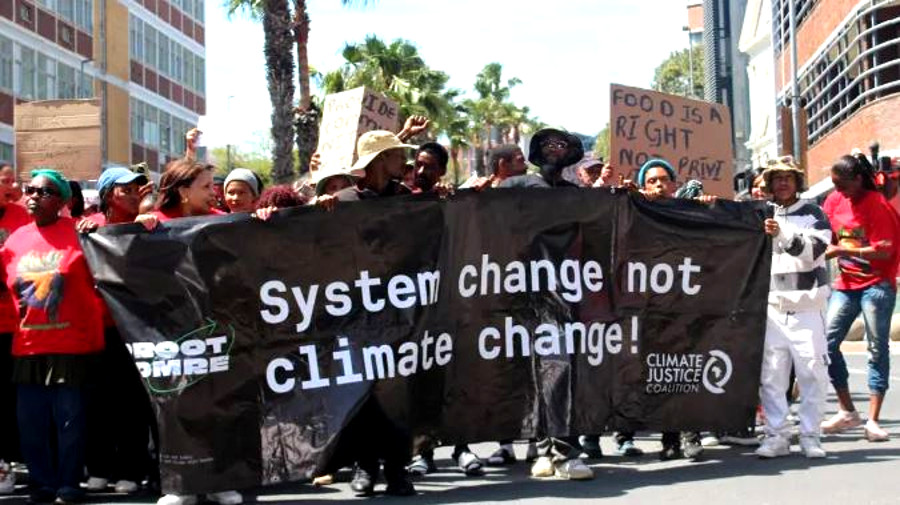
Over 200 organisations have endorsed the call to end hunger and stop climate harm. All photos by Mzi Velapi
On World Food Day, and with El Niño looming, climate justice activists called for system change.
Mzi Velapi (Elitsha News) 16th October 2026
About 200 residents and activists marched through the streets of Cape Town on World Food Day, calling for the government to end hunger and stop climate harm. Organised by the Climate Justice Charter Movement (CJCM) and the South African Food Sovereignty Campaign and allied partners, the protesters handed the memorandum to parliament where they called for the adoption of the People’s Sovereignty Act No 1 of 2024, a People’s Sovereignty Policy and an immediate ban on pesticides.
At least 14 to 15 million people in South Africa live below the food poverty line and experience regular food insecurity, while 11,000 children die due to malnutrition every year, and 10-million tonnes of food go to waste every year, according to Unite Against Hunger.
A recent report by the International Panel of Experts on Sustainable Food Systems (IPES-Food) found that nearly 1.4-billion people in the world work in the agrifood sector, including farmworkers. Despite their number and the vital role they play, they are among the most exploited workers in the world.
Speaking to Elitsha, Kara Mackay from Women on Farms Project said that women farmworkers bear the brunt of lack of access to food because of the unequal power relations that govern their relationship with farm owners. “The issue of poor wages and the high prices of food is linked to unequal power relations where the farmer is seen as the producer and the farmworkers as merely consumers,” she said.
Retired farmworker, Magrieta Prins from De Doorns said that farmers deny workers the opportunity to grow their own food by controlling their access to water. “Farmworkers do not have land to grow their own food but even in instances where they are allowed to do so, the farmer controls their use of water and in most times just deny them access to water,” Prins said.
A seasonal farmer from Ceres, Charmaine Lynx said that not having access to water impacts on their ability to produce their own food. “The social grants play a crucial role during off season. I have to look after my daughter and family during off season as I share my AllPay grant with them. Some have to resort to recycling as a means to put food on the table for their families,” said Prins.
One of the demands of the protesters is the implementation of the climate emergency social contract, that requires the government and the corporations which promote and profit from fossil fuels, pay the price.
Communities on the coastal areas of the Western Cape are experiencing severe weather that has impacted on their ability to feed their families. Fisher woman from Buffels Baai in the Southern Cape, Sarah Niemand said that the weather patterns have resulted in cold waters and fish migrating away. “For the past two months we struggled to get fish because they are scarce because of the bad weather,” she said.
Addressing the protesters outside of parliament, activist and academic, Vishwas Satgar said that southern Africa is heating at twice the global average rate, pushing the region toward an estimated 3°C of warming as global mitigation targets face severe shortfalls. “We are here to tell this government that we are not going to pay the price for their failure of leadership to prepare this country. Climate signs are telling us that El Niño is coming and the last El Niño resulted in collapsed food systems and pushed the food prices up as a result,” Satgar said.
Responding to the memorandum, Mfuneko Toyana said that the government will announce additional funding to respond to El Niño, when the minister of finance tables the Medium-Term Budget Policy Statement next week.
https://elitshanews.org.za/2026/10/16/end-hunger-stop-climate-harm-protesters-take-demands-to-parliament/
Back
|
|

|
Thanks for visting the G20 From Below Website. If you want something published here or other enquiries mailto:Brics-from-below@protonmail.com
Please Visit the BRICs from below website. The BRICs from below website was established in 2016 to news and analysis on worker and community protests in the BRICS countries and against the activities of BRICS based multinationals especially in Africa. The G20From Below website was set up in to 2025 to extened this work to the G20 countries.

Introducing BRICS from above, BRICS from the middle and BRICS from below
BRICS FROM ABOVE
Heads of state, Business Forum, elite allies
*BRICS as anti-imperialist (ANC & Pretoria rhetoric – “Talk Left, Walk Right”, e.g. national-liberation tradition, foreign ministry on global geopolitics, finance minister on IMF reform, sports minister on FIFA)
*BRICS as sub-imperialist (Pretoria relegitimising world capitalism, lubricating neoliberalism in - and exploiting - Africa, intensifying class war against SA’s poor/workers/women/nature on behalf of global/local capital, ensuring maximum greenhouse gas emissions alongside BASIC/US no matter local/continental/global consequences, and playing “deputy sheriff” role to imperialism)
*BRICS as inter-imperialist (Pretoria's potential support for a new internet delinked from US, promotion of Putin v Obama in September 2013 at G20, and mainly backing Russia in Crimea/Ukraine conflict - as well as earlier episodes where SA lined up with China in UN e.g. in relation to Burma)
BRICS FROM THE MIDDLE
Academic Forum, trade unions, NGOs
BRICS advocates (most of Academic Forum, Johannesburg & Pretoria “think tanks” and others who suffer persistent “failure of analytical nerve”)
*wait-and-see (most NGOs and trade unions - as well as “Third Worldist” intellectuals - who wish for BRICS to become “anti-impi” at UN, Bretton Woods Institutions, Development Bank, Contingent Reserve Arrangement, etc)
*critics (those associated with brics-from-below network who consider BRICS to be “sub-impis” and sometimes also “inter-impis”)
BRICS FROM BELOW
Grassroots activists whose visions run local to global
*localist (stuck within local or sectoral silos, including myriad “popcorn protests” - even some against BRICS corporations or projects - that are insurgent, unstrategic, momentary, at constant risk of becoming xenophobic, and prone to populist demagoguery)
*nationally-bound (most activists who are vaguely aware of - and hostile to - BRICS yet so overwhelmed by local, national and sectoral battles, they fail to link across borders - even BRICS hinterlands)
*solidaristic-internationalist (“global justice movement” allies aspiring for joint campaigning against common BRICS enemies such as Vale, China Development Bank, DBSA, Transnet/mega-shipping, fossil fuel corporations and other polluters, coming BRICS Development Bank)
JEALOUS PRO-WEST CAPITALISTS
Most white organic intellectuals of capital connected to Old Money, multinational-corporate branch plants, Business Day, northern-centric big biz, Democratic Alliance and their ilk.
|