 |
|  |


|
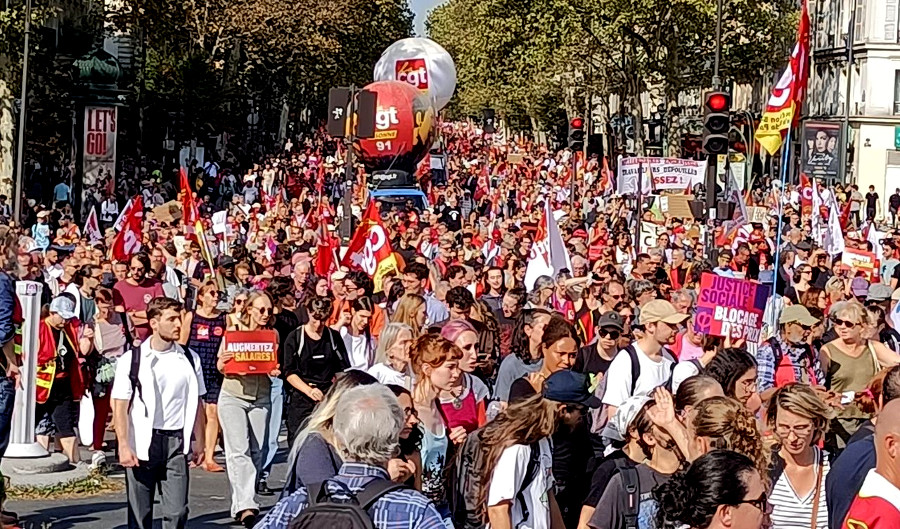
Hundreds of thousands march in French public sector strike against austerity and war Vincent Bohan, an official of the General Confederation of Labor (CGT) union in Poitiers, spoke on health, child care and retirement home workers. “We’re sick of wage freezes; 60 percent of low-wage public sector workers are paid less than the minimum wage for a full workweek,” he said. “More and more people rely on us, but there are not enough of us to meet the population’s needs.” Asked about Macron’s statement last week that France and Russia could soon be at war, he said: “When you hear Macron’s speeches, each one more provocative than the last, with billions of euros spent on killing, while people in France are starving, one feels like telling him: stop … help people struggling here rather than killing people elsewhere. Frankly, we are very worried.” On the presidential elections, Bohan warned against a neo-fascist victory but said workers would also come into conflict with Mélenchon if he won: “There is no ideal candidate. We look at candidates’ programs. The one we feel closest to, for now, is Mélenchon, in any case we don’t have a choice. But even if Mélenchon is elected, the night of his election will not be a night of revolution. We will have to get onto the street to force him to do what we would like him to do.” Stéphane, a CGT member working in university cafeterias, criticized low wages and staffing as demand surged after universities instituted €1 lunches. “Today we are in serious trouble, there is not enough equipment, staff, and we have extremely low wages.” A worker with seniority earns €1500 a month, which is not a living wage in Paris, he said: “Often our bank accounts are empty by the 5th day of the month, we take out loans. It is very complicated, unlivable.” Stéphane said his coworkers feel “fear, there is no other word” at the wars, and disillusionment with official politics: “We are eager for [Macron’s presidency] to be over, but we don’t see much of a future.” Asked about the sell-out of the pension fight, Stéphane said there are “disagreements” in the CGT, whose newly installed general secretary Sophie “Binet is not a particularly impressive person. But we are far removed from all that, struggling in university cafeterias.” Students hold up signs protesting tuition hikes for foreign students; "National preference -- the [neofascist] RN dreamed of it, Macron is doing it." Sorbonne University students Sara and Alex told the WSWS they were protesting “the freeze of student housing aid, the rise of tuition for foreign students, it is a racist and xenophobic measure that aims to block foreigners from accessing our universities and education.” They also criticized police repression: “It is insane to bring plainclothes cops to beat high school students who are just protesting for access to education.” Sorbonne University students Alex and Sara at the September 29 public sector strike in Paris. Sara added, “Youth do not understand why all this money goes for war, why Macron launches strikes abroad even as there are very big problems in his own country. We are firmly against war and financing war.” Eric, a worker at oil and energy firm Total, said he was striking in solidarity with public sector workers: “There can be no industry without public services and no public services without industry.” He also opposed European militarization: “All the billions Macron spends on the army, he should put it in hospitals, schools, firemen who fight fires every summer. Clearly this money, it has no business going to weapons.” He said he expected that the presidential election, whatever its outcome, would solve nothing. “Once the president is elected, the people will have to continue pressing … forcing the government to take measures for the good of the people,” he said, adding: “Mélenchon by himself, without the people, will do nothing. Workers will have to keep pushing on him. And how? By striking, demanding real social measures be taken.” Hillah, a health assistant, holds up a sign saying; "I work full time as a health assistant on night shift and my salary only makes it to the 10th of each month." Hillah, a health assistant, told the WSWS: “Health assistant is a precarious job, undervalued and very poorly paid, with many short-term contracts. I’ve had temp jobs for three years and I got my diploma five years ago. We do several people’s work. I am all alone at night in intensive care for 27 patients, it deprives them of chances to get care and there is chronic fatigue and psychological stress for health staff.” What led to the 2023 pension struggle in France being sold out by the unions, and what role did the CGT bureaucracy play in that defeat?Who is Bogdan Syrotiuk and what does the Ukrainian government's case against him reveal about how Trotskyists are treated in the war with Russia?How does the French ruling class's turn toward militarization against Russia connect to similar war preparations happening in other European countries right now? Asked what Lecornu’s austerity measures mean, she said: “I wash people with paper because I don’t have gloves. I get to work, and I’m told there is no protective equipment, we can’t change patients’ clothes, there are no sheets, patients are cold but I have no blankets to give them.” Hillah stressed her opposition to war with Russia: “We, as health workers, can potentially be drafted. I didn’t sign up for this war. … But today, violence is always increasing.” She also bitterly criticized police repression: “France is the country of freedom, of freedom of expression. But today we are afraid to attend protests, to speak of our ideas, because they can shoot our eyes out with rubber bullets.” Hillah and other protesters called for the liberation of Bogdan Syrotiuk, condemned to 15 years in prison by the NATO-backed Ukrainian government on false charges of treason for calling to unify Ukrainian and Russian workers against the war. They emphasized the importance of a struggle for a political movement unifying workers internationally against war and for the defense of social rights. Bogdan, Hillah said, “does not deserve to be imprisoned for expressing his views. Today, there is nothing to do but to stop the wars. It will not be easy, but common ground must be found, because Ukraine is being destroyed. Finally, what is [Bogdan] demanding? He is demanding peace. And there is nothing more important than peace, liberty and solidarity.” Stéphane, the cafeteria worker, said that “15 years is unacceptable, freedom of expression must be respected. [Bogdan] has a right to think what he wants, he must not be the only one who thinks that way. … Just saying what one thinks does not justify a prison sentence.” Alex, a Sorbonne university student, said, “I call for his liberation,” adding that governments are persecuting him because “they know we can gather together and protest … They know if we all unite, it threatens them and their economic interests.” https://www.wsws.org/en/articles/2026/09/30/tmza-s30.html Back |
|
||||||
Thanks for visting the G20 From Below Website. If you want something published here or other enquiries mailto:Brics-from-below@protonmail.com
|
|||||||