Behind the removed documentary: The survival crisis of Chinese food delivery workers
Dakeng Dongjingkouyi (China Labor Forum) 29 July 2026
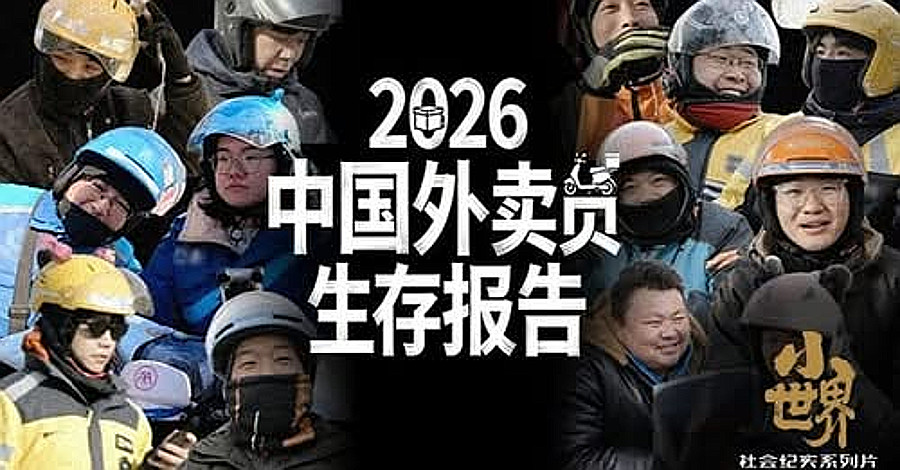
"The income from food delivery is decent, as long as you're willing to sacrifice your health and physical strength." Wang Wan, author of *Running Food Delivery: The World of a Female Rider*, summarized the plight of food delivery workers in this way in the documentary 2026 China Food Delivery Worker Survival Report, produced by *Sanlian Life Weekly*. These two sentences not only encapsulate the reality of food delivery workers but also reflect the common predicament faced by tens of millions of low-income workers in contemporary China: fewer and fewer job opportunities, longer and longer working hours, and increasingly fading hopes for improving their lives. Wang Wan has held 17 jobs before becoming a food delivery worker due to unemployment, a situation shared by many others.
"2026 China Food Delivery Rider Survival Report" uses the true stories of several food delivery riders struggling in Beijing to showcase the survival dilemmas and "involution" faced by contemporary low-income workers. The documentary resonated deeply not only because it tells the stories of food delivery riders, but also because they have become a stark microcosm of the crisis in China's labor market. For over a decade, the food delivery industry was touted as a successful example of "flexible employment"; today, it is a refuge for the unemployed, migrant workers, college graduates, and low-income laborers. The documentary quickly gained widespread attention after its release in May, but it also became another documentary to be removed from all online platforms by the Chinese Communist Party.
Some urban villages in the suburbs of Beijing, where large numbers of delivery riders congregate, have been dubbed "delivery villages." Many riders say the most lucrative period for the food delivery industry is over. Around 2017-2018, a single delivery fee often exceeded ten yuan; today, many orders only bring in three or four yuan. Although working hours haven't decreased, income has clearly declined. As platforms continuously compress delivery times, adjust order dispatch rules, and lower prices, riders must work faster and longer hours to earn similar incomes as before.
The riders in the documentary have all worked as security guards, porters, cooks, or waiters, and some have even slept on the streets because they couldn't afford rent. Their experiences vary, but they have in common that in order to maintain their income, they generally need to work 12 to 14 hours a day, suffer from chronic sleep deprivation, and constantly worry about overtime, fines, and reduced income.
Do you yearn for big cities?
More notably, the composition of food delivery workers is changing. In the past, they were mainly older, less educated migrant workers; however, in recent years, an increasing number of workers from other industries have switched to food delivery due to unemployment, including women. The film also interviewed several university and college students. Contrary to media reports that food delivery workers are mostly highly educated white-collar workers, those delivering food in Beijing are mostly from rural areas in surrounding provinces. Their education levels are low, and food delivery is one of their few options. They come to the city to work because it's harder to earn money in rural areas.
Xiao Zhang, a food delivery driver from Hebei, pointed out that in his hometown, the average annual income from farming is not even enough to make a basic living. Therefore, even though working conditions in Beijing are deteriorating, many people still have no choice but to stay.
"Do you yearn for big cities now?" "No, not anymore. After all, the pay is lower, and it's much more tiring than before." This sentence is perhaps the most noteworthy point in the entire documentary. For decades, migrant workers believed that "going to the city would improve their lives"; but today, this belief is gradually disappearing. Delivery riders face not only long hours and unstable income, but also road safety issues caused by platform delivery time limits. "Worrying about safety is useless; I can't earn money,I'm struggling to even eat, let alone worry about my life." This sentence reveals the reality faced by many riders: the danger doesn't come from individual recklessness, but from insufficient income and the pressure of survival. The platform's so-called "on-time delivery guarantee" essentially transfers the delivery risk to the riders. Capitalists don't need to personally force riders to run red lights; they only need to continuously compress delivery times, and riders are forced to bear the risks themselves.
Without independent unions, this situation will only worsen. More importantly, the attractiveness of big cities to migrant workers is declining. The CCP recently attempted to relax some household registration restrictions, expanding migrant workers' eligibility for public services. This is not out of consideration for "improving people's livelihoods." Amid slowing economic growth and rising risks of labor shortages, authorities are also concerned about a large-scale exodus of people returning to their hometowns, which could further weaken urban economic activity and consumption.
The reason delivery drivers are trapped in long hours, low income, and high risk is not because of inadequate platform management, but because the entire system is built on exploitation and profit-seeking. Workers need to be able to organize collectively to fight for higher wages, safer working conditions, and control over their workplaces. This means establishing truly independent labor unions.
The "2026 China Food Delivery Rider Survival Report" reveals more than just the hardships faced by food delivery riders. Their stories are, in fact, a microcosm of the plight of the contemporary Chinese working class. This is one of the reasons why the documentary was quickly taken down: it exposed too many people to the hidden realities concealed behind China's capitalist development model.
https://chinaworker.info/zh-hant/2026/07/29/49365/
Back
|
|

|
Thanks for visting the G20 From Below Website. If you want something published here or other enquiries mailto:Brics-from-below@protonmail.com
Please Visit the BRICs from below website. The BRICs from below website was established in 2016 to news and analysis on worker and community protests in the BRICS countries and against the activities of BRICS based multinationals especially in Africa. The G20From Below website was set up in to 2025 to extened this work to the G20 countries.

Introducing BRICS from above, BRICS from the middle and BRICS from below
BRICS FROM ABOVE
Heads of state, Business Forum, elite allies
*BRICS as anti-imperialist (ANC & Pretoria rhetoric – “Talk Left, Walk Right”, e.g. national-liberation tradition, foreign ministry on global geopolitics, finance minister on IMF reform, sports minister on FIFA)
*BRICS as sub-imperialist (Pretoria relegitimising world capitalism, lubricating neoliberalism in - and exploiting - Africa, intensifying class war against SA’s poor/workers/women/nature on behalf of global/local capital, ensuring maximum greenhouse gas emissions alongside BASIC/US no matter local/continental/global consequences, and playing “deputy sheriff” role to imperialism)
*BRICS as inter-imperialist (Pretoria's potential support for a new internet delinked from US, promotion of Putin v Obama in September 2013 at G20, and mainly backing Russia in Crimea/Ukraine conflict - as well as earlier episodes where SA lined up with China in UN e.g. in relation to Burma)
BRICS FROM THE MIDDLE
Academic Forum, trade unions, NGOs
BRICS advocates (most of Academic Forum, Johannesburg & Pretoria “think tanks” and others who suffer persistent “failure of analytical nerve”)
*wait-and-see (most NGOs and trade unions - as well as “Third Worldist” intellectuals - who wish for BRICS to become “anti-impi” at UN, Bretton Woods Institutions, Development Bank, Contingent Reserve Arrangement, etc)
*critics (those associated with brics-from-below network who consider BRICS to be “sub-impis” and sometimes also “inter-impis”)
BRICS FROM BELOW
Grassroots activists whose visions run local to global
*localist (stuck within local or sectoral silos, including myriad “popcorn protests” - even some against BRICS corporations or projects - that are insurgent, unstrategic, momentary, at constant risk of becoming xenophobic, and prone to populist demagoguery)
*nationally-bound (most activists who are vaguely aware of - and hostile to - BRICS yet so overwhelmed by local, national and sectoral battles, they fail to link across borders - even BRICS hinterlands)
*solidaristic-internationalist (“global justice movement” allies aspiring for joint campaigning against common BRICS enemies such as Vale, China Development Bank, DBSA, Transnet/mega-shipping, fossil fuel corporations and other polluters, coming BRICS Development Bank)
JEALOUS PRO-WEST CAPITALISTS
Most white organic intellectuals of capital connected to Old Money, multinational-corporate branch plants, Business Day, northern-centric big biz, Democratic Alliance and their ilk.
|