 |
|  |


|
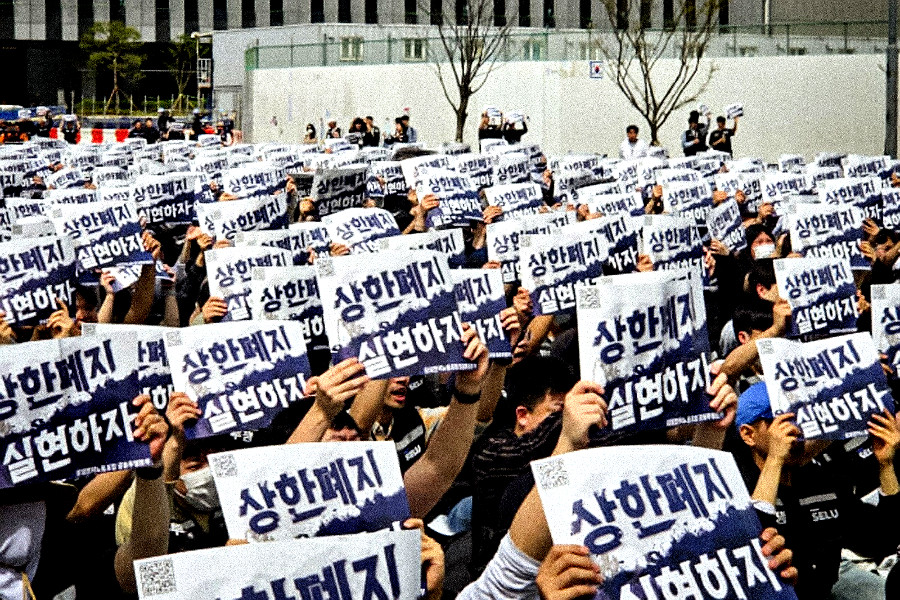
South Korea: sell-out deal smothers awesome power of Samsung workers Samsung Electronics is South Korea’s preeminent monopoly and alone makes up around 14 percent of the country’s annual GDP, 23 percent of its exports and 26 percent of its stock market. Taking Samsung – its parent conglomerate – in its entirety, it accounts for roughly 20 percent of South Korean GDP. What makes this national champion of particular strategic importance is, amongst other key technologies, its production of semiconductors, a lynchpin of South Korea’s export-driven economy. Samsung alone supplies 36 percent of the global market for DRAM (Dynamic Random-Access Memory) chips, which are indispensable for modern computers. It is also a key supplier of high-bandwidth memory chips (HBMs) to western tech giants such as Apple and Nvidia. As one of two key microchip producers in the world, the AI boom – which has driven supply shortages and rocketing prices – has led to unprecedented sales of Samsung products. In the first quarter of 2026, Samsung declared an operating profit of $42.4 billion (57.2 trillion won), a year-over-year increase of 755 percent. As a result of this windfall, Samsung has become one of the world’s top five most profitable companies. Yet despite this, the workers have been left to accept their usual pay and bonuses. When they leave work and return home, they face – along with the rest of the South Korean working class – the consequences of Trump’s war in Iran: rising inflation and spiking energy prices, as well as extra bothers caused by state-mandated energy-saving measures, such as an every-other-day driving rule for public sector workers. Aggravating Samsung Electronics workers’ frustrations was the substantial pay gap between them and employees at SK Hynix, the main rival corporation in the domestic semiconductor industry. In September 2025, in order to avert strike action, SK Hynix scrapped its cap on bonus pay and conceded 10 percent of its annual operating profits to workers. This set the example. Under pressure, the three major unions at Samsung joined together for a strike vote on 18 March 2026. They demanded the removal of bonus caps and a 7 percent wage increase. If not, they would launch what would have been the second-ever strike in the company’s history, after the action in 2024. Over 93 percent voted in favour, a resounding declaration of class war. Ruling class in panic The possibility that one of the world’s most important chip producers could be stopped by workers sent a shockwave throughout the ruling class of South Korea and the world. Samsung was particularly threatened by the fact that a large proportion of the workers intending to strike were this time from the memory card division, which accounted for over 40 percent of Samsung Electronics’ overall revenue in Q4 2025. Moreover, as Samsung’s products are indispensable to western tech monopolies, there were fears that the strike “could throw a wrench in the AI boom”, in the words of Fortune magazine. A stoppage of production would have caused untold ripple effects across the global electronics supply chain, the cost of which would be incalculable. AMCHAM, the American Chamber of Commerce in Korea – and mouthpiece of the US capitalist class – sternly warned that if a strike materialises, it could “undermine Korea's long-term investment competitiveness” and that “competing regional manufacturing markets could benefit if concerns over predictability and continuity persist”. In other words, they loudly threatened to move their investments elsewhere unless South Korea could get a handle on these “disruptions”.It was therefore up to the South Korean state to uphold the class peace. The state steps in From the announcement of a strike, President Lee Jae-myung, a self-proclaimed ‘labour-friendly’ reformist of the bourgeois Democratic Party of Korea (DPK), wasted no time in publicly voicing opposition to the “excessive” demands of the unions. He said: “In the Republic of Korea, which embraces the liberal democratic basic order and a capitalist market economy, labour should be respected as much as business, and management rights should be respected just as labour rights are.” Sworn in after last year’s general election as a safe pair of hands for the ruling class following former President Yoon Suk-yeol’s bizarre attempt at a coup, Lee has made conscious efforts to maintain class peace by placating workers. For example, he has introduced limited reforms to real estate regulations and a ‘yellow-envelope law’ expanding legal bargaining rights for subcontracted labourers. As we predicted previously, the social stability he desires has been found wanting, especially due to the Iran War. But, when it came to the Samsung strikes, the government’s so-called ‘progressive’ agenda entirely evaporated to defend the interests of the ruling class. Lee’s government stepped in to mediate between the workers and Samsung. Such was their unease that, on the eve of the strike, the labour ministry threatened to invoke emergency arbitration measures, which would have forcibly halted industrial action for 30 days. In other words, the state would have stepped in to break the strike. Workers divided In the end, the urgency of the situation and its implications for the world economy forced Samsung’s management to concede to some of the workers’ demands, 90 minutes before the strike was to take place. But contrary to the fighting spirit shown by the rank-and-file membership, the way in which the struggle was concluded has damaged the unions within Samsung. The deal was designed by the management to split its workforce, effectively buying off one section at the expense of the other. Among the three major unions in the company, the Samsung Electronics Labour Union (SELU) mainly represents the DS (semiconductors) division of the workforce. Meanwhile, the National Samsung Electronics Union (NSEU) alongside the smaller Samsung Electronics Company Union (SECU) separately organise the DX (finished appliances) division. As the DS is the more profitable part of the business, Samsung offered the aforementioned $400,000 (600 million won) in bonuses to the DS employees alone. DX workers were offered $4,000 (6 million won), 100 times less. Evident discontent over this fact was reflected in the votes on 27 May. While the SELU membership voted 80.6 percent in favour of the deal, it was rejected outright by the workers of the other two unions: 78.9 percent of the NSEU workers voted against, while only 47 out of over 8,956 workers of the SECU voted in favour. As SELU represented the majority, the deal passed. Before, the workers of Samsung – although fragmented across multiple unions – organised and struck together. Now, by these means, two classes of workers have effectively been created along this arbitrary, technical dividing line and embittered against each other. The dejection among DX workers was such that the SECU dropped out of negotiations wholesale and has since filed court appeals to legally invalidate the deal. Even within the SELU, 6,000 DX workers – having been sold out – left the union in the days following the deal. As a result, the SELU is no longer the biggest union in Samsung. What is criminal is the union heads’ compliance in the face of this. Instead of ramping up pressure for a better deal for all, they decided to run ahead and accept a deliberate half-measure, which left an entire section of the labour force sidelined and unsatisfied. The chairman of the SELU, Choi Seung-ho, staunchly defends this betrayal. In his platform for re-election as union chair, he even includes that the company’s composite unions should henceforth effectively conduct future negotiations separately. The fragmentation of the unions plays squarely into the cynical designs of the capitalists, who could sow further disunity by giving different unions different deals and thereby undermine any future struggles at the company. Class war In spite of the betrayal, the course undertaken by the Samsung Electronics workers has set a dangerous precedent for all of South Korea’s conglomerates, spurring on union activity as a whole. Immediately, workers across key companies – including Hyundai, LG, Kakao and more – began demanding similar pay schemes. On 10 June, the Kakao union held the first-ever walkout in the company’s history. Beyond South Korea, workers of another key semiconductor manufacturer, TSMC in Taiwan, are taking note – some are now calling for union organisation, which is presently forbidden. This is a classic case of workers beginning to understand the real power they hold and beginning to leverage it. In this case, workers of a highly strategic company for world capitalism flexed their muscles to claw back the immense wealth they have produced for the bosses – and forced the bosses to make concessions. But it also underscores the importance of leadership. Had they not been led by a yellow union leadership – who plainly act as ‘labour lieutenants of capital’ – into a divisive and demoralising deal, a decisive victory could have been won. That would involve Samsung workers striking united, while appealing for solidarity actions from workers across South Korea. That would have shuttered some of the world’s biggest tech corporations and, in the process, demonstrated which class actually runs society. Moreover, this is only a sign of things to come. South Korea, along with the rest of Asia and the world, is descending into an ever-deepening crisis. In one way or another, broader layers of the working class will be set on the path of struggle. In this process, Marxist ideas will be indispensable for them to win not just a small share of the capitalists’ profits, but an entirely new society. https://marxist.com/south-korea-sell-out-deal-smothers-awesome-power-of-samsung-workers.htm Back |
|
||||||
Thanks for visting the G20 From Below Website. If you want something published here or other enquiries mailto:Brics-from-below@protonmail.com
|
|||||||