 |
|  |

|
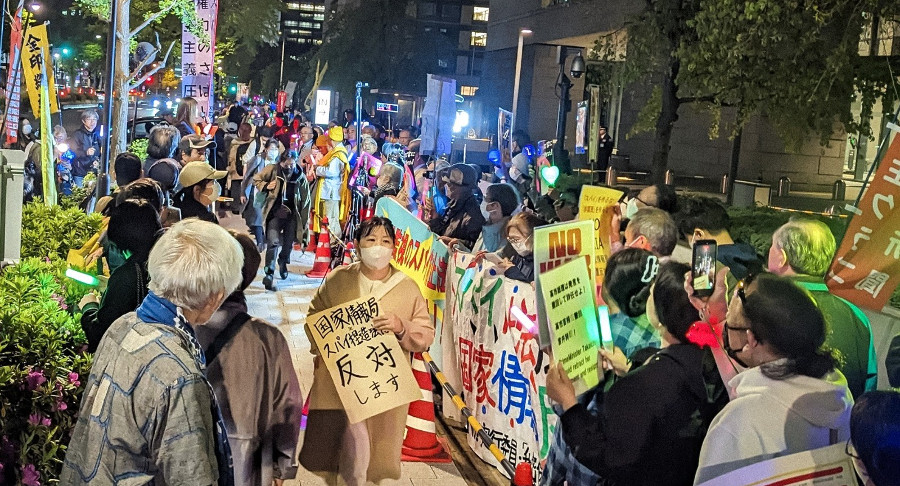
Japan: mass demonstrations against militarism – which way forward? Takaichi came to power with a record majority just last year, and had hoped that she could speed through these changes. Now, with the Iran War putting constitutional revision in a new light, and concretely showing the bloodshed and economic havoc that imperialist war entails, she is facing growing opposition. The protests are currently confined to waving ‘pen-lights’ and chants of ‘No to war!’ and ‘Protect the Constitution!’, with only a small section calling for the downfall of Takaichi. But after years of inactivity on the part of the Japanese masses, they signify that a new generation is entering the political arena. The protests can only expand as the consequences of the Iran War begin to bite and as the pressure to remilitarise from the American and Japanese bourgeoisie becomes more intense – remilitarisation at the expense of the conditions of the working class. Opposition to the Iran War Although these demonstrations were sparked by the threat of remilitarisation, the Iran War has aggravated the discontent. As in many other countries, the US-Israeli attacks against Iran were incredibly unpopular from the start. Only nine percent of people in Japan supported the attack, while 82 percent did not. This was before the economic impact of the closure of the Strait of Hormuz, the lifeline of Asia, was felt. 95 percent of Japan’s crude oil was imported from the Middle East, making it particularly vulnerable to any disruption of traffic through the Strait. The government has had to resort to releasing a total of 70 days’ worth of oil reserves while also introducing state subsidies on fuel. For now, these measures have managed to keep energy prices stable at around ¥167 per litre. But they are unable to keep down the spiralling prices of goods which require fertiliser, helium and oil to produce. In other words, this war is only intensifying the cost-of-living crisis, which was already hitting the working class of Japan. Remilitarisation The real driving force of these protests is the fear that Japan will get tangled up in conflicts like the Iran War thanks to Takaichi’s steps towards remilitarisation. The government recently passed the largest military budget in Japanese history, at $66.5 billion, aiming to raise this even further in 2027. Restrictions on arms exports have also been reduced so that Japan can send lethal weapons like fighter jets, destroyers and submarines to countries that have defence-technology agreements with Japan. This includes a whole host of South-east Asian nations, as well as the UK, US, India and Australia. By establishing defence pacts and selling lethal arms to countries like Indonesia and the Philippines, Japan is hoping to draw them away from Chinese imperialism which has been increasing its influence in the region. At the same time, the attention of the US imperialists is clearly elsewhere. Trump is bogged down in the Middle East, mobilising over 2,000 marines from Okinawa. Perhaps more seriously, the question is raised as to whether the US would even be capable of stopping such an invasion given that they are losing against Iran. This has left the Japanese imperialists increasingly worried that the US cannot be relied upon to help against China in the event of an invasion of Taiwan, for example. As such, they are taking it upon themselves to rearm and protect their interests in the region. Takaichi’s sabre-rattling over Taiwan last November was aimed at fostering a mood of nationalism in the country to ideologically prepare for this. Events in Iran have accelerated this process. Japan has historically maintained friendly relations with Iran and could have acted as a mediator in ceasefire negotiations. In fact, on 20 March, Iran offered to allow Japanese ships through the Strait, since they are not the enemy of Iran. Such an agreement would have alleviated the problem of high energy prices threatening Japanese industry and consumers. But it would have also drawn the ire of Trump. Seeking to prove Japan as an obedient American ally, Takaichi took the opposite course. Trump demanded that Takaichi deploy the Maritime Self-Defence Forces (MSDF) to the Strait of Hormuz. Even though this would directly violate the constitution, she was eager to get involved and was only held back by the less hawkish elements in the LDP, who warned of the dangerous political consequences: only four percent would support the deployment of the SDF before a ceasefire, whereas 49 percent oppose it entirely. Given the political and economic implications, it is unlikely that Japan will get directly involved in this particular conflict. However, the mounting pressures of a rising China and a declining, unreliable America – which would become even more intense in the case of the US’s defeat to Iran – are forcing the Japanese ruling class to re-arm. That is bringing them into direct collision with Japan’s old ‘pacifist’ Constitution. What does ‘constitutional revision’ mean? The Japanese Constitution was created by US imperialism, which occupied defeated Japan in the aftermath of the Second World War. Seeking to ensure that Japan would never rise again to become its rival in the Pacific, it placed firm, constitutional limits on its ability to maintain a standing army, including Article 9, the so-called ‘pacifist clause’. This has been a thorn in the side of the Japanese bourgeoisie ever since, and the LDP has, from its inception, spent decades trying to revise the Constitution. As US imperialism’s priorities began to change with the threat of revolution spreading across the Pacific from China to Korea, they too began to support remilitarising Japan via constitutional change. Constitutional revision re-entered the spotlight under former Prime Minister Shinzo Abe, who represented the most reactionary elements within the LDP. His proposals included revising Article 9 so that Japan could officially possess a military, granting the right to impose emergency powers, which would effectively be a form of martial law, as well as an Anti-Espionage Law. Nonetheless, this was consistently blocked by widespread opposition among the Japanese masses, who wished to maintain a clean and permanent break with the militarist past. When Abe attempted to push through these counter-reforms in 2015, hundreds of thousands came out into the streets to oppose them. Even after Abe’s resignation and death, the Suga, Kishida, and Ishiba governments were all too weak and divided on this question to push forward the change. However, Takaichi’s recent victory has provided the party with a two-thirds majority in the Lower House. Even though the LDP is in a minority in the Upper House, more and more of the bourgeois opposition parties are openly supporting constitutional revision. The final hurdle is that, to revise the Constitution, Takaichi needs to win a referendum with a two-thirds majority. But Takaichi’s sabre-rattling with China over Taiwan has made that possible, as it has pushed support for constitutional revision to 59 percent, with 31 percent against it. This means that constitutional revision is more feasible than even during the Abe administration, although still short of the majority needed and with large reserves opposed. In other words, while anger against militarisation is being expressed on the streets, a sizable part of the population has been affected by the LDP’s fear-mongering over China and North Korea. The tendency is towards polarisation. The dire economic consequences of the war, however, can cause further upsets and swings in the public mood. Anti-militarist struggles in Japan Mass movements against militarism have a long history in Japan, but the greatest example was the movement against the US-Japan Security Treaty (Anpo) in 1960, which reached revolutionary proportions. One-third of the population participated, three national general strikes were held involving millions of workers, and the masses almost stormed the National Diet, Japan’s national legislature. Although the movement was not carried to its completion, it managed to force the US to cut the number of soldiers stationed in Japan by 37 percent, forced hated war criminal Kishi Nobusuke to resign his premiership, and made then-US President Eisenhower cancel his trip to Japan. This shows the power of the organised working class when mobilised en masse. More recently, the emergence of Students Emergency Action for Liberal Democracy (SEALDs) in 2015 also held potential to rally the masses against militarism during Abe’s attempts to revise the Constitution. Unfortunately, due to the students’ failure to connect with the broader layer of the Japanese working class, it fizzled out. The appetite clearly exists for a real struggle against war and rearmament. The problem is that these struggles have been permeated with pacifist ideas by groups like the Japanese Communist Party (JCP), which is one of the more visible organisations in the movement. The JCP continues to take a compromising stance toward the ruling class, limiting itself to criticising the US and Israel merely on the grounds that it is violating international law, rather than addressing the core issue of imperialism and capitalism. The JCP’s Chair, Shii Kazuo, shamefully called for Iran to “exercise restraint and avoid retaliation” during the 12-Day War against Iran last year – falling in line with the rest of the liberal press. End all wars through class struggle! The current movement has been gaining size and momentum with each demonstration, leaping from 3,600 at the first demonstration to 50,000 at the third. Instead of the elderly veterans from the 1960s and 70s who usually compose Japan’s anti-war demonstrations, these protests are predominantly composed of young and unorganised activists. This is only an embryo of what could be. But as Takachi tries to force through her programme of remilitarisation, and as the consequences of the Iran War bite, it could very well spawn a larger movement that barrels into the mainstream. However, the question of what tactics and strategy should be adopted remains. Pacifism is the dominant tendency in these demonstrations, which are led by the No to War! Don’t Destroy Article 9! All-Out Action Executive Committee and No to Amending Article 9! National Citizens’ Action (NCA). These are civil organisations, mainly consisting of legal, religious and advocacy groups that are loosely linked with the left-wing opposition parties like the JCP. The NCA correctly highlights the crimes of Japanese imperialism at home and abroad, as well as the record levels of military spending of the government which is leading to heightened tensions with China. However, its call to action is for people to sign a petition asking the government to stop any efforts towards amending the Constitution. To ask the imperialists to kindly refrain from remilitarisation is like asking a tiger to be vegetarian. Imperialism is not a choice but, as Lenin explained, the highest and most mature form of capitalism. The great powers divide and redivide the world amongst themselves to secure markets, raw materials and spheres of influence. Ultimately, that requires force. In the case of Japan, the idea that the ruling class can simply ‘choose’ to remain defanged – despite the pressure from the Trump administration and the fact that its imperialist interests in the Pacific are being challenged by China – is utopian. Nor can there be any trust in liberal institutions like the United Nations, or the piece of paper that is the Constitution. Trump has shown that when push comes to shove, the imperialists can dismiss the rules if they do not align with their interests. However, we also understand that the young, sincere participants of the current movement understand ‘pacifism’ as a demand to end imperialist wars. The leaders tell them that they must rely on the protections of the Constitution and work within the capitalist system to achieve this. We, the communists, oppose this. The only force in society that can be relied upon to consistently and successfully fight against imperialist war is the working class, which suffers while the warmongers profit. Without the input of the workers, the key levers of the economy, including the military manufacturing facilities in Japan, would sit idle: they are the ones who have the power to shut it down. Therefore, the current anti-war movement must raise its sights beyond ‘defending the Constitution’ and fight to bring down the Takaichi government as the first step towards ending Japanese imperialism. It must penetrate the workplaces, campuses and neighbourhoods across the country and coordinate a national campaign of strike action to hit the imperialists where it hurts: their profits. Such a movement could pose the question of who rules society, and in whose interest society’s wealth is used – the bosses or the workers. A workers’ Japan would have no interest in imperialist aggression abroad, and on the contrary would provide the greatest assistance to the struggle against imperialism and against capitalism wherever it could. We say: if you want peace, prepare for class war! No illusions in the Constitution! Only the working class can stop war! End imperialism by ending capitalism! For a socialist federation of East Asia! https://marxist.com/japan-mass-demonstrations-against-militarism-which-way-forward.htm Back |
|
||||||
|
|||||||