 |
|  |

|
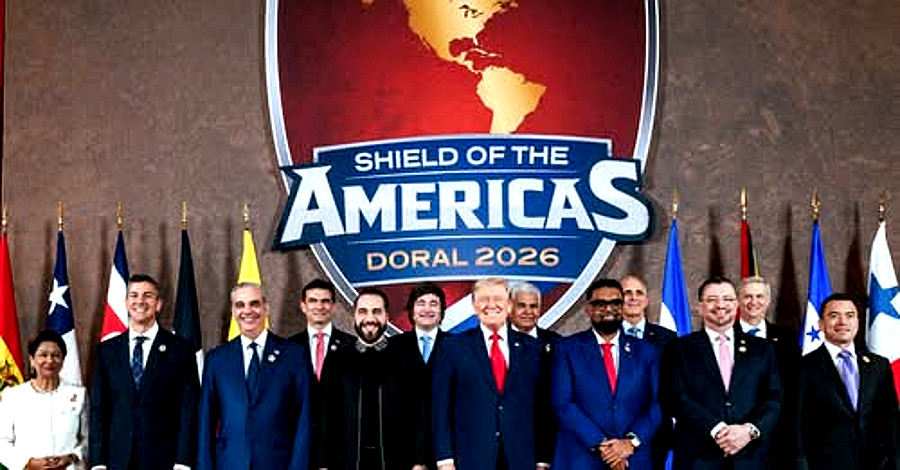
Shield of the Americas: Trump manoeuvring to regain control of the whole continent But this was not a drug or guerrilla camp. It was a dairy farm. Workers told The New York Times soldiers arrived on 3 March, beat them with the butts of their guns, threatened to kill them, then doused sheds with gasoline and lit them on fire. A helicopter returned three days later and dropped bombs on the smoking ruins. One of the destroyed huts had been used for making cheese. Carbonised remains of chickens littered the ground. The bombing of the farm clearly had nothing to do with ‘narco-tyranny’. There is a real, mounting disaster in Latin America due to drug violence. Ecuador has gone from being one of the safest countries in Latin America to one of the most dangerous since the pandemic, due to its role in the shipment of cocaine from Peru and Colombia. It now has a higher murder rate than Haiti. Cartels in Mexico unleash death and terror on the poor population daily and recruit thousands of jobless youth to carry out their turf wars. This is the crisis the US is trying to exploit. But it doesn’t take a detective to sense there are ulterior motives. After all, it’s American companies who started the fentanyl crisis. It was Trump who pardoned Juan Orlando Hernández, the former Honduran president, who was serving a 40-year prison term in the US for drug trafficking. Ecuadorian President Daniel Noboa’s family, owners of Noboa Trading, were caught smuggling hundreds of kilograms of cocaine. The reporter who broke this story had to flee the country due to death threats from Noboa’s party. The drug war is simply a cover for the US’ imperialist actions, as it has been for a long time. Before invading Venezuela, the US declared Maduro was the leader of the Cartel de los Soles, a claim so ridiculous that the US Department of Justice had to admit it didn’t exist. Of course, they admitted this after Maduro was kidnapped. How will the Shield be used? The Summit on 7 March was, unsurprisingly, thin on details. After posing for photos, the member nations signed an agreement affirming they will: 1) ‘Expand multilateral and bilateral cooperation to enhance security’; 2) Cooperate in efforts regarding ‘border security, countering narco-terrorism and trafficking, securing critical infrastructure, and other areas as mutually determined’; 3) ‘advance peace through strength’; and 4) ‘join a coalition to combat narco-terrorism and other shared threats to the Western Hemisphere’. That was it! In fact, Latin America is littered with groups just like this one aiming to do similar things (UNASUR, ALBA, CELAC, OAS), all of which have either ceased to exist or are zombies limping along. But what separates the SOTA from this graveyard of accords is that it is the direct and living embodiment of Trump’s National Security Strategy, and it is formalising a relationship which already exists on the ground. As far as the Americans are concerned, the whole continent – North and South – belongs to them. “President Trump has drawn a new strategic map,” said Pete Hegseth at a SOUTHCOM (US Southern Command) meeting last Sunday: “At the Department of War, we call this strategic map ‘Greater North America’. Why? Because every sovereign nation and territory north of the Equator, from Greenland to Ecuador and from Alaska to Guyana, is not part of the ‘Global South.’ It is our immediate security perimeter in this great neighbourhood that we all live in.” At the summit, the newly appointed Special Envoy for the Shield of the Americas, Kristi Noem said: “We’re also going to keep our adversaries at bay. Those adversaries that wish to change our way of life and our values that are outside of our hemisphere, we want to ensure that we’re continuing to keep them out of our hemisphere and focus on building alliances amongst ourselves and our strengths.” This echoes Trump’s National Security Strategy (NSS). Acknowledging the relative decline of US imperialism, it speaks of refocusing America on its core imperialist interests and spheres of influence: “We will deny non-Hemispheric competitors the ability to position forces or other threatening capabilities, or to own or control strategically vital assets, in our Hemisphere.” The main “non-Hemispheric” nation influencing Latin America is China, which has become South America’s largest trading partner. China purchases Latin American raw materials, exports cheap manufactured goods, and invests in infrastructure projects. The US’ aim is not to completely cut off trade with China, as this is impossible. What the US does want is control over key infrastructure and critical minerals, while denying access to its rivals (China, Russia, etc.). According to the NSS: “We will work with allies and partners to maintain global and regional balances of power to prevent the emergence of dominant adversaries. As the United States rejects the ill-fated concept of global domination for itself, we must prevent the global, and in some cases even regional, domination of others. This does not mean wasting blood and treasure to curtail the influence of all the world’s great and middle powers. The outsized influence of larger, richer, and stronger nations is a timeless truth of international relations. This reality sometimes entails working with partners to thwart ambitions that threaten our joint interests.” The Shield of the Americas is nothing more than a political and military tool to control the hemisphere and coordinate reaction at a central level. Summit member states can formally request American military intervention on their own soil to address both domestic and foreign military threats. The summit’s ugly logo, bright studio lighting, massive amount of photos, and the fact it was held in Florida are not an accident. They’re a giant billboard aimed at China saying: ‘you might buy copper and iron from these countries, but they belong to us. They’re politically subservient to us’. An example of a similar body is Russia’s Collective Security Treaty Organisation (CSTO) with Armenia, Belarus, Kazakhstan, Kyrgyzstan, and Tajikistan. It organises joint exercises, weapon supplies, shared border security, and military training. The CSTO was key in crushing Kazakhstan’s January 2022 revolution. At root, it’s an organ designed to defend Russia’s sphere of influence, just as the US is trying to do in its backyard. However, as Trump has found in Ukraine and the Middle East, his grand plans for retrenchment are easier said than done. In Latin America, his aims are made more difficult by the strong, continent-wide public opposition to the presence of US troops. Last November, Ecuador’s Noboa gave Kristi Noem a horseback tour of former US military bases in the coastal cities of Manta and Salinas, with the plan to reopen them, and fill them with US soldiers and equipment. But the 2008 constitution of the left-wing government of Rafel Correa bans all foreign military bases on Ecuadorian soil. Shortly after Noem’s visit, Noboa put forward a referendum to change this, as is required by law. It was defeated by 60 percent of the vote. Therefore, the US’ war on ‘narco-tyranny’ is simply a convenient excuse to bring troops in through the back door. The Scramble for the Hemisphere Already, the US is using economic, political and military pressure to squeeze China out of its ‘backyard’. It has been on a steady march toward this goal since the start of Trump’s second term. The SOTA is merely organising already existing political forces. The Chile-China Express is a planned 20,000-kilometre-long fibre-optic cable set to connect Hong Kong to the port of Valparaiso, allowing Beijing to reduce its dependence on internet routes through North America. This cable “basically leaves the United States unable to see what is happening” in regional data traffic, telecommunications expert Jonathan Frez told Agence France-Presse. In retaliation, the US has sanctioned three Chilean officials, including the Transport Minister, and pressured them to rescind their approval of the project. The project is now in procedural limbo, but is likely to be cancelled in favour of Google’s Humboldt Cable from Australia to Chile. The US is also trying to find alternatives to the minerals that China overwhelmingly controls on the world market. Mexico has large graphite, fluorspar, copper, and lithium deposits as well as high quality sphalerite ore, which contains cadmium, gallium, germanium, and indium. But while the country has smelting capacity, it does not have the ability to concentrate these critical minerals in high quantities. This would require billions of dollars over several years. Last month, the US-Mexico Mineral Pact was signed with the aim of nearshoring critical mineral supply chains, including establishing price floors. The US is trying to squeeze China out of the Panama Canal, with Panama’s Supreme Court recently declaring the contracts for the ports at each end of the canal – controlled by Hong Kong-based companies – null and void. Instead, to bypass the canal, China is building a Peru-Brazil trading route, which would cut shipping times to China by 10 days. This includes the Port of Chancay in Peru, the Port of Santos in Brazil, and a proposed 4,500-kilometre railway to connect both. To counter this, the US has pressured Peru to spend $1.5 billion to modernise the Callao Naval Base, just 80 kilometres from the port of Chancay, for the US to use. It has warned Brazil and Peru that there will be consequences if the Chinese trade route is completed. Lastly, the US wants to remove any Chinese allies in the region, either economically, or by force. That was a part of the motivation behind the US invasion of Venezuela, a key Chinese partner on the continent, which exported petroleum, mineral ores, and gold, which it traded for military hardware. Maduro was captured just hours after meeting a delegation of Chinese diplomats. After the invasion, Kelly Armstrong, Governor of North Dakota, said, “Somebody’s going to develop the oil in Venezuela – it’s too valuable,” adding, “Do I want Chevron and Exxon and US companies … or do I want Iran and China developing that resource?” After Venezuela, the biggest node of support for Russia and China in Latin America is Cuba. Member states of the SOTA have been pressed to isolate the island, namely to expel Cuban doctors (Guatemala, Honduras, Jamaica), close Cuban embassies (Ecuador, Costa Rica), and to stop any and all sale of petroleum to Cuba. None of these events are isolated. They are all parts of the web the US is weaving over the continent. We can expect that signatories to the Shield of the Americas will continue to bend in the same direction as the scramble for the continent continues. The Shield shows the world who Trump’s lapdogs are. But it is not a homogeneous bloc. Ecuador has bent the most to the US due to its internal crisis. Peru is a close second. Just last month, the president there was impeached over a scandal where he met with Chinese businessmen in Lima’s Chinatown. Argentinian President Javier Milei is one of Trump’s biggest cheerleaders, but he said his country “cannot operate without China” at the 2026 World Economic Forum. On the other hand, Uruguay, though politically aligned with the US, refused to attend the summit to keep its close ties with China intact. The crisis of capitalism will continue this trend, forcing each country to pick a team: America or China. On the other hand, Brazil, Mexico, and Colombia, which represent 60 percent of the continent’s working class and GDP, were not included in the summit. But this does not mean that the ruling classes of these nations are not subservient to American imperialism. This is most clearly shown with Cuba. All three produce petroleum. Any of them could break the blockade on Cuba. Yet all have caved at the threat of tariffs and military attacks, and agreed not to send any oil. Their capitulation was all the more humiliating as, on 31 March, a Russian state-owned oil ship carrying 730,000 barrels of oil sailed straight past the US coastguard and into Cuban ports. Asked by reporters about this, Trump said, “We don’t mind having somebody get a boatload, because they need—they have to survive,” he said. “I told them, if a country wants to send some oil into Cuba right now, I have no problem with that. Whether it’s Russia or not.” There is massive support for the Cuban people in Latin America. In Mexico, nearly 90 percent of the population approves of shipping oil. Working people are left asking: if Russia can send oil, what excuse do left-wing Mexico, Colombia, and Brazil have? Speaking about the Cuban oil blockade, Lula said, “we are no longer colonised countries. We cannot allow anyone to interfere in the affairs and territorial integrity of our countries.” Claudia Sheinbaum has said Mexico has every right to send fuel to Cuba, whether for humanitarian or commercial reasons. But what use is a nation’s ‘right’ to do anything, if it cannot freely use it? Weakness in this case will only invite aggression, and the US is already attacking these countries. Mexico was goaded into killing the leader of the Cartel Jalisco Nueva Generacion, El Mencho, which caused massive chaos in the country. In July 2025, the US imposed a 50 percent tariff on the majority of Brazilian goods for its participation in the BRICS. Colombia’s President Gustavo Petro has been named in two separate criminal investigations led by prosecutors in the United States, which claim he is a drug trafficker – the same pretence used to kidnap Maduro. Colombia has elections in May, which the US will certainly sink their dirty claws into. This shows the limitations of left reformism in fighting imperialism. You cannot guarantee development, a standard of living, and low crime in a system where your economy is controlled by the imperialists and your budget is determined by world commodity prices. The failures of the Pink Tide show that if you accept the rules of capitalism, you accept its limits. In fact, every single one of the reactionary leaders who participated in Trump’s summit was elected off the back of the failures and capitulations of leftist governments. How do we fight imperialism? The Shield of the Americas does not come from a place of strength, but of weakness. America is in relative decline all over the world, and is looking to reconquer old markets while abandoning others. There is no world where the US could keep China completely out of the continent and absorb all of Latin America’s commodities. Instead, these SOTA countries are willingly carrying out America’s plan to minimise Chinese influence under threat of American invasion and economic tariffs. But the United States is promising something China cannot: the power of the American military. Just this month, 75,000 Ecuadorian troops were mobilised in the country to tackle ‘drug crime’. And even though foreign military presence is constitutionally prohibited, the US Southern Command is in the country right now, providing personnel, military equipment, and surveillance. US special forces have even joined Ecuadorian troops in boots-on-the-ground operations. At the same time, an electoral judge in Ecuador, acting on requests from President Daniel Noboa’s administration, recently suspended the country’s largest opposition party, the left-wing Revolución Ciudadana of Rafael Correa, for nine months. This suspension prevents the party from engaging in political activities and from participating in the 2027 local elections. Signing on to the SOTA and having the American Military on call gave Noboa’s government the confidence to act. But Trump’s plans in Latin America involve the mobilisation of the armed forces and billions of dollars of investment. This is its biggest imperialist offensive on the continent in a generation. They are doing so arrogantly and chaotically, assuming they can succeed simply by barrelling in belligerently. This would be incredibly difficult even if the conditions were perfect for the US, which they are not. The US imperialist offensive in Latin America is bound to provoke, at a certain point, a massive backlash. As Trotsky said in 1938: “The policy of American imperialism will necessarily increase the revolutionary resistance of the Latin American peoples whom it must exploit with growing intensity. This resistance, in turn, will encounter the fiercest reaction and attempts at suppression by the United States.” Ecuador has seen general strikes in the 2000s, 2022, and 2025. The massive influx of American troops, the bombing of innocent farmers, and the prosecution of the biggest left-wing party are laying the groundwork for another massive confrontation. The same confrontation is being prepared in every single country the US is marching into. We’ve already seen mass mobilisations in Argentina and Bolivia, including general strikes against austerity. The American working class is also overwhelmingly against intervention in Cuba and Latin America. They mobilised in their millions throughout the country, especially in Minneapolis, to crush ICE. An openly revolutionary appeal should be made to American workers by the Latin American working class. The experience of the Cuban Revolution proves that the best tool workers have for fighting imperialism is expropriating the very capitalists begging Trump to invade their countries, along with the American, European, and Chinese corporations which dominate the commanding heights of the economy. The Shield of the Americas is an attempt to recolonise the continent. Revolutionary measures are the only way to stop this. While Trump and Hegseth speak of a ‘Greater North America’, we fight for a Socialist Federation of the Americas. https://marxist.com/shield-of-the-americas-trump-manoeuvring-to-regain-control-of-the-whole-continent.htm Back |
|
||||||
|
|||||||