 |
|  |

|
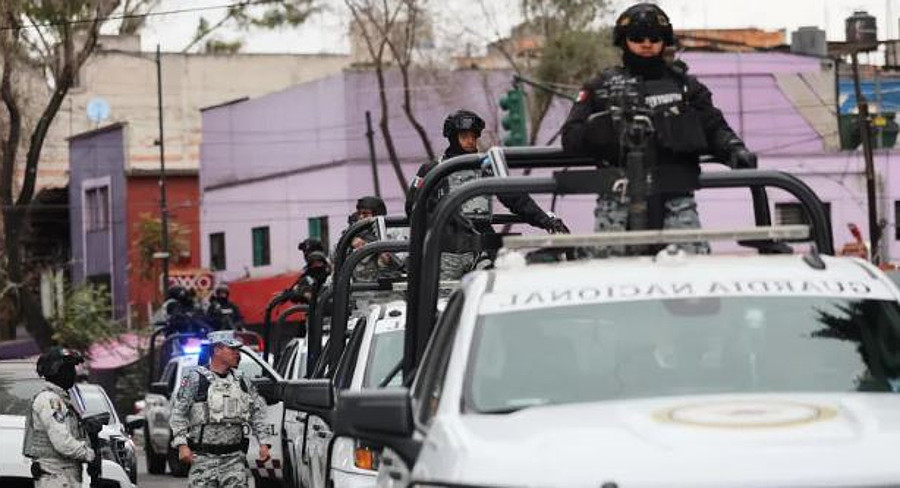
Killing of El Mencho brings chaos to Mexico changes nothing A military mission on 22 February in Tapalpa, Jalisco, ambushed CJNG leader Nemesio Oseguera Cervantes, otherwise known as ‘El Mencho’. A shootout between Mexican forces and CJNG bodyguards ensued, and Cervantes was killed. CJNG henchmen all across the country then arsoned buildings, assaulted government facilities, and ambushed state forces. A 20,000 peso bounty was offered for each military member killed. Travel throughout several regions of the country was impeded as roadblocks choked the highway system. In one video, a CJNG member takes the keys to a PEMEX fuel tanker and starts shooting at it, before shooting at the driver running in the opposite direction. For days the capitalist press published piece after piece about the instability this would bring to tourism (won’t somebody think of spring break!), mining, and of course, the upcoming FIFA tournament. But it’s ordinary working people who suffer most. The only civilian killed was a local pregnant woman, and witnesses reported civilians being lit on fire at the local market. Sieges like these are not new. A little over two years ago, Mexican forces arrested Ovidio Guzmán, son of Joaquin ‘El Chapo’ Guzmán. The Sinaloa cartel which he led then turned Culiacan into a war zone. They shot at a passenger plane, shot down two helicopters, and killed 10 soldiers. This was done just days before Mexico hosted president Biden. The last time Guzman was arrested in 2019, the cartel caused so much carnage the state released him within four hours. Even further back, a 2015 operation targeted El Mencho. The CJNG shot down a Mexican helicopter with a 50 calibre machine gun, killing nine Mexican soldiers. This weapon of war had been purchased 100 percent legally from a gun shop in the USA. This is no accident. No matter where you look, the United States’ war on drugs has left its indelible mark in every part of this warzone: American guns, used to defend America-bound drugs, fighting American instigated military operations. The reality is Trump’s approval is in the doldrums after starting wars, failing to curb inflation, and doing little to stop the flow of drugs. He needed a win to deliver to his base. Back in January, he told Fox news “We are going to start now hitting [Mexican] land with regard to the cartels. The cartels are running Mexico.” There’s also a long game behind all this. America has stated very clearly they want to shore up their power in their own backyard, as seen by Trump’s ‘Donroe Doctrine’, mainly to keep Chinese influence out. But American bases in Latin America are extremely unpopular after decades of plunder, death, and imperialism. Fighting narcotrafficking is therefore a handy fig leaf for the Americans to further entrench their military. Pete Hegseth, speaking on 5 March, told a meeting of Latin American countries to aggressively attack cartels, and that “America is prepared to take on these threats and go on the offense alone if necessary.” Stephen Miller, the deputy White House chief of staff, also said “Cartels that operate in this hemisphere are the ISIS and al-Qaida of this hemisphere and must be treated just as ruthlessly.” The war on terror playbook is at use once again. While the operation itself was carried out by Mexican forces, it was supported by the Joint Interagency Task Force-Counter Cartel, a Pentagon-led group launched this January. Information from the CIA, FBI, and DEA was supplied to Mexico. Trump had repeatedly threatened Mexico’s government with new tariffs if they didn’t do enough to tackle drug crime, which President Claudia Sheinbaum is all too happy to oblige, despite insisting the state would not wage the same failed ‘drug wars’ of the past. By Trump’s metrics, this was a massive success: an American-Mexican operation has killed the leader of one of the largest fentanyl producers and exporters to the US. But will this have any impact? La Empresa Cartels like the CJNG are not small street gangs, but massive capitalist enterprises enmeshed with the regular economy. The CJNG is involved in drug production and trade, fuel theft, human trafficking, illegal mining, extortion, real estate, cryptocurrency, and time-share scams. They even have their fingers in tequila and agricultural trading. It’s estimated to employ upwards of 35,000 people, and is colloquially known as ‘La Empresa’, or ‘the company’. If you’re a disparate criminal group you can even franchise the CJNG ‘brand’ while paying a central fee, as if you’re opening a McDonald’s. They operate in nearly all of Mexico, every American state, and more than 40 countries. No serious person believes chopping the head off this hydra will do any lasting damage. Previously, the ruling PRI had a ‘Pax Mafiosa’ with organised crime for nearly 70 years. There was a tacit agreement that different groups would control turf as long as they didn’t disrupt the legitimate economy. This came to an end with the drug war of Felipe Calderon in 2005, starting the process we are now witnessing. The number of homicides in Mexico more than tripled between 2007 and 2021 – a year which claimed 34,000 victims. Killing a leader can even exacerbate the problem. The CJNG emerged from a power struggle after the founder of the Sinaloa Cartel was killed. El Mencho was a member of the latter before founding the CJNG and declaring war on several rival groups. The cartels, which in their totality employ an estimated 175,000 people (Mexico’s fifth largest employer) and make billions of dollars in profit, are cemented into the foundations of capitalism, just like organised crime in Russia, America, Italy, etc. A massive amount of cartel expenditures goes to corruption at the municipal, state, and federal level. Elements within the police and army do the job of the cartels, and workers have little confidence in them. In 2014, the military, and the state apparatus more generally, orchestrated the disappearance and killing of the 43 Ayotzinapa students at the bidding of local crime groups. Cases like these are common. Working class people in working class neighbourhoods are crying out for basic safety. However, the way to achieve it is not by deploying more police, more soldiers, and expanding the reach of the armed forces. Strengthening the state apparatus only sharpens the same tool used against the working class and the youth. Working people can only rely on their own power. Strengthening the state apparatus only sharpens the same tool used against the working class and the youth / Image: La Prensa Gráfica Noticias de El Salvador, Wikimedia Commons Mexico has seen a mosaic of spontaneous groups organised to fight against cartel violence and defend their communities. These have been successful at winning skirmishes against gang terrorism in states like Michoacan, Chiapas, and Jalisco. However, their decentralised and often apolitical character has meant they’re not sustainable in the long term, and have at times morphed into gangs themselves or been absorbed into state-regulated militias. Mexican workers and peasants have a proud tradition of struggle and have shown, time and time again, that they have what it takes to fight. Let’s not forget this year marks the 20th anniversary of the Oaxaca commune, where workers took over entire zones in the state of Oaxaca, organised by strike committees to defend themselves against death squads hired by the government. How do workers win? Mexico has hundreds of years of revolutionary history behind it, where workers and peasants armed themselves to fight reaction. As large and expansive the cartels are, they would be no match for the millions-strong Mexican working class if it were armed and centrally organised. But ending this violence is as much an armed struggle, as it is an economic and political one, and it doesn’t stop at the borders of Mexico. Ending the stranglehold of the cartels is impossible without, for one, granting land reform and funding to peasants in Colombia who grow coca leaves instead of coffee or corn, which pay too little to survive on. You can’t end the flow of weapons into Mexico without control of the arms industry by the American working class. You can’t end the opioid epidemic which fills the pockets of the cartels without ending the pain, suffering, and destruction that gets millions hooked on opiates to begin with. Lastly, the cartels would never be able to recruit if there didn’t exist a pool of millions of jobless, poor, uneducated youth throughout Mexico who are promised riches, respect, and a lavish lifestyle. The cartels are one of the most grotesque growths of Mexican capitalism, fueled by American imperialism. Knocking off one capo before a rival gang got to him will never fix a thing, just as it hasn’t before. It will require a no-holds-barred struggle against the whole of the rotten capitalist system to put an end to the daily violence the Mexican working class masses suffer every day. https://marxist.com/killing-of-el-mencho-brings-chaos-to-mexico-changes-nothing.htm Back |
|
||||||