 |
|  |

|
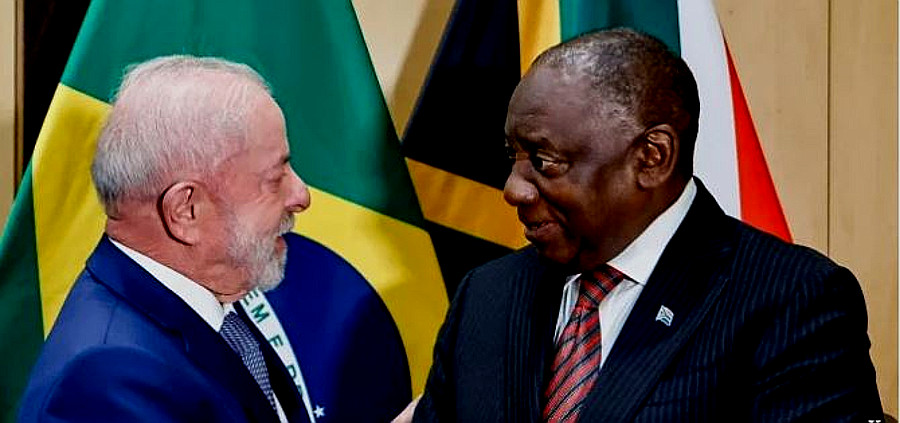
Ramaphosa’s state visit to Brazil So, we have a problem with primary products and with corrupt companies from Brazil. And we don’t really have much to offer Brazil, especially because we can’t undercut Chinese competitors. Both countries have been de-industrializing because we have really been suffering from excessive capacity in the Chinese market. So half of our cars now from China and India our steel market was crushed, our chrome smelters crushed. So I think that’s the commonality and yet Oliver we’re both - South Africa and Brazil - in the BRICS. The main democracies that are you know critical of the US, India being the other one, and now hosting. Last year Brazil hosted. SABC: Actually, let me let me pause you there. What is Lula da Silva’s posture towards the west and in particular American Trump right now? Patrick: You know, it’s mixed, because once Trump allied with Lula’s main competitor, a man called Jair Bolsonaro, his predecessor as president, Lula had been president in the 2000s, his successor Dilma Rousseff was impeached in a fake corruption scandal. But then when Bolsonaro took over from the years 2019 to 2022, and then in 2023 tried to have a coup, well, he was put in jail. And that’s what Trump reacted to and said we put 50% tariffs on Brazilian exports to the US and Brazil had a trade deficit with the US. It was nonsense for Trump to do that. It was just pure political retribution to punish Lula. And that’s similar to South Africa: the allegation that there’s a white genocide or that there’s some critique of US racism. Perhaps there was something to that. But I think the main thing for Brazil, is it could take a much greater lead now in opposing the US as it goes to war with Israel against Iran and against so many norms of international law. And the dilemma is that, if you think that Brazil is connected to the US in many ways, but it’s also connected to Israel through Petrobras through its 9% supply of oil, just like South Africa is through Glencore and African Rainbow Minerals with coal. So we have a lot of complications and I’m just hoping that in that private meeting, there could be some way forward. Last September Brazil tried to have a tariffs meeting of the BRICS. It was hosting the BRICS last year and it failed. There was nothing that came out of that meeting that said to Trump, you got to stop the tariffs. It was actually only the Supreme Court a couple of weeks ago. So maybe as India takes up the BRICS hosting, this group, at least South Africa and Brazil as the main democracies opposed to US imperialism, will actually be able to do something. That’s what we’re hoping that they’re consulting over right now. SABC: Diplomatic resources are finite both in terms of capacity as well as time. And so you have to make the opportunity cost calculations, when you engage diplomatically with other countries. Does the political economy structure of Brazil warrant us to invest in a bilateral relationship with him, instead of just continuing to invest in BRICS as a multilateral body and reap the benefit through that, instead of what could potentially be seen as a duplication of diplomatic efforts? Patrick: Well, it’s also duplication of economic relationships because these are both mineral exporters. I mean the main areas that we probably have more export potential would be gold and platinum, but the entire world is demanding them, and the prices are very high. So I don’t see much in what President Ramaphosa suggests, that you need to come and invest and you need to trade. As I say, the three big Brazilian companies have had quite a disastrous role here. Instead, it’s more that these are giant democracies of the global south and if they can break out of a subimperial relationship with the west, which sometimes they fall into, and actually be multipolar in character, this is the claim with the desire that BRICS would change multilateral relationships. This could be terribly important. And again, this isn’t what we heard in the speech a few minutes ago. We heard much more about, ‘I smell money in the room.’ And I fear that’s not really going to generate much more than a smell. SABC: Like I said, Brazil’s population is three and a half times the size of South Africa’s population. And usually that’s an economic advantage to a country that would hope to be a net exporter to that country. Is there anything South Africa produces manufactures that Brazil might potentially need that we at this moment can take advantage of? Patrick: No, it’s actually the other way around and I mean the basic point you made earlier. South Africa is the most unequal country in the world and we overtook Brazil in 1994, which was then the most unequal. What Lula did was raise minimum wages and provided a Bolsa Famila social grant. So inequality came down there, while it rose here. In that sense what I see Brazil potentially being able to do is to restart its economic activities from the bottom up. I think we need to do that too. But the extreme inequality in a place like this and the character of export industries, which are still based on mining and petrochemicals – that’s just duplication of what Brazil already has – except for gold and platinum. And again, if we see these are great potential allies in promoting world democracy, I hope that’s where their attention lies and not in games about corporates that may or may not be able to do deals. There’s not much there in my view. SABC: How do you mitigate the risk of global disruptions? Brazil is as vulnerable to the war in the Middle East as South Africa at the moment. And you would hope that your major trade partners, as we want them to become, aren’t as vulnerable. Patrick: I mean, Petrobras, the big oil company, will benefit from oil well over $100 a barrel, whereas we’re importing that oil. So, that would be obviously a place where you’d hope that relationships are, just across the ocean, a ship away. I would worry though, that if we do remain so reliant and Petrobras comes in and does offshore oil and especially gas drilling, off the west coast, and maybe up into Namibia, that may result in the kind of relationships that we have with multinational oil companies. Those aren’t pretty. They tend to involve climate change, emissions and corruption, and local ecological destruction. So Petrobras - because Brazil hosted the climate summit last year - it was actually quite a problem for President Lula, especially. We add that they’re exporting oil to Israel at a time genocide is going on, and this terrible war. SABC: And of course, the Orange Basin remains contentious, at least in the courts, that is. We’re going to have to leave that there, prof Bond. Thank you so much for your time. Really do appreciate it, Prof. Professor Patrick Bond is with the University of Johannesburg. https://www.youtube.com/watch?v=le9B2CoLwNo Back |
|
||||||