 |
|  |

|
Argentina: Nothing is going according to plan Industrialicide: the map of the catastrophe This Sunday night, at the opening of Congress, Milei will surely proclaim himself the "best president in history" and declare that the country is about to "take off into the stratosphere." But his self-congratulatory tone contrasts sharply with an untamed economy. In short, the industry began to decline in mid-2025, but it has been stagnating for over a decade. In January, there was a general industrial contraction of 3.6% year-on-year, according to FIEL, and 4.4% year-on-year, according to the Orlando Ferreres consultancy (official data is not yet available). Also in January, according to the Association of Automotive Manufacturers (ADEFA), which represents one of the main industrial sectors, production showed a 20.7% drop compared to December and a 30.1% decrease compared to January 2025. The initial figures for the beginning of the year and the wave of closures, suspensions, and requests for preventative crisis measures indicate that the industrial sector is experiencing a sharp decline in its critical situation. Economic liberalization and the drop in consumption are cited as the main causes. The occupation carried out by the FATE workers is symbolic in many ways: it starkly exposes the industrial crisis to which the current economic system is leading; it reveals the national bourgeoisie, represented by Javier Madanes Quintanilla, one of the wealthiest businessmen in the country, effectively implementing labor reform and shifting the burden of the crisis onto the workers; and, fundamentally, it shows a working class prepared to fight to defend its jobs. Nine hundred and twenty families are facing uncertainty due to Madanes Quintanilla's decision to close the tire factory. The industrial crisis spans the entire country. In Tierra del Fuego, workers at Aires del Sur, a company that manufactures air conditioners under the Electra and Fedders brands, also resorted to occupying the factory to preserve 140 jobs. The working class is united in struggle: workers from FATE and Aires del Sur exchanged messages of solidarity. Also in Tierra del Fuego, at the Newsan appliance factory, businessman Rubén Cherñajovsky laid off 45 employees and suspended another 70, hoping that the labor counter-reform will grant him better conditions for his profits, as denounced by one worker. The Georgalos company, in the San Fernando district (the same district as FATE), announced a new round of suspensions with reduced pay: the measure applies to union representatives, delegates, and workers with more than thirty years of seniority who are being suspended for the third time. In Pilar, the ceramic workers at Ilva are facing a lockout and layoffs. In Córdoba, La Paila, a long-established alfajor company, announced its closure. Dozens of workers are now unemployed. In the same province, the tire company IBF also laid off forty people; Córdoba Goma, a historic business located in the heart of the city of Córdoba, also closed. Meanwhile, the appliance motor factory WEG laid off about twenty workers, citing the impact of imports. Even "support" for the government is backfiring: the Marengo Group (Santa Fe), which launched "No Money" candies in support of Milei, has entered a terminal crisis due to the drop in consumption. In La Pampa, the General Pico meatpacking plant has filed for a Preventive Crisis Procedure (PPP). In the Litoral region, the crisis has its own distinct episodes. The poultry company Tres Arroyos closed one of its plants in Entre Ríos. The textile company Emilio Alal, with over a century of history, shut down its plants in Corrientes and Chaco in January, resulting in approximately 260 job losses. The Northwest region is not immune: in La Rioja, the company Hilados applied for a Public-Private Partnership (PPP); in Tucumán, TN Platex also ceased production, shifting the burden of the crisis onto the working class with 190 suspensions and offers of voluntary redundancies. Many other cases could be mentioned. The Quilmes brewery laid off workers. Seca SA, which produces the Cocot and Dufour brands, laid off 140 employees. In San Luis, Masterlajas, a flagstone producer, closed its doors. Alimentos Refrigeradoras, which manufactured dairy products for Sancor, ended its operations in Lincoln (Buenos Aires province) and Monte Cristo (Córdoba), laying off nearly 400 workers. This quick overview only considers recently reported cases. But the list is much longer if you go back further in time. The government celebrates economic liberalization as a sword that “disciplines” unscrupulous business owners who took advantage of previous protectionist conditions to obtain extraordinary profits, as Roberto Méndez, CEO of the tire shop Neumen, confessed: “We were ripping people off with the price of tires.” In 2025, total imports grew by 24.7%, while exports increased by 9.3%. But what is surprising is the increase in imports from China: 53.9% year-on-year, with a 93% rise in consumer goods alone. Not only that, but last year, in capital goods, the Asian giant sold three and a half times more to Argentina than the United States; in intermediate goods, twice as much as the Americans. 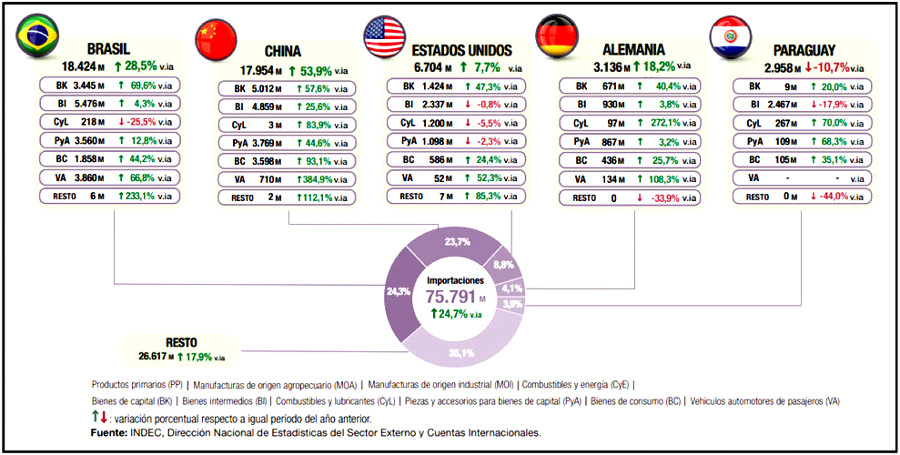
The government applies economic flat-earthism to analyze "price" as the sole indicator of economic efficiency, ignoring the enormous historical differences and variations in economic structure. But, fundamentally, it ignores the fact that its own actions are deteriorating the general conditions for capital accumulation in Argentina. Adam Smith is celebrating in Beijing. Milei's deception is such that while he kneels politically before Donald Trump, in economic terms he is surrendered to the "disciplining" that Chinese goods exert on a local bourgeoisie that is backward in terms of productivity and technologically dependent on economic powers. Meanwhile, during the Milei era, more than a dozen US multinationals left the country. The exodus also includes multinationals from other countries: Petronas, Enap Sipetrol, Mercedes Benz, Telefónica, Southern Cross (Atria Soluciones Logísticas), SHV Holding (Makro), Profértil (owned by Nutrien), Dasa, and Magnera. Others have put themselves up for sale, such as Carrefour and Raízen (Shell). Economist Iván Carrino , a government supporter, put on the blinders that racehorses wear to analyze the situation: he stated that “assuming that the entire manufacturing industry would disappear with the open economy, and that no other sector would absorb that labor, only 18% of wage earners would be left without work.” First, Carrino downplays the significance of the 18% of registered wage earners: 1.2 million workers in the manufacturing industry. Second, the capitalist economy, while benefiting a handful of exploiters who live off the unpaid labor of millions of workers, is nonetheless a complex, interconnected system where the social division of labor implies a massive, unplanned social cooperation. Therefore, industry cannot be "analyzed" as an autonomous entity. For this reason, it is no surprise that the industrial crisis is eroding commerce and services. The working class, with reduced incomes or fewer jobs, cuts back on supermarket spending, stops hiring plumbers for home repairs, loses its health insurance or stops paying for private health plans, stops going to the movies, and stops taking vacations. In this way, the crisis centered in industry progressively erodes commerce and services, and spreads throughout the entire productive sector. There is ample evidence that this is happening. Dr. Ahorro, a pharmaceutical company, closed branches in the neighborhoods of Caballito, Pompeya, Villa Devoto, Villa Lugano, Balvanera, Constitución, and Saavedra, as well as in several provinces, resulting in ninety layoffs. Its employees took action to demand their reinstatement. They denounced that "Dr. Ahorro is saving all the money owed to us on our salaries, vacation pay, and Christmas bonuses, while preparing for new mass layoffs." Price Waterhouse Coopers (PwC), one of the four largest professional services firms in the world (one of the "Big Four"), announced two hundred layoffs. The workers' compensation insurance company of the Galeno Group laid off another six hundred workers. Defining the ongoing phenomenon in the manufacturing sector as "industricide" could indicate a defeatist diagnosis of the outcome of Milei's policies, or it could indicate the objective of his policies: to establish an organized struggle so that this is not the only possible outcome. National industry is, in reality, a foreign-owned industry: among the five hundred largest companies, almost 80% of the added value corresponds to foreign-owned enterprises. The national bourgeoisie, historically associated with imperialist interests, offers no alternative to the dismantling of industry sought by Milei and the international financial capital that wants to reshape the country according to its interests. In practice, the defense of industry is carried out by the heroic acts of resistance of the working class, which fights for the preservation of its jobs and, in the long term, to prevent the destruction of the country's productive forces. The anti-national interests of Argentine business owners are nothing new: it is the same social class that called for the 1976 coup, that sold off the country in the 1990s, and that now seeks to deliver another blow to the working class. This privileged bourgeoisie, fed with public funds, benefited from the nationalization of its debts, a fraudulent operation carried out by the Central Bank at the end of the last civic-military dictatorship: Techint, Renault, Pérez Companc, Bridas (PAE), Industrias Metalúrgicas Pescarmona (Impsa), Ford, and also Aluar and Fate (owned by the Madanes Quintanilla family) transferred this mortgage to the State, initiating the neoliberal cycle of expanding a fraudulent debt that, recycled to this day, weighs like a mortgage wielded as a weapon to impose austerity on the working majority. These businesspeople appear on all the capital flight lists of recent decades, as well as in the Panama Papers, Morgan Papers, and other revelations that have come to light, exposing their use of tax havens to evade taxes and conceal their assets. In 2001, according to a FLACSO investigation , Javier Madanes Quintanilla ranked second on a list of the fifty people who made the most foreign currency transfers (capital flight) abroad. This occurred while small savers were being locked down in the "corralito" (bank freeze). The businessmen, who for Milei are heroes and social benefactors (when their true condition is that of being exploiters), are mutating with the crisis: Paolo Rocca became “Don Chatarrin”, Javier Madanes Quintanilla became “Don Gomita Alumínica” and Roberto Méndez is the “Señor Lengua Floja”. Several industrialists are reconfiguring their businesses in response to the changing times: they are converting to importers or turning to extractive industries. Rocca has long been heavily involved in Vaca Muerta, and the president of the UIA (Argentine Industrial Union), Martín Rappallini, is a partner in the San Jorge Project to extract copper in Uspallata (Mendoza), a project rejected by popular mobilization that condemns polluting mega-mining and defends the Glaciers Law. The industrial crisis cannot be resolved as quickly as the vote on the labor counter-reform: it is an ongoing process that will take time, blood, sweat, and tears. Even Milei's attack on the business world has put the UIA and the AEA on high alert. It is possible that this situation will begin to create a rift between a sector of the business community and the government, which they support in its efforts to destroy the working class with the labor counter-reform, but which they reject when it destroys their own businesses. Milei backs down in the battle against inflation The Consumer Price Index (CPI) for January showed an increase of 2.9%. January marked the eighth consecutive month of rising CPI. Between 1.5% in May 2015 and 2.9% last January, inflation grew uninterrupted for eight months, practically doubling its rate. The most alarming situation is happening at Argentinians' dinner tables: the basic food basket increased by 5.8% in just one month. If that figure is annualized, inflation for the poorest of the poor approaches 97%. The inflationary surge is occurring despite the economic team applying all possible anchors: primarily, the wage anchor (which has been losing ground to inflation for months), the exchange rate anchor with the dollar pegged, the fiscal anchor with the adjustment of public accounts, and tariffs with increases lagging behind what the government wants. Milei seems to be losing his main battle, and his response is the classic playbook of what he calls old politics: postponing the methodological update of the CPI so that the thermometer doesn't register the fever. The decline in the purchasing power of income due to inflation, which is strong among public employees, also began to be noticeable among salaried workers in the registered private sector, who lost ground to inflation between August and December (latest data available). The decline in purchasing power leads to the dead end of household debt. But this desperate measure is reaching its limits: the financial system is suffocating families. According to a survey by the consulting firm PxQ, the monthly burden of debt service (loans and credit cards) now accounts for 20% of family income. This translates into a surge in payment defaults: Tarjeta Naranja's delinquency rate jumped from 4.7% to 16.3% in a year; Mercado Libre's rose from 5.2% to 13.5%. Consumption is falling not only due to a lack of income, but also because of the weight of usurious debt that is becoming unpayable. This dire reality could bring the crisis to the sector favored by the government: the financial system. Stagflation is advancing In the spring of 2021, Javier Milei boasted about his economic discussions with Domingo Cavallo: “Without a doubt, he is the best Economy Minister in all of Argentine history,” the now-president declared at the time. Cavallo has long since become an “unpresentable figure” in Milei's eyes. The former minister, one of those responsible for the economic, political, and social catastrophe of 2001, is well aware of the consequences of currency devaluation and economic liberalization: Cavallo acts as a voice from the past, pointing out the contradictions facing the precarious economic framework of the libertarian experiment. The economist from Córdoba reappeared on TN a few days ago after a year of virtually no public commentary. And he did so to address the most pressing issue: he pointed out that it is relatively easy to overcome hyperinflation, or to lower inflation from the levels at which Milei took office to current levels, but "the most difficult thing is to achieve complete stability" and a sustainable long-term equilibrium exchange rate. He argued that the economy is entering a state of stagflation, a situation that combines stagnation with inflation. Furthermore, he indicated that Milei's government operates with exchange controls and interventions, along with unstable and high interest rates, creating an indigestible combination that negatively impacts economic activity. The former minister criticized the lack of a logical sequence for opening up to the outside world, arguing that it should begin with tax cuts, a significant reduction in country risk, and lower interest rates on loans, among other factors. He also argued that the Large Investment Incentive Regime (RIGI) is only applicable in a country where general conditions are insufficient to attract investment. Despite correctly pointing out several contradictions in Milei's economic plan, Cavallo's proposed solution has explosive potential: lifting all exchange controls and raising tariffs. His most important argument was the need for profound change: a new monetary, exchange rate, and financial regime to revitalize both domestic and international credit. There is another area where the former minister's argument falls short: the notion that total economic liberalization would overcome economic stagnation. In Cavallo's analysis, stagnation doesn't refer to a current situation following the timid rebound in 2025 after the 2024 collapse, but rather, correctly, to the structural stagnation of the Argentine economy: it has been hovering at similar levels of activity since 2011. Cavallo argues that the current moment is as crucial as 1991 under Carlos Menem, when the economy was emerging from hyperinflation and entering a period of stability and growth. However, the truth is that back then, the Peronist president rode the wave of neoliberalism, while now the global economy flounders between sluggish growth and stagnation. In other words, the global economy cannot push the Argentine economy upwards as it did in the nineties or as it did at the beginning of the 21st century thanks to the push from China and vigorous growth in the core economies. 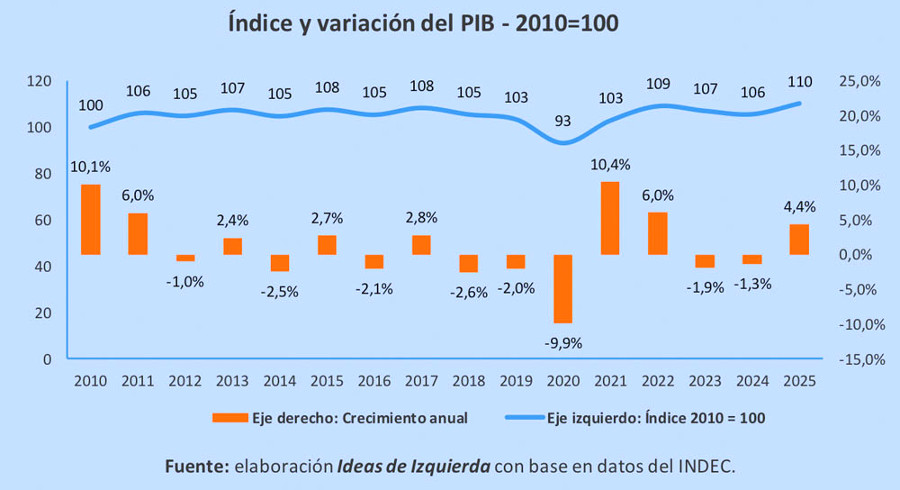
Economic activity in our country has lacked the drivers to pull it out of its long-standing stagnation. The year 2025 ended with approximately 4.4% growth. Even so, this level of activity is only about 2% higher than in 2015 or 2017. Even in terms of GDP per capita (that is, the wealth produced in a year divided by the number of inhabitants), the 2025 level is lower than it was fifteen years ago. The devastating crisis in industry is not of the kind of creative destruction imagined by the Austrian economist Joseph Schumpeter: it is not a “whirlwind” that is renewing the economy, where new business models emerge that surpass the old ones and operate by leading to structural changes. Even in the area where Minister Caputo is supposed to be a champion, the results aren't the best. The country risk rating remains above 500 points. Cavallo stressed that it needs to be brought below 300 to revive lending. There is a contradictory investment trend in Vaca Muerta, combining large-scale hydrocarbon export projects with the withdrawal of international players (Exxon, Petronas, Total). In mining, the other major extractive sector, investments are moving at a certain pace in lithium, but are virtually at a standstill in copper, which comprises projects on a much larger scale than lithium. Despite some niche investments, the Milei administration is facing a kind of general investment strike. Neither unbridled liberalism nor a crony bourgeoisie The current crisis is not a mere "accident," but the result of a war plan against the working class. But the solution will not come from that "national bourgeoisie" that today laments imports and the drop in consumption, but which yesterday profited from the nationalization of its fraudulent debts under the dictatorship. The Roccas, the Bulgheronis, and the Madanes Quintanillas are the same ones who appear in the Panama Papers and are funneling the capital produced in the country to tax havens. Defending "national industry" under the control of these businessmen is defending the continuation of exploitation and dependency. The only realistic way out of Milei's industrial destruction and the plundering by financial capital is a program that attacks the root of the problem. First, we must declare the non-payment of the fraudulent external debt: this debt is a chain that drains national resources to fuel speculation and keep the country subject to the designs of imperialism. Dollars should go to health, education, and a public works program, not to the IMF. Nationalizing the banks is essential to end capital flight and ensure that credit serves social needs, not usury. State control of foreign trade would protect the domestic market without benefiting the monopolies that are friendly to those in power. In perspective, the economy must be reorganized under the management of the workers in strategic activities: production must be planned rationally and democratically based on what the working people need, not on the profitability of a handful of Milei's "heroes" who live off state subsidies and the starvation wages of the workers. Faced with the decline of liberal idols and the failure of crony capitalists, the need arises for an alternative of the working class to reorganize the country from below. https://www.laizquierdadiario.com/Nada-marcha-de-acuerdo-al-plan-la-economia-se-frena-la-industria-en-crisis-y-la-inflacion-avanza? Back |
|
||||||
|
|||||||