 |
|  |

|
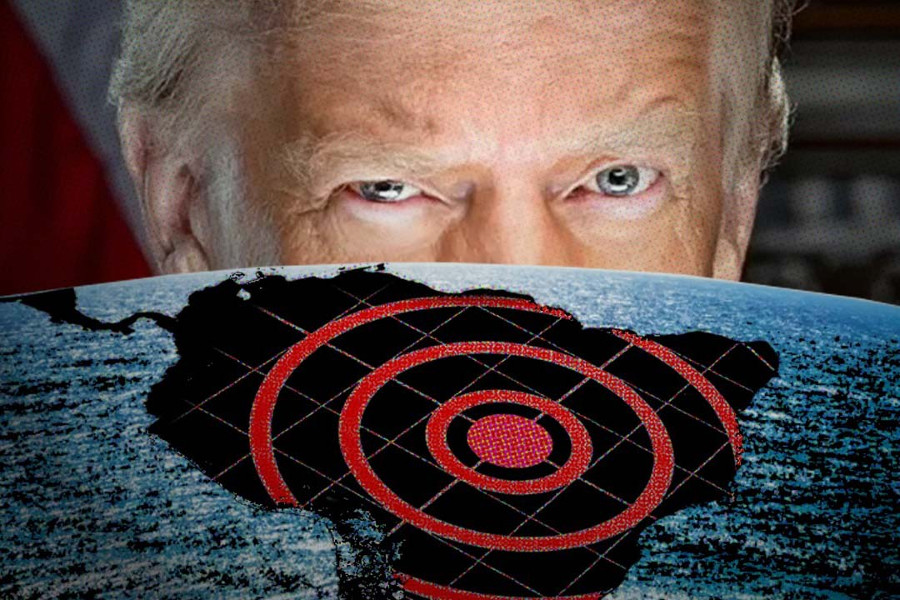
Manifesto against imperialist aggression in Latin America The brutal bombing of Venezuela by US imperialism on 3 January brings to light the new reality we face in Latin America, including in Mexico. A new policy for the continent and the world is being announced by the thundering of US missiles. The bombing of Venezuela and the kidnapping of its president, the anti-migrant policy of the US, the abandonment of NATO by US imperialism, and the breaking of the established rules on which the world order was based, are the signs of a new global age, as Alan Woods recently wrote: “the age of unbridled imperialism, in which might is right, and the entire world will be divided into spheres of influence between the great powers.” Trump's arrival in his second term and the relative decline of US imperialism A year has passed since Trump began his second term as head of the US government, a period that has shaken the world from top to bottom. This peculiar character is not the cause of global chaos, but rather the ultimate result of this period of capitalist bankruptcy, crisis, war, and revolution. More specifically, it is the result of the relative decline of US imperialism and the rise of other global powers, such as Russia and China. Recognising the decline of US imperialism and China's growing influence in the world, Trump's strategy was to end conflicts that were not in the direct national security interest of US imperialism and the ruling class in his country. Trump turned his back on the European bourgeoisie in the war in Ukraine and focused all his attention on reinforcing his dominance in what he considers his backyard. This has caused a global earthquake, with European, and particularly German imperialism, being left exposed. Europe was dragged into the war in Ukraine by Biden, and now, with defeat looming, they are helpless in the face of Russian military might. The old allies have been kicked in the teeth, and with that, the western bloc that dominated the world in recent decades is breaking apart. To reaffirm this new reality, we see Trump’s proposals towards Greenland, a colony of the Danish crown and a member of NATO. From the outset, Trump said that his interest was focused on Latin America, Greenland, and Canada. He has already shown what he is capable of in Venezuela and has made it clear that one of his next objectives is to acquire Greenland because he considers it essential for his national security. This will destroy NATO, but he does not care much about this; his interests are beyond what Europeans may think or do. For Trump, all this is strategic because it is the way to make US imperialism strong again, which is why he does not care about destroying international law. He has said it in no uncertain terms: “I don't need international law.” For him, only his own morality tells him what to do and what not to do. As dialecticians, we know that morality and thoughts are a reflection of one's material condition, therefore his morality is that of an imperialist in need of more resources and power. Trump's policy on Latin America On 5 December, the Trump administration published its National Security Strategy, which reveals its true colours, as it makes clear the government's intentions towards the world. This document confirms the policy that was already being implemented and puts it in writing so that there is no doubt about its intentions. In relation to the American continent, the document sets out three general axes: the fight against drug trafficking, against migration, and against the advance of China. The fight against the advance of China is the essence of the matter; the other two are excuses to close the door to Chinese imperialism in the region. Under the pretext of the fight against drug trafficking, it has forced Mexico to ‘negotiate’ (read: the US has imposed) a change in the fight against drug trafficking, and an anti-China economic policy. The US has also put a knife to Mexico’s throat, which can be used at any time, by designating the cartels as terrorist organisations. The criminal policy against Venezuela began with the invention of a supposed Cartel de los Soles, and the accusation that President Nicolás Maduro was leading this organisation. It is important to note the US Department of Justice has already said that the aforementioned cartel does not exist, debunking all the Trump administration's lies. Trump has accused Colombian President Gustavo Petro of having a cocaine factory and recommended that he watch his back. This accusation is a direct threat against Colombia and the working class of the continent. In another of his statements, the US president said that plans for a ground attack on Mexican cartels are moving forward. More recently, he has said that Cuba will no longer receive oil from Venezuela, tightening the economic siege against the island. Trump's policy toward the continent is very clear. He is using his economic, political, and military power to expand and consolidate the interests of US companies in the region, so that they can control the markets of different countries and access strategic resources, minerals, and infrastructure. What is described in the Security Strategy has been put into practice since the beginning of the Trump administration. This policy began with statements and diplomatic pressure, but has now taken the form of threats and brutal attacks. The first country to suffer this pressure was Panama, due to its relationship and contracts with China regarding the Panama Canal. The imperialist threat succeeded in halting the Chinese companies’ contracts, and there was even talk of them selling their businesses to US companies, although this has not been resolved. Another of Trump’s achievements was the admission that the US military could enter the Central American country. The Panama Canal is a trade route that the US considers strategic for its national security, as are the maritime routes in the Arctic. At the same time that the imperialist war machine began to move into the Caribbean, the US interfered to determine the outcome of three elections on the continent. In Argentina, it used blackmail to pressure the electorate to vote for Milei's candidate. In Bolivia, taking advantage of the divisions among the reformists, it promoted Rodrigo Paz, who is an ally of imperialism. In Chile, it intervened to ensure that the right-wing Kast was the winner in the election. In Honduras, it openly supported the candidate of the right-wing National Party, Nasry Asfura, and to leave no doubt about its support, it released former president Juan Orlando Hernández, already convicted in the US for drug trafficking crimes. The latest and most brutal act of intervention on the continent was the bombing and kidnapping of the Venezuelan president on 3 January. Imperialist intervention in Venezuela The US imperialist bombing of Venezuela marks a turning point on the international stage, making it clear that Trump does not care about the fiction of international law – force is what decides. It is a return to the era of crude and harsh imperialism. Since there is no army as powerful as the US military to stop it, this means that the US can do whatever it wants. On the night of 3 January, this harsh reality took everyone by surprise. The attack on Venezuela was preceded by six months of military harassment and aggression, including attacks on speedboats, more than 100 extrajudicial executions, and the theft of oil tankers. Add to that the capture and kidnapping of Maduro on the night of 3 January, which involved the murder of nearly 100 civilians and military personnel. The Revolutionary Communist International, including our sections in the US and Venezuela, condemned the imperialist aggression against a sovereign state from the first day of the escalation in late August. In imperialism's struggle to dominate and conquer markets, spheres of influence, and fields of investment, we revolutionary communists unconditionally side with the country under attack. The objectives of the attack were: control of Venezuela’s oil and mineral resources, the expulsion of US rivals from their position of influence in the country (China and Russia), and to send a clear message about US military power as a warning to others. In any case, we must keep a sense of proportion. The US had to use all its military might, its most advanced weapons, 20 percent of its war fleet, and 150 aircraft for a military operation limited to a single specific objective, which does not even involve stationing invading troops on a permanent basis. The response of the Venezuelan masses has not been as it was in 2002 when the oligarchy and the imperialists staged a coup against Hugo Chávez. At that time, the masses took to the streets from far and wide to surround the Miraflores Palace. The demonstrations we have seen recently have lacked the fire that only a revolution can inspire. The government of Nicolás Maduro carried out a counterrevolution in Venezuela after Chávez's death. All the most important aspects of the Bolivarian Revolution were destroyed by the Maduro bureaucracy. Workers’ control has been crushed, companies that were nationalised have been privatised, and peasants have been expelled from lands that were expropriated under Chávez. At the same time, collective bargaining and workers’ rights have been destroyed, militant trade unionists have been imprisoned, left-wing parties (including the Communist Party) have been removed from the electoral register. Next to nothing remains of the Bolivarian Revolution. The fact that this Thermidorian counterrevolution has been cynically carried out by Maduro’s bureaucracy under the banner of ‘socialism’, ‘Bolivarianism’, and ‘Chavismo’ has led to the widespread discrediting of these ideas. It has led to a process of deep political demoralisation among the masses of workers and poor in Venezuela, and has caused confusion throughout the continent. The situation in Venezuela can now only be defined as one of semi-colonial domination by the US. The government of Delcy Rodríguez is formally the continuation of Maduro’s government, but in practice the US dictates its policy in all fundamental aspects, and to do so it has taken control over the flow of oil and the resources generated by its sale. Classical imperialism The Monroe Doctrine of 1823 represented the ambition of a young and dynamic capitalist country to control the continent and expel its former European colonial masters. With the Roosevelt Corollary in the early 20th century, US imperialism, which was approaching maturity, assumed the right to police the entire hemisphere. Today, the Trump Corollary or ‘Donroe Doctrine’ represents the desperate attempt of a senile and crisis-ridden imperialism to face the challenges of a world in which it is no longer the sole dominant power. The objective of this Corollary is to reestablish the authority of US imperialism in the Western Hemisphere based on US national security. To achieve this, it seeks to eliminate non-hemispheric competitors (i.e., China) either by force or by controlling strategic assets in those countries to make them dependent on imperialism. It seeks to promote regional leaders and presidents who are allies and aligned with its programmatic interests, intervening in different ways in each country. It speaks of the need to deploy its military apparatus with the excuse of closing migration routes and curbing drug trafficking in the region. The US has also threatened to use lethal force against organised crime groups, particularly drug traffickers who have already been classified as terrorists. We have already seen all of this in action in Venezuela. This new national security doctrine turns the entire continent into a battlefield in which the US seeks to reestablish its dominance and expel China. The working class and peasant masses are paying the price for this dispute. Mexico in the crosshairs At a press conference the day after the bombing of Venezuela, Donald Trump threatened two countries in the region. Regarding Colombia, he said: “Colombia is very sick too, run by a sick man who likes making cocaine and selling it to the United States. And he's not going to be doing it very long, let me tell you.” At the press conference, someone asked if that implied an operation, and Trump replied, “It sounds good to me.” Since Trump’s arrival, imperialist pressure has increased sharply / Image: public domain Of Cuba, he said it “looks like it's ready to fall. I don't know if they're going to hold out… And you have a lot of great Cuban Americans that are going to be very happy about this,” referring to the fact that the island is only sustained by Venezuelan oil, which will no longer be coming. Days later, he also threatened Greenland and Mexico. Regarding the latter, he said the following in an interview: “We are going to start now hitting land with regard to the cartels. The cartels are running Mexico.” Mexico has always been a strategic priority for US imperialism. The two countries share a 3,152 kilometre border through which millions of legal and illegal immigrants pass each year. Mexico is the US’ main trading partner, with trade between the two countries amounting to around $632 billion in 2024. In addition, 40 million Mexicans live in the United States. These aspects are of utmost importance because, although Mexico is a country totally dependent on the United States, 15.9 percent of total US trade is with its southern neighbor. In a way, an important part of the US economy also depends on companies located in Mexico, mainly automobile and assembly companies. Since Trump’s arrival, imperialist pressure has increased sharply. Using migration and drug trafficking as an excuse, imperialism has forced a change in Mexico’s policy towards drug trafficking, made the Mexican government impose tariffs on Asian goods – mainly from China – and made it adapt to the immigration requirements demanded by the United States. The demands have been met to the letter, with the Mexican government even turning a blind eye to the imperialist pressures, in order to curry favour with Trump. Mexico has extradited more than 50 leaders of organised crime groups, including drug traffickers who ran major organisations such as Los Caballeros Templarios. While Claudia Sheinbaum's government has given in, it has presented its actions as a successful negotiation, in which Mexico has managed to curb Trump’s attacks. In other words, the government's rhetoric is that it negotiates as an equal, but in practice it ends up giving in to everything the US asks for. Claudia thought that this action could prevent tariffs from being imposed on Mexican exports. She managed to ensure that, for the time being, all goods covered by the USMCA trade agreement are exempt from tariffs, but this could end at any moment. She was unable to avoid the 10 percent tariff on other goods exported outside the trade agreement or those imposed on the automotive, silver, and aluminium industries. The government has gone from disbelief to resignation. First, they denied that tariffs could be imposed, but now, in one of her morning press conferences, Claudia has said that by declaring drug cartels to be terrorist organisations, the Americans have a legal framework for intervention. Seeing Trump's actions in Venezuela, the threats to Mexico no longer sound ridiculous. A possible imperialist aggression would have very important repercussions in Mexico; the government would be sitting on a powder keg that could explode. If Claudia accepts the aggression without resistance and her denunciation remains mere rhetoric, the reformist ‘Movement for the 4th Transformation’ would lose significant credibility, and the support the president now has would quickly fall. On the other hand, if she called for resistance in the streets, she would risk the movement overtaking her, and losing control of the masses by calling on them to take control of the situation. The big problem for reformist governments, which are threatened by imperialism, is that they do not envision a society outside of capitalism. If you accept capitalism, you have to accept the rules that dominate it, and as we have already mentioned, the new rules are dictated by force and subjugation. Intervention in a country like Colombia or Mexico would be very different from what has been done in Venezuela. In both countries, reformism is robust and has mass support. The response from the masses would be swift, and it would not be easy to return to normalcy if their leaders were arrested. If what imperialism wants is for Mexico to give up more than it already has, the best course of action is to wait for the negotiation of the USMCA trade agreement, which is up for review this year. Imperialism will surely force Mexico to give in to all its demands. If imperialism decides to attack, not only would the country rise up, but a portion of the Mexican-Americans living in the US would surely be on guard, and riots would break out in more than one city. In the mind of a judicious person, sitting down to negotiate with Mexico – with all the aforementioned precedents – would be the best way to maintain the dominance that the US already exercises. The problem is that Trump is not very judicious, to say the least, and anything can be expected of him. If what he is looking for is to maintain his economic subjugation, the government has opened the door for him, but if his objectives are more political, for example, to oust the government, things are going to get complicated. Much can happen throughout the year. We are only at the beginning of January and the political situation is heating up. We will have a long year ahead of us, with developments that we have not seen in recent times. We must have a clear perspective in order to prepare ourselves for the fights ahead. The position of the communists It would be irresponsible not to draw conclusions from what we are witnessing. It is right for the Mexican government to repudiate armed intervention, but it is not enough. In its seven years in power, the government did nothing to break its dependence on the US; on the contrary, it deepened it, closing off any other possibility of ‘independent’ development. If there is one country that suffers directly from the pressures of US imperialism, it is Mexico. The president believes that through ‘good’ negotiations with Trump, she can save herself from the new relationship, but this is a mistake. The Mexican government has used these pressures to consolidate its popular support with nationalist rhetoric, while confirming its alliance with the national bourgeoisie to ‘strengthen’ the economy. She thinks that the national bourgeoisie will support her, but they have no allies, they look out for their own interests, and if they see the ship sinking, they will jump like rats in search of a new foothold. Our position is very clear: we oppose imperialist intervention in Venezuela and throughout Latin America. We oppose the threats and pressure that imperialism exerts against Mexico. Our position is very clear: we oppose imperialist intervention in Venezuela and throughout Latin America / Image: fair use If imperialism launches a military attack against Mexico, we will fight in a united front with all the forces that oppose intervention, including Claudia's government. But unity must strengthen our fight, not whitewash imperialism or numb the consciousness of our class. In response to the call for ‘national unity’ made by the Morena leadership, we call for international unity of the exploited in the struggle. If a section of the bourgeoisie wants to join the struggle, it must be behind the programme of the working class. The unions and social organisations have already begun to mobilise. The day of struggle on Saturday, 10 January, in Mexico City is a good example of how the unions can take the lead in this struggle. The working class can shut down US factories in the event of an attack. The working class, together with students and peasants, can paralyse the country with a day of strikes, dealing a heavy blow to international capital and thereby pushing for an end to hostilities. The working class and its allies, with independent leadership, are the only ones who can push the government into an open struggle against imperialism. They must demand the arming of the people, and the formation of anti-imperialist committees that fight with weapons in hand to defend national sovereignty and against the domination of big capital. Communists will be at the forefront of the anti-imperialist struggle against any attempt at military intervention against the country, defending the democratic right to national sovereignty. At the same time, we demand that the government take measures to prepare us for a major attack by imperialism. We fight for the implementation of the following measures, which we consider necessary and which we will defend from the grassroots of the unions, educational institutions, and neighbourhoods: *Speak clearly about the dangers of imperialist intervention, call for the mass mobilisation of workers and youth. *Form a plan to mobilise and arm workers in defence of national sovereignty against any imperialist attack. *Form workers’ committees in all companies to be ready to act in case of imperialist aggression. *Integrate a national strike council that can mobilise and paralyse all US and national capital companies to stop production in the event of aggression. *Form a national anti-imperialist committee that can take action in the event of any aggression, with representatives from the workers, students, peasants, and indigenous peoples. *Nationalise all US capital companies in the event of aggression. Only a people that is organised and willing to fight to the end can stop any attack. Imperialism does not need ‘provocations’ or excuses to intervene. Weakness invites aggression, and our approach is, as Lenin argued: if you want peace, prepare for war. https://marxist.com/manifesto-against-imperialist-aggression-in-latin-america.htm? Back |
|
||||||
|
|||||||