 |
|  |

|
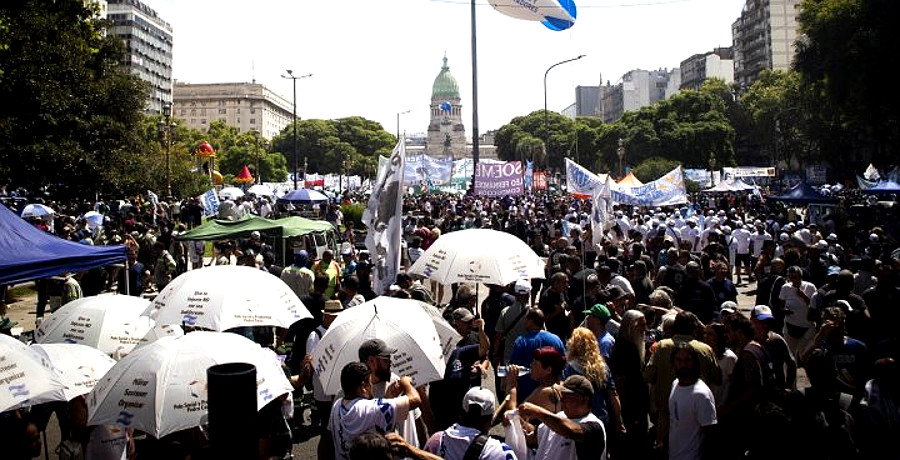
Argentina: The combination of anger and class struggle opens a new scenario for defeating labor reform. In other words: a government (and its affiliated media) that in just over two years wielded a heavy hand, repressed social protest, passed laws favoring big business, and subordinated the country to Donald Trump, and that now seeks to advance a labor slavery law to attack the right to organize, facilitate layoffs, break up vacations, challenge overtime pay, and extend the workday, among many other things, tried to portray itself as a victim of the mobilization. Only the rightward shift of the media system can explain how this ridiculous operation even took place. However, by late afternoon and evening, all the lies were exposed . After the initial crackdown, several thousand protesters returned to the area around the National Congress, while others arrived after work, only to be met with an indiscriminate crackdown that involved shooting, tear-gassing, and arresting dozens of demonstrators . It became clear that this had been the government's objective from the very beginning. Everything else is just excuses. The government secured preliminary approval but failed in a key objective: in exchange for making concessions to the governors regarding profits and negotiating a few points with the CGT (by selling out the workers), it sought a peaceful day to project an image of "governability" to financial capital, but it failed. The streets were not calm. From her social media accounts, Myriam Bregman clearly addressed the situation: “Patricia Bullrich is so broken that she’s forgotten that brutal reforms generate resistance . If young people’s future is stolen, they will have to win it back through struggle. Violence is lying. Violence is voting for a reform against the people. Violence is shooting indiscriminately from motorcycles. It’s ridiculous to think that these attacks can happen without anyone resisting or raising their voice.” By nightfall, this clumsy operation by the government and the media had been seriously called into question, revealing the underlying issue: we are facing a national government and a vast economic power that sustain themselves through repression, the support of Donald Trump, and the complicity of the union bureaucracy and the complicit opposition. Even so, this cannot mask the growing social discontent. The previous day, the National Institute of Statistics and Censuses (INDEC) had reported—even using the outdated methodology due to government intervention—that January's inflation was 2.9% , the highest since last March, thus calling into question the disinflation that has been its main rallying cry. At the same time, the chainsaw-like project of austerity, reduced consumption, a cheap dollar, import liberalization, and submission to Trump and the IMF is generating a crisis in much of the real economy, with the loss of thousands of jobs , while other major political problems, such as the crisis with the police in Santa Fe, are also part of the political landscape. The government is failing to revive the real economy, control inflation, or project any signs of political and social peace. And now, it wants to add a plan for labor exploitation to the mix. In this sense, the day of action served as a channel for expressing rejection of the labor reform, but, much more profoundly, it reflected a broad social opposition to the government. The thousands of people who mobilized and resisted repression did so commendably, despite the CGT's leadership, which acted in total betrayal . This betrayal isn't new; for months they have been negotiating the reforms with the government without even calling for a national strike or a plan of action. The lukewarm call for Wednesday's demonstration, without a strike and with "freedom of action" for the unions, and to top it all off, without even filling the plaza in front of Congress or holding a rally, was clearly intended to serve a policy of negotiation with the far-right government. This allowed the essential elements of the reform to be passed and prevented the full social force of the working class from being expressed. However, anger is building, the CGT triumvirate is more discredited than ever, and thousands of people still sought ways to express their anger and resistance , even going after their working hours, when the repression had already been unleashed. Even so, it's not just Milei and the CGT. Early in the morning, Governor Martín Llaryora, of the Peronist party in Córdoba, began the day by repressing those protesting against the labor reform in that province. It should be noted that the day of struggle wasn't limited to the City of Buenos Aires; it was a nationwide movement . The day continued with the opening of the Senate session, thanks to the support provided to the La Libertad Avanza (Freedom Advances) coalition by the UCR (Radical Civic Union), the PRO (Republican Proposal), and sectors of Peronism . This is nothing new: since the beginning of his administration, many of these accomplices have facilitated the approval of the Bases Law and so many other austerity and sell-off measures for Milei. One fact not to be forgotten: those who debated the precarious employment of millions in the Senate are senators who earn 10 million pesos a month, and in almost all cases, possess millions in personal wealth. The political regime presents a highly distorted view of reality. Between a ruling party mired in total crisis, economic collapse, and scandals—a party only saved in October by Donald Trump's intervention, which allowed it to win the election more out of fear of chaos than genuine support—and a fragmented, complicit, and crisis-ridden opposition, neither of these actors truly represents the profound social discontent that exists. This is the underlying reason why new, combative sectors are beginning to emerge, seeking an alternative path forward. In this context, the working class and youth can only rely on their own strength. Faced with a government that has nothing to offer but attacks and a Peronism adrift, there is another option: to take a gamble on mobilizing the working class, with a major challenge starting today: to redouble the struggle in every workplace, school, and neighborhood to fight to impose, from the ground up, an active national strike and a plan of action on the path to popular rebellion and a general strike, in anticipation of the labor reform bill being debated in the Chamber of Deputies. This includes a major grassroots struggle by building the broadest possible committees of action, as well as denouncing the leadership of the CGT (General Confederation of Labor) and demanding accountability from the union leadership of the CTA (Argentine Workers' Central Union), UOM (Metalworkers' Union), Oil Workers, Bank Workers, and all the unions that present themselves as more combative but maintain conciliatory stances. What happened this Wednesday was the first round of a fight that's just beginning. Even if it's finally approved by the Chamber of Deputies in a few weeks, the labor reform will face thousands of acts of resistance wherever they try to implement precarious employment and layoffs. Lustramax, the Garrahan Hospital, and so many other places are proof of this. The PTS and the Left Front are deeply committed to this perspective and are playing an increasingly important role in these struggles. They come from a 2025 election in which they supported all the struggles and gained significant prestige, which was expressed electorally as a combative statement for always being where they needed to be : with pensioners, with the Garrahan Hospital, with disability groups, and with all sectors in struggle, while many looked the other way, passively complicit with Milei. But this political activity didn't take a break; it continued throughout the summer, deploying a massive campaign of agitation against the labor reform , not only in the usual activist circles, but also by providing resources to reinforce major tourist centers like Mar del Plata and Córdoba, among others, with small planes and millions of posters and flyers. It also channeled energy into major struggles like those at Lustramax and the Garrahan Hospital , focusing on establishing coordination mechanisms to support these struggles and build strength to challenge the rank and file of the unions and fight to impose a national plan of action from below. All of this was done while simultaneously waging an anti-imperialist campaign against Trump's attack on Venezuela, the threats against Cuba and Iran, and supporting the workers' and peasants' struggle in Bolivia. This Wednesday, all that activity and orientation was reflected in the streets, with the thousands who participated alongside the left in a critical and independent manner, separate from the CGT's call to action. But there was also enormous recognition in the streets for our party and its main leaders, such as Myriam Bregman, Nicolás del Caño, and Christian Castillo, who stood shoulder to shoulder with thousands and are recognized as important figures in the struggles, offering a perspective that neither the union bureaucracy nor Peronism currently provides. Today, no fight has ended; rather, another stage begins. These hard-won gains will be put to use in the fight when the issue is debated in the Chamber of Deputies, the next step. To all the comrades with whom we have shared so many challenges in the streets, we propose that we face this new chapter together, starting today. In the coming days, the PTS will be convening open meetings, and we invite you to participate. These struggles are in our hands and are part of building a great party of the new working class that offers an alternative to capitalist decline. https://www.laizquierdadiario.com/El-combo-de-la-bronca-y-la-lucha-de-clases-abre-un-nuevo-escenario-para-derrotar-la-reforma-laboral? Back |
|
||||||
|
|||||||