 |
|  |

|
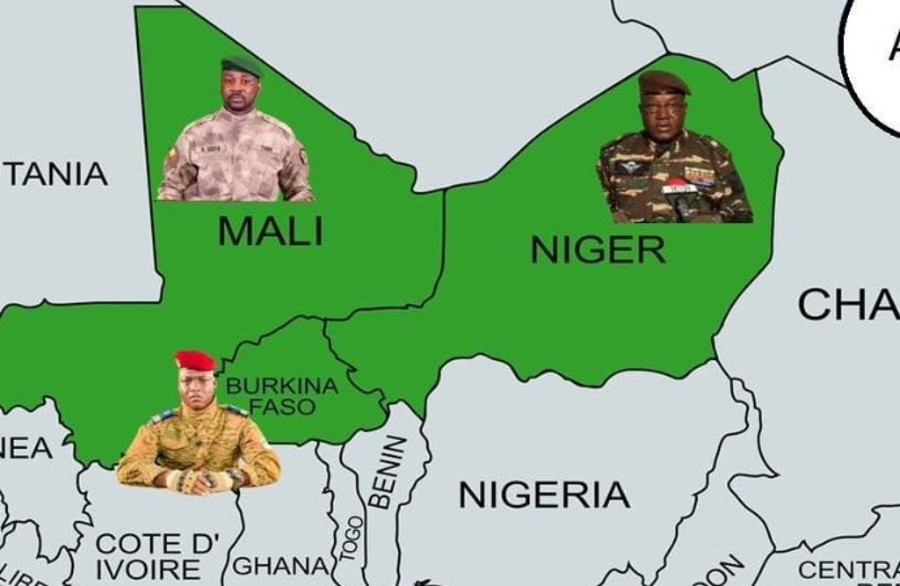
Ibrahim Traoré, the Alliance of Sahel States and the fight against imperialism in West Africa Reading the western press, one could be forgiven for thinking that the experience of the AES has been a total disaster. Almost daily, ‘respectable’ sources, such as the BBC, Le Monde, or Jeune Afrique, publish fresh lamentations about the suppression of democratic rights, economic crisis and the spread of Islamist terror. The implication, which at times is even announced explicitly, is that Mali, Burkina Faso and Niger were oases of stability and democracy before the military took power. This is a lie used to cover the appalling record of imperialist interference in these countries, which has produced the crisis confronting the region today. Capitalism has brought nothing but misery to the people of the Sahel. Brutally colonised by the European powers, on formal ‘independence’, the new states of the region were deliberately left balkanised, weak and economically dependent. For decades, the mineral wealth of these countries has been extracted to the benefit of multinational corporations, with no discernible improvement in the living standards of the vast majority – many of whom lack electricity, healthcare, education, or even enough food to eat. Mali, Burkina Faso and Niger are amongst the ten poorest countries on Earth, according to the UN’s Human Development Index. The looting of the region has been facilitated by the maintenance of brutal and corrupt dictatorships, financed, armed, and propped up by foreign powers, above all France. Blaise Compaoré ruled Burkina Faso with western backing for almost 30 years, before he was ousted by an uprising of the masses in 2014. Elections, when they take place at all, have simply served to maintain the same corrupt clique of imperialist lackeys in power, using widespread vote-buying and fraud. If any opposition party succeeds in garnering enough support to be a threat, its leaders are often ruled ineligible to stand in elections. Protests are regularly fired upon using live ammunition. By such means, Alassane Ouattara recently won his fourth successive term in office as President of the Ivory Coast, with the continuous support of the western powers, above all France. One could say this is simply business as usual for African ‘democracy’. But in Mali, Burkina Faso and Niger, the situation was brought to breaking point by the invasion of the Sahel by a number of well-armed Islamist groups. Imperialist intervention in Libya in 2011 caused a flow of arms and fighters into Mali, where the separatist struggle of the Tuareg people was opportunistically hijacked by Islamists affiliated to Al-Qaeda. By 2020, Islamists affiliated to both Al-Qaeda and Islamic State had spread from the remotest parts of northern Mali to cover up to 70 percent of the country. They had also begun to seize control of territory in Burkina Faso and Niger, bringing a trail of massacres, looting and crop failure in their wake. This barbaric onslaught continued to escalate despite the presence of over 20,000 foreign troops from France, the US, and the UN. Revolutionary mood The deep crisis in the region was bound to have an impact on consciousness, particularly amongst the youth, who make up the majority of the population. Today, approximately 65 percent of the population of the ‘G5’ Sahel states is under the age of 30. Across the African continent, people are connecting their worsening conditions – the lack of decent employment, security, education, healthcare and housing – to the corruption of their own ruling class and the denial of basic democratic rights. The eruption of the Sudanese Revolution and the toppling of Al-Bashir in 2019, marked a turning point in this process. In Mali, a mass protest movement was provoked by the hated government of Ibrahim Boubacar Keïta, when it carried out a constitutional coup in the midst of the COVID-19 pandemic in the spring of 2020. Images of the president’s son lounging on a yacht further enraged the masses, who came out into the street in their thousands. In addition to social and democratic demands, protestors increasingly pushed anti-imperialist slogans to the forefront, such as, ‘France, get out!’ Not only in Mali but across the Sahel, protestors were identifying the constant interference of foreign imperialism as the chain which binds together all of the elements of backwardness and oppression in their countries. As one Nigerien protestor put it in 2023: “I have no job after studying in this country because of the regime France supports… All that has to go!” Attempts to crush the protests only provoked the masses further. On 10 July 2020, Mali’s National Assembly building was set alight in scenes that have since been echoed in Kenya and Nepal. Roughly a month later, Keïta was overthrown by a group of officers who set up a transitional government calling itself the ‘National Committee for the Salvation of the People’. Bonapartist regimes In the years following the coup in Mali, a similar situation opened up in Guinea, Burkina Faso and Niger. Despite their specific differences, in all of these countries protests broke out against the crisis faced by the masses and the corruption of the regime; repression failed to quell the movement; and splits emerged within the state. However, without any organisation or revolutionary leadership, the masses were unable to seize power themselves. Hence, a power vacuum was created, with the outcome that a section of the army officers stepped in as guardians of ‘order’ and the ‘nation’. Having promised a transition to democracy, the military in each of these countries has strengthened its grip on power. In Mali, Burkina Faso and Niger, all political activity is restricted and elections have been postponed indefinitely. This phenomenon is known to Marxist theory as ‘Bonapartism’, after the famous military dictator of France, Napoleon Bonaparte. Under the conditions present in these countries, this was inevitable. It is necessary to ask, on what basis is democracy possible? The most basic requirement for bourgeois ‘liberal’ democracy is a bourgeoisie, which rules through its parties, lawyers, journalists, etc. But in these countries, there is no independent indigenous bourgeoisie. The closest thing to an indigenous capitalist class are for the most part individuals placed on the boards of foreign monopolies operating in the region, or men of political influence who make their profits through looting the state. Another essential element in the democracies of the West is the role of the workers’ organisations and parties, which both defend formal democratic rights and participate in the machinery of the state. But again, whilst the working class in these countries is stronger than the bourgeoisie, it is a small minority of the population, largely employed in the informal sector in extremely insecure conditions, and lacking its own party. Added to that, the fact that Mali, Burkina Faso and Niger are at war, with large parts of their territory in the hands of armed Islamist groups, renders anything even resembling stable bourgeois democracy, with its elections, independent judiciary, etc., a utopia. The fraud of bourgeois democracy in Africa is recognised implicitly by a large section of ordinary Africans. In a poll conducted by Afrobarometer in 2024, democracy remained the most favoured political system across the continent, but only 37 percent said that they were satisfied with how democracy worked in their countries. A majority (53 percent) said they would accept a military takeover if elected leaders “abuse power for their own ends”. Significantly, in Mali and Burkina Faso, only 18 and 25 percent respectively rejected military rule, while only a minority of Malians said they preferred democracy in general. All this serves to underline just how hollow ring the calls from western governments for a ‘return to democracy’. The response of most people in these countries is rightfully, ‘what democracy?’, to which many would add that democracy is impossible without genuine national independence. But this does not exhaust the question. Not all Bonapartist regimes are identical. We have seen dictatorships that crush the masses in order to serve as a protector for the ruling class and its foreign backers, such as the Al-Burhan regime in Sudan today. But we have also seen military rulers who lean on the masses and strike heavy blows against the old elite and imperialism. Such regimes can move in one direction or another under both domestic and international pressure. Pressure In no country is the army a single, homogenous bloc; ultimately it reflects the class composition of society as a whole. This is particularly the case in the poorest countries, where the army represents one of the most stable forms of employment for people from working and middle-class backgrounds. Therefore, the intrigues and power struggles that are continually taking place within the army in these countries tend to reflect the underlying class struggle. Often there is a simmering tension between a younger layer of officers, closer to the conditions and outlook of the rank-and-file and the masses, and the older, senior officers, who are widely regarded as corrupt, incompetent, and completely detached from reality in their air-conditioned offices, far from the front. During periods of crisis, this tension can easily boil over into open mutiny. In both Mali and Burkina Faso, a second round of coups followed only nine months after the first. Both were preceded by a drastic decline in the security situation and a restive mood within the ranks of the army. In both countries, the transitional governments that had been installed by the first coups promised to deal with the Islamist invasion, but remained tied to the same domestic elites and foreign powers. Forced to balance between a conservative wing of senior officers and civilians officials on the one hand, and a group of more radical officers on the other, these regimes were paralysed, which only added to the instability both at the front and at the rear. In Mali, an attempt by the interim president to reshuffle the cabinet – which many saw as an attempt to sideline military figures – prompted the 37-year-old Colonel Assimi Goïta to depose him in May 2021. This was celebrated not only within the army but also on the streets by the ‘M5’ protest movement, which had played a major role in the overthrow of Keïta in 2020. Whatever his individual intentions, Goïta had evidently leaned on sections of the army and the masses to take control of the situation. But these events did not take place in a vacuum. The direction that Goïta would subsequently take was also determined by the important shifts taking place in world relations, which continue to shape events to this day. Previously, the western powers had been able to reverse unfavourable coups by applying sanctions, cutting countries off from international markets, and applying unbearable pressure to either force the coup regimes into giving them guarantees, or cause their collapse. In some cases they even resorted to military intervention. This was carried out with success when ECOWAS intervened to reverse a coup in the Gambia in 2016. The same playbook was followed once more when Goïta took power. France suspended all military co-operation with Mali, whilst it maintained troops in the country. Further, Mali was suspended from the West African regional bloc, ECOWAS, and economic sanctions were placed on the state and 150 individuals associated with Goïta. However, the world situation had changed. China and Russia were rising as powers on the world stage. China had already become Sub-Saharan Africa’s number one trade partner, while Russian mercenaries had begun to establish a foothold in Africa, propping up the Touadéra regime in the Central African Republic. This meant that western sanctions could no longer have the same effect. For the first time in decades there was an alternative. This was recognised by the masses themselves in the waving of Russian flags at demonstrations throughout the Sahel, from Senegal in the west to Chad in the east. Instead of backing down, Goïta dug in, insisting that French forces withdraw completely from the country as quickly as possible. To fill the gap, he then visited Moscow and invited mercenaries from the Wagner Group to help the Malian Armed Forces combat the Islamists. By the end of 2021, Wagner troops had begun to arrive. The combination of severe crisis, western pressure, and alternative offers by rival powers had pushed the coup regime to carry out a radical break from the past. And once this had been accomplished the Malian ‘model’ itself became a pole of attraction. The same process would unfold in Burkina Faso, when 34-year-old Captain Ibrahim Traoré seized power in September 2022 at the head of a group of junior officers. Within a month he had requested the withdrawal of all French forces in the country. Like his Malian counterpart, Traoré then turned towards Russia for support, but accompanied this turn with much more radical anti-imperialist rhetoric. Traoré would become an international icon when he gave a fiery speech at the Russia-Africa Summit held in July 2023, in which he boldly announced: “My generation also asks me to say that because of this poverty, they are forced to cross the ocean to try to reach Europe. They die in the ocean, but soon they will no longer have to cross, because they will come to our palaces to seek their daily bread. “[...] We African heads of state must stop behaving like puppets who dance every time the imperialists pull the strings.” He concluded with the famous slogan of Thomas Sankara, the leader of the Burkinabè Revolution of 1983-87: “Glory to our peoples, dignity to our peoples, victory to our peoples. Homeland or death, we shall conquer!” As Traoré was making his speech, Western pressure backfired once again in Niger. When President Bazoum attempted to remove the head of the presidential guard, General Abdourahamane Tiani, Tiani simply had him arrested and declared himself the head of a new government. Following the coup, ECOWAS, under the leadership of Nigerian President Bola Tinubu, not only suspended Niger’s membership but closed its borders, cutting off 70 percent of its electricity. This caused a deep economic and humanitarian crisis overnight. ECOWAS then even threatened military intervention to reverse the coup. Far from isolating the regime, this enraged the Nigerien masses. It pushed them towards the junta and into further opposition to the West. The French embassy was blockaded by protestors who set French flags alight. In this context, Tiani turned towards neighbouring Mali and Burkina Faso, and also requested the withdrawal of all French troops from his country, which was a major hub for western operations in the region. With the threat of invasion hanging over them, it was then that the three nations announced the creation of the Alliance of Sahel States in September 2023. Again, this step was met with enthusiastic support, not only within the AES itself, but even in other West African states. ECOWAS had to carry out a humiliating retreat and reversed the sanctions. Progress Since 2023, the process has developed a logic of its own. With each step that the military juntas took against western imperialism, the masses have responded with support, which has further emboldened the leaders. One can find a lot of reports online, claiming all kinds of fantastic achievements. Sadly, many of these are exaggerated or totally untrue. But there have, nonetheless, been a number of significant developments. First, the expulsion of all French troops is not a small matter. For more than 100 years they have killed, looted and meddled in these countries. French presidents and advisors have strutted through the corridors of the state, treating African leaders like their personal valets. Now they are gone. The masses feel their own strength in the role they played in this. Not only that, but the eviction of France from the AES began a domino effect throughout all of Francophone Africa. Even close French allies, such as the Ivory Coast and Chad have requested that France withdraw, as the presence of French troops has become so politically toxic. Today, France officially has a small force in Gabon and a military base in Djibouti. This is a huge defeat for French imperialism, which has long used its military presence in Africa to maintain its diplomatic and economic interests. Beyond the military sphere, all three governments of the AES have applied much more pressure on foreign multinationals. All three states have passed new mining codes, which oblige all foreign mining companies to pay higher royalties under threat of losing their licences. In Mali, for example, when Canada-based multinational Barrick Gold (the biggest gold miner in the world) refused to pay the new rates, Goïta’s government took what could be described as a ‘no-nonsense approach’: three metric tons of gold were seized by helicopter from the company’s Loulo-Gounkoto mine; the state blocked all gold exports from the mine; and several Barrick employees were detained. Day-to-day operations at the mine were taken over by the state while negotiations were taking place. Barrick unsurprisingly protested this breach of the ‘rule of law’ – meaning the rule of monopolies. Nevertheless, Barrick eventually agreed to pay a settlement of $430 million, in return for the restoration of its operations at the mine. In a number of cases, the juntas have gone so far as to nationalise mines operated by western firms. In August 2024, two mines which were subject to a legal dispute were nationalised by the Burkinabè state. Across the AES a total of six mines have been nationalised, as well as three more mining licences. Perhaps the most significant case is in Niger, where the government has nationalised the Somair uranium mine from the French state-owned monopoly, Orano. French capitalism has relied on dirt-cheap uranium from Niger since uranium mining began there in the 1970s. Now it has lost access to a major source of both commercial and military-grade uranium. Orano claims that 1,500 metric tons are stockpiled at its Somair site. The progressive character of these nationalisations is self-evident. It is impossible to quantify the profits that these multinationals, and the states where they have based, have made by underpaying African states and workers. This includes not only the profits made from the sale of the minerals themselves, but also the additional profits made by industrial and energy monopolies that have benefitted from lower prices. Any steps towards reclaiming this stolen wealth for the people of the region is to be welcomed by the workers of the world. Predictably, the institutions of the ‘rules-based order’ have mobilised to protect the mining companies. The World Bank has forbidden Niger from selling this expropriated stock of uranium. This is a crime against the people of Niger. The government has every right to mine and sell its own resources. And frankly, Orano has already been paid a thousand times over for its investment. In Burkina Faso, the government has used increased gold revenues to raise spending on health, education and social protection, while cutting the wages of top state officials. As a result, the extreme poverty rate had fallen by almost two percentage points to 24.9 percent. This is in spite of a serious ongoing security crisis in the country. On the political front, the AES officially announced in 2024 that it had become a confederation – that is, more than just a military alliance, but a unified state in the making. It has even issued common passports and set up an investment bank. These steps do not amount to full integration, but they reflect the absolutely correct idea that African nations cannot solve their problems except through overcoming the old borders, drawn up by the colonial powers in order to keep Africa weak. With greater economic integration, the AES reportedly aims to create its own currency. This would mean breaking away from the CFA franc, the colonial currency printed by the Bank of France, which remains a vital means by which French imperialism continues to exploit the continent. It remains to be seen if this will be achieved, but if the AES were to break from the CFA franc, it would send shockwaves across the whole of Francophone Africa, threatening a potentially fatal blow to French trade interests in the region. Consciousness Arguably the most important impact of these nationalist governments has been on consciousness. When Ibrahim Traoré invokes the revolutionary slogan of Thomas Sankara and Che Guevara – “Homeland or death! We will be victorious!” – and speaks to stadiums full of people, declaring a revolution against imperialism, this has an effect. It has provided a pole of attraction for all the anger and discontent that has been accumulating for years amongst the African youth. For this reason, Traoré is enormously popular all over Africa and beyond. His image can be found on buses in Nairobi. Clips of his speeches are shared by millions of social media accounts all over the world. After an attempted coup against Traoré in April 2025, solidarity demonstrations were held in Ghana, Liberia and even further afield. The explanation given for this in the western media is the usual bogeyman of ‘Russian disinformation’. What this fails to explain is the reason why so many people enthusiastically consume and distribute this material. Clearly they recognise their own struggle in Traoré’s anti-imperialist rhetoric and the policies of his regime. The fact is that millions of the poorest people on the planet are being brought into the political struggle, in many cases for the first time, and are linking their own fight for a better life with the international struggle against imperialism. This fact alone has enormously progressive implications, and cannot be viewed in isolation from the revolutionary events that have recently gripped other African nations, such as Kenya and Madagascar. This shift in consciousness amongst the masses is also being reflected in the language of the leaders. When Traoré came to power he may have immediately adopted some of the language and imagery of Sankara, who led the Burkinabè Revolution of 1983-87, but unlike Sankara, he did not talk about revolution. Instead, at that time he limited his slogans to national sovereignty and development. This changed definitively on 1 April 2025, when Traoré announced that Burkina Faso was carrying out a “popular and progressive revolution”, which has now become the leading slogan of his government. Meanwhile, General Tiani announced in a speech on 30 September: “It is the people of the Sahel who are leading the revolution.” Unlike Traoré, Tiani is neither young nor a junior officer. He was part of the ruling establishment of Niger for more than a decade and had previously never made any reference to revolution, Sankara, or much else for that matter. What can explain this sudden epiphany? Clearly, there is a deeper underlying process at play, which is pushing Goïta, Traoré and Tiani in the same direction, for now. Politics would be very simple indeed if all phenomena had only progressive or reactionary content. While it is true that all three regimes possess their own contradictions and reactionary elements, the fact remains that they are currently leading an anti-imperialist struggle that retains the support of a wide layer of the oppressed. It is the duty of all communists to support the struggle of any colonial or semi-colonial nation to free itself from imperialist domination. But it is also necessary to ask: will the AES be able to carry out this struggle to a successful conclusion in its present form? And what is the way forward for the masses of the region? Limits Since gaining formal independence from colonialism, Africa has had a long history of coups and counter-coups. In many countries, a section of the officer caste seized power, eliminated the old rotten elite and carried out a series of reforms in the name of national sovereignty and economic development: Nasser in Egypt, Gaddafi in Libya, the Derg in Ethiopia… the list goes on. During the Cold War, the existence of the Soviet Union and Cuba as providers of support and models of state-led development played a very important role. Under this influence, many African regimes adopted socialist policies and even overthrew capitalism altogether. As part of this revolutionary wave throughout the colonial world, the 33-year-old Marxist army captain Thomas Sankara seized power along with a number of left-wing officers in Upper Volta in 1983, declaring a “democratic and popular revolution”, which expropriated the big bourgeoisie, nationalised the land, and mobilised workers and peasants to take part in the planned development of the economy. As part of this revolution, Upper Volta was renamed to Burkina Faso: ‘the land of the upright people’. Today, the depth of the crisis faced by the masses is arguably even worse. In many of these countries, industrial capacity and formal employment has actually declined since the 1980s. The bitterness and rage directed against imperialism and the corrupt ruling class at home is also present everywhere, especially amongst the youth. As we have seen, a new spate of coups have been launched in the name of genuine political and economic independence. Traoré regularly refers to Sankara and quotes from his speeches. He even dresses like Sankara, always wearing a red beret, military uniform, and a gun. But he has not gone nearly as far as Sankara did, either in rhetoric or in action. The international situation is very different compared to the 1970s and early-1980s. The USSR no longer exists, China is a capitalist superpower, and the deep economic crisis in Cuba means that it is no longer the model it once was. So when nationalist regimes come into being, such as those of the AES, what alternative model exists for them to follow? The answer is China and Russia. Both combine capitalist market economies with heavy state intervention to foster industrial development while prioritising national security and independence. Both function as strong Bonapartist states successfully challenging the West, as Russia is doing in Ukraine and China more broadly in world trade. The influence of Russia and China are evident in Traoré’s speech on the “popular and progressive revolution” being carried out in Burkina Faso. For example, when he states that “no country has ever developed under democracy”, he is likely pointing not only to the lack of development in Africa, but also to the fact that Russia’s brief experience of liberal so-called ‘democracy’ coincided with a period of economic collapse, from which the country recovered under the Putin dictatorship. Fundamentally, the absence of any powerful workers’ states on the world scene means that the passage of nationalist Bonapartist regimes over to the overthrow of capitalism is extremely unlikely, if not completely ruled out. Therefore, without the conscious intervention of the working class, these regimes will keep to the bounds of the capitalist system. It is significant that none of the AES leaders have ever even mentioned the word ‘socialism’. When Traoré talks about capitalism being “savage”, this does not mean he has any intention of overthrowing capitalism. What he means is that it should be directed and restrained by a strong state. The struggle of any dominated country against imperialist domination should be supported by the world working class, irrespective of its government. But precisely because these are Bonapartist regimes, which furthermore base themselves on capitalism, there are serious limits to what can be achieved. We can look to history to see what this entails. In all of the nationalist regimes established in the postwar period, revolutionary leaders were either deposed by a more conservative section of the army when it felt that its privileges were threatened, or the ‘revolutionaries’ carried out the counter-revolution themselves, turning back towards the West and selling off their nations’ wealth to the imperialists. The fact that this counter-revolution was universal across all of Africa shows that it was not caused by mistakes or betrayals by individual leaders. As Bonapartist regimes, they inevitably keep power concentrated within the hands of a clique of military officers and state bureaucrats, rather than the people. Ultimately, if a decisive section of this bureaucracy feels it can get a better deal through collaborating with imperialism, or if its survival depends on it, such states will eventually bend to the pressure. It is noteworthy that Guinea experienced a similar coup to Mali in 2021, and even established close relations with Goïta’s government when ECOWAS threatened both countries with regime change. But since then, the regime of Doumbaya has taken a different course, explicitly holding up the Rwandan regime – a key western ally currently pursuing a brutal war in eastern Congo – as a model. It must also be said that, on a capitalist basis, the unification of the AES into a single state is impossible. Such a state would have no need for three distinct military bureaucracies, each with their own political and economic interests. They would all have to be integrated into the same command structure. But who would sit at the top? Would it be Traoré, who currently sits as the chairman of the alliance? In that case, the tops of the Malian and Nigerien armies will have to accept second place. And is it guaranteed that Traoré will always command in the interests of all three military regimes, and not just his own? Merely posing the question demonstrates the enormous contradictions inherent in the fusion of several bourgeois states into one. It was these contradictions that pulled apart the short-lived ‘Mali Federation’ in 1960, and they would have a similar effect in the Sahel today. For now, the Islamist invasion and the pressure of western imperialism are pushing the three states together, and along their present radical course. But it would be naive to believe that all layers within these states are in favour of the present course, and it cannot be ruled out that the situation could move in a reactionary direction in the future. Solidarity with the people of the Sahel and their struggle for liberation does not mean uncritical support for the leadership in all instances, which helps no one. Capitalist barbarism Mali, Burkina Faso and Niger continue to face a deep crisis. The security situation is extremely serious. Thousands of people have been killed since 2023 and roughly 3.5 million are internally displaced. Around 60 percent of Burkina Faso’s territory is now believed to be beyond government authority. And contrary to the claim of Mali’s minister of foreign affairs, that the armed forces have reconquered the “quasi-totality” of its territory, Islamist attacks have now spread across the entire country, reaching areas that had been previously unaffected. In October, Bamako (Mali’s capital) was brought to a standstill after the most powerful Islamist group in the region, Jama'a Nusrat ul-Islam wa al-Muslimin (‘JNIM’), successfully attacked and destroyed hundreds of oil tankers delivering fuel from Senegal and the Ivory Coast. In recent weeks, the fuel supply has been largely restored, in the capital at least. But this does not mean a decisive victory against the Islamists has been won. JNIM’s fuel blockade did not succeed in provoking the downfall of the regime, which would have had appalling reactionary implications for the whole region. But this was a genuine risk, as shown by the fact that Goïta was forced to carry out two purges of the senior officer caste in the space of only four months – in October, and again at the beginning of this year. What the blockade has achieved is the opening of negotiations with local community leaders, which were green-lit by the government in October. This is a significant shift from Goïta’s previous position – of an outright refusal to negotiate – which clearly indicates that the government no longer feels able to drive the rebels from their bases in the countryside. This means that large swathes of the countryside are now under de facto Islamist control. Already, in many areas outside the capital, women who are caught travelling on public transport without a veil are publicly whipped. It is essential to understand that the war the AES is fighting cannot be won without the overthrow of capitalism in the region. The weakness of the state has been a common feature of African capitalism ever since independence. This has been exploited not only by foreign powers but by networks like Al-Qaeda and Islamic State. In the remotest parts of the Sahel, the state is almost completely absent, allowing the Islamists to step in as mediators in disputes over land and cattle, and offer mafia-style ‘protection’. By these means, the Islamists succeeded in occupying the border regions between Mali, Burkina Faso and Niger, and have effectively established a parallel state. From this base they draw zakat (a religious tax), control mines, launch cattle raids, and carry drugs across the Sahara. This would not be possible without the capitalist world market, both in its ‘legitimate’ and ‘black’ forms. Cattle trading represents a significant part of the economy in countries in Ghana and Ivory Coast. Agricultural capitalists in these countries make sizeable profits from dealing in stolen cattle from Mali and Burkina Faso. This effectively allows rebel groups to ‘launder’ their stolen gains. Likewise, the rising demand for gold has made the smuggling of gold from rebel-controlled mines especially lucrative. And with these resources they have proven capable of buying drones from the black market and using them against government targets with deadly effect. Above all, the greatest asset for the Islamists is the poverty of the rural masses in these countries. Young men willingly sign up to fight for JNIM or work in one of its mines because it is a job. As one fighter in Niger put it when interviewed by The Economist: “Everything you want, the bosses will give you… money, women, meat and a motorbike.” It is simply not possible to eliminate these evils by military means alone. Only the planned development of the economy and infrastructure on a regional scale could strengthen the state, cut off the Islamists’ access to finance and fighters, and begin to reverse the tide. But this is impossible on a capitalist basis, not least because the local capitalist class is utterly incapable of carrying this out. Instead, lacking the means to compete with the foreign monopolies, they either serve as their local agents or simply make profits through corrupt links to the state. A fractured region Western imperialism and its allies are knowingly pushing the AES states to the brink of collapse in order to protect their spheres of influence and give the African masses a harsh lesson that ‘there is no alternative’. For the imperialists, it is a case of ‘rule or ruin’. But for neighbouring African states to collaborate in the destabilising of their own region only highlights the utterly reactionary and short-sighted character of the ruling class in these countries. The AES states have also been largely abandoned by the corrupt bourgeois states of the region. The AES was created in the first place because ECOWAS imposed harsh economic sanctions and even threatened military intervention in Niger to carry out regime change, all in the name of restoring an utterly fictitious ‘democratic rule’ in these countries. Eventually, they were forced to back down and withdrew the sanctions in February 2024, but not before destroying part of the Nigerien economy. Businesses deprived of electricity closed down, while the state budget was cut by 40 percent. Even after the departure of the AES from ECOWAS, co-operation was still possible in a number of areas, but it has not been forthcoming. It is clear that a number of West African states are collaborating with their close western allies to isolate and weaken the AES. This was acknowledged in a telling comment from a retired Ghanaian Colonel, Festus Aboagye, when he said: “Some member states of ECOWAS align themselves with outside partners to try to topple these regimes. Ghana’s approach is to protect national interests.” The Ouattara regime in Ivory Coast, which remains a key ally of French imperialism in the region, has made it quite clear that it does not approve of Mali’s turn towards Russia. Nigeria, under the leadership of Bola Tinubu, has also been steadfastly opposed to the post-coup regimes in the Sahel from the beginning. Both of these important states retain close links with Western imperialism, but that is not all. The image and rhetoric of the AES leaders, and Traoré above all, are very popular in these countries, and their corrupt rulers evidently fear what it would mean for them if the AES were seen as a successful alternative model for the region. Therefore, they are seeking to prevent any possible ‘contagion’ from the north. This was most clearly seen during the recent coup attempt in Benin. When a group of officers announced the overthrow of the country’s pro-Western leader, Patrice Talon, he was contacted immediately by the French president himself, who then offered “logistical support”, while Nigeria intervened directly with its own air force to overturn the coup. This has not prevented neighbouring Togo from moving closer to Russia, with whom it signed a Military Cooperation Agreement last year. It also recently extradited Burkina Faso’s deposed former leader, Paul-Henri Damiba, who had been living in Togo in exile after he was blamed for an attempted coup against Traoré at the beginning of this year. This new level of co-operation between an AES member and a coastal state has only given Ouattara more incentive to see the fall of Goïta and Traoré to the north. In effect, West Africa has been carved into two hostile blocs, each backed by different foreign powers, each interfering in the other’s internal politics, whilst hardening their borders and restricting co-operation in all spheres. This has only played right into the hands of the Islamists, who have infested the border regions between the AES and the coastal states. Future risks The turn to Russia was largely driven by the need for urgent support in the fight against the Islamists, but it has not produced the desired results. Wagner recently withdrew from Mali, apparently on very acrimonious terms. This is not only due to a number of military setbacks but also a conflict over mining rights, in which the nationalist government was blocking the acquisition of Malian assets by foreign nationals, including Russians and their agents. Africa Corps maintains a force of around 1,000 mercenaries in the country, but this has not prevented the Islamists from extending their reach. China, on the other hand, has provided armoured vehicles and artillery to the AES, and will happily buy up mining licences. But as the example of the war in eastern Congo shows, it has no interest in providing its allies with the support required to stabilise their countries. Ultimately, China’s ‘win-win strategic partnership’ with Africa means: ‘If you live, China wins; if you die, China wins.’ Recently, Turkey has at least partially stepped into the gap left by Russia’s need to focus its resources on Ukraine. Burkina Faso has bought a number of Turkish drones and Niger received Turkish military advisors. But this is not nearly enough to restore security to the region. The longer the war continues, the more it risks degenerating further into an even wider civil war, which at a certain stage could even threaten the collapse of the state in at least one of these countries. Even before the coups, local defence militias carried out reprisals against suspected terrorists, often members of the Fulani ethnic group, which is present throughout the region. This cycle of violence has escalated recently: Islamists attack villages, pro-government militias carry out reprisals, and innocent Fulani caught in the violence often join the Islamists for protection and revenge. The only people who stand to gain from this are the Islamists and the imperialists. JNIM, which is linked to Al-Qaeda, has explicitly presented itself as the defender of the Fulani. This is a cynical lie, which is knowingly legitimised by the constant, one-sided coverage of conflict in the Western media. What happens next will depend on a multitude of factors, of which one of the most important will be the outcome of the Ukraine war. If Russia is freed up to send troops and equipment to the Sahel, this could translate into further gains on the battlefield, but at a cost. Russia is an imperialist power; it does not prop up governments out of charity or solidarity, but to serve its own interests. And if in order to survive these states become more dependent on foreign support, from whatever the source, they will be forced to adapt their programme to their new benefactors, which would eventually result in things moving in a reactionary direction. Ultimately, there is no way to escape the horror of imperialist domination without breaking with capitalism altogether. For socialism The perspective for Africa today can be summed up in the words: socialism or barbarism. The fate of the AES is tied up with the stability of the entire region. If any of the AES member states are dragged down into barbarism, like Libya or Syria, this will inevitably result in the further destabilisation of the neighbouring coastal states, affecting millions of people. Likewise, the fate of the people of the Sahel is tied up with the revolutionary struggle of the workers, peasants and youth of West Africa. The overthrow of capitalism in any of the neighbouring countries would immediately offer a lifeline to these countries besieged by imperialism. As Sankara explained at a regional summit in September 1985: “[S]ecurity will never be achieved, it will never be obtained until the revolution has liberated the peoples [of the region].” The idolisation of Ibrahim Traoré across the region shows that the mood exists for such a revolution throughout West Africa. But hoping for another Traoré, or even another Sankara, is mistaken. Again, to quote Sankara himself: “It is out of the question for them to expect saving power from any people whatsoever, from any messiah whatsoever. That would be a mistake, a grave mistake, a monumental mistake, a counter-revolutionary mistake.” What is required for all of this is a revolutionary party capable of leading the oppressed masses to victory. The seizure of power by the workers and peasants of even a single country would set off a revolutionary wave that could topple capitalism throughout the entire region, at last taking its immense resources out of the clutches of foreign multi-nationals and their local cronies, and into the hands of the people. This would lay the basis for a Socialist Federation of West Africa, which could at last unleash the incredible potential of these countries through the democratically planned integration and development of their economies, eliminating the scourge of Islamist terror, and transforming the lives of the masses beyond recognition. It is not difficult to imagine the impact that such a development would have on Africa as a whole. It would deal imperialism a blow from which it would never recover. This is the future we are fighting for, not only in Africa, but across the world. Workers of the world, unite! https://marxist.com/ibrahim-traore-the-alliance-of-sahel-states-and-the-fight-against-imperialism-in-west-africa.htm? Back |
|
||||||
|
|||||||