 |
|  |

|
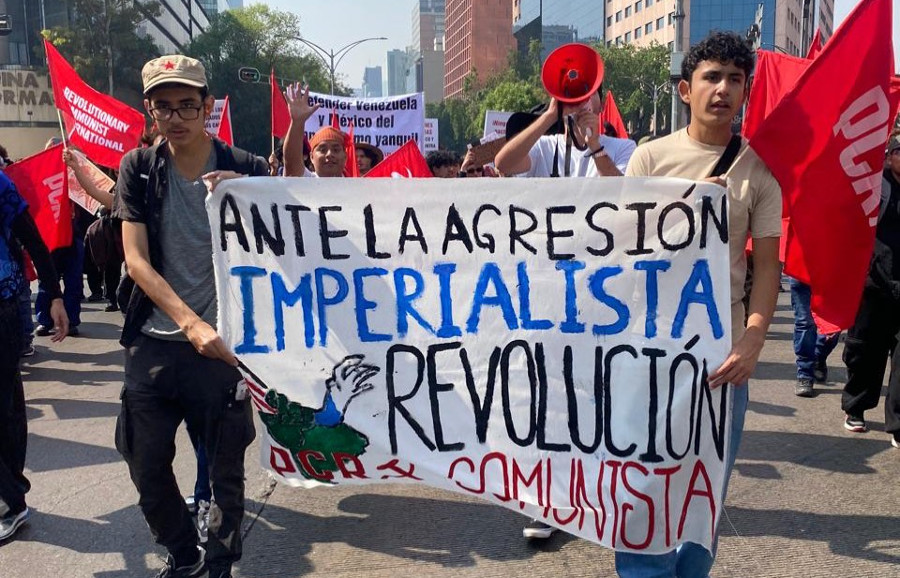
Mexico, if you're so close to Trump: then let him hear us shout, let's overthrow imperialism! Trump has been very clear about his intentions toward Mexico. Even after fully settling back into office upon returning to the White House, he declared the border with Mexico a national emergency due to the large number of migrants (hardworking people who have had to migrate, but whom Trump has declared persona non grata ); he labeled the cartels as terrorist groups; and he announced tariffs. His words have been: “Mexico isn’t going to like this, but they need us more than we need them.” Given Mexico's extreme economic dependence on the US economy, the Mexican state has had to yield to the demands of the imperialist power to change its anti-drug policy, carry out immigration work on the northern border, and even implement tariffs on China. In February 2025, 10,000 members of the Mexican armed forces were deployed to the border to stem the flow of migrants. Additionally, 55 drug traffickers were extradited to the United States during the first eight months of the year. Needless to say, even the country's water has been demanded: Trump invoked the 1944 Water Treaty, in which Mexico is obligated to deliver more than one billion cubic meters of water to the United States, and Mexico has already begun releasing water from the San Juan River. Despite all these concessions, and despite Claudia Sheinbaum's repeated statements that there will be no military intervention because she is "collaborating well" with Trump, the US president's statements increasingly affirm the opposite. The idea that the government is acting with a "cool head" prevails among a significant portion of the population, who believe it is negotiating well with the American giant. But how much can we really talk about collaboration and negotiation when we're telling the story of David and Goliath? While the president's stance against armed intervention is correct, good negotiations with Trump are not enough. The fundamental issue is not simply calming the US president's nerves, but understanding the objective conditions that justify his presidency: the relative decline of the world's leading capitalist power, which is doing everything in its power to return to its former glory. This explains the resurgence of the Monroe Doctrine, which is being used against Latin American countries, and the deployment of the US imperialist machinery. Understanding this, neither Sheinbaum nor her cabinet will be able to fundamentally overthrow the imperialist hydra, no matter how many negotiations they continue, if they are not based on action that involves the role of the masses in the field of revolutionary struggle. Drug trafficking in Mexico We can affirm that the growth of organized crime is linked to a process of attacks against the living conditions of the working class by the national bourgeoisie and the State: Between 1976 and 2018, wages lost 80% of their purchasing power; we have seen attacks on the health and education sectors, the privatization of pensions, and an increase in informal employment; in addition, there is violence, constant insecurity, the drug problem, forced disappearances, and the fear of not returning home. In short, social precarity, a product of the system, has been the breeding ground that allows for the proliferation of criminal groups. This is the reality faced by the proletariat and peasantry, and Trump has shown his hand on this issue by claiming that drug cartels control the country and that, therefore, it has become a national security problem for the United States. In this way, the drug issue is being used as leverage to pressure the Mexican government. But it would be wishful thinking to suggest that a US military intervention will actually solve these problems; history demonstrates the misery that imperialist adventures bring to oppressed countries. And yet, this is precisely what the Mexican right and far right are promoting: political parties like the PAN and the PRI have recently positioned themselves in favor of intervention in Venezuela, and some figures have openly stated that Mexico should suffer the same fate. This doesn't surprise us; they are the dregs of the dregs. The problem is that the 4T (Fourth Transformation) has also failed to prove effective in its seven years in office. Although security policy has been strengthened during Sheinbaum's term—with nearly 40,000 arrests and a 37% decrease in homicides—last year was marked by barbaric expressions of capitalist society. We have the discovery of clandestine graves at Rancho Izaguirre in Jalisco, which operated as an extermination and recruitment camp for organized crime. In Guadalajara, near the Akron Stadium, which will serve as one of the venues for the 2026 World Cup, graves containing nearly 500 bodies have been found. These are stark testimonies to the crisis of disappearances that Mexico is experiencing. While the 4T (Fourth Transformation) initially sought to eradicate corruption and the infiltration of criminal elements from the highest levels of the state, the degeneration of Morena (the ruling party) due to the influx of opportunistic individuals has rendered this crusade impossible. Late last year, it was revealed that the leader of the La Barredora criminal group in Tabasco, part of the Jalisco New Generation Cartel, was the state's police chief, appointed by Adán Augusto López during his administration—now the head of Morena's senators. Another case that has emerged from the shadows is that of "huachicol fiscal" (tax evasion), an illegal business and perhaps the biggest corruption case uncovered so far during the 4T. This involves the massive evasion of taxes to import low-cost fuel, implicating high-ranking officials and members of the armed forces, such as the army and navy, given their positions in charge of the country's customs offices. After years of questioning, impunity, and stalled cases involving Gertz, his negotiated departure from the Attorney General's Office reflects a shift in Sheinbaum's security policy. Ernestina Godoy, an ally of the president, has been appointed to replace him. Godoy's arrival may inspire confidence in some, but time will tell if simply having another person in charge is enough to truly address the structural problems of organized crime and corruption in the state, or if a revolutionary program is needed to completely eradicate the misery of the current system. We believe in the latter. This is not to deny the hopes the working class has for the current government, but we adhere to the fundamental premise that truth is always revolutionary. And truth isn't always pleasant, especially when those hopes rest on a government that will be limited in its ability to solve the country's fundamental problems and face imperialist interference. During the morning press conference on Tuesday, January 6, Sheinbaum indicated—or resignedly acknowledged—that the U.S. government, by classifying fentanyl as a weapon of mass destruction and the cartels as terrorist groups, has sufficient grounds to intervene with carte blanche in Mexico. The reality is that she is increasingly cornered. We need to be clear about the issue of combating drug trafficking and the role of imperialism. Trump's solution through military intervention will not solve the problem of organized crime. Firstly, because at no point has there been any mention of halting arms sales to the cartels; it is the Americans themselves who end up supplying weapons to the "terrorist groups" they claim to want to attack. The US government has absolutely no plans to end drug trafficking in its country. There is no policy to isolate and attack these groups, seize money, etc. It has no policy to improve living standards so that drug addiction is no longer so widespread. None of this is part of its plan; it is simply imperialist intervention disguised as a war on drugs. As long as the privileges of big capital (whether Mexican, American, or Chinese) remain unaddressed, it is impossible to stop the ills of capitalism: organized crime, corruption, and disproportionate violence. A revolutionary program must advocate for the expropriation of the major economic and financial levers and place them under the democratic and participatory control of the working class. Only in this way will living standards be permanently raised, and only then will a radical step be taken toward eradicating the root causes of organized crime. The economies of Mexico and the United States Mexico's economic dependence on the United States is staggering. Just look at the 2024 data: 83.1% of total Mexican exports of manufactured or semi-finished goods (in addition to some agricultural products and crude oil) went directly to its northern neighbor. Some media outlets celebrate that, despite the imposed tariffs, Mexican exports to the US increased by 7% in the first 10 months of 2025. They portray Mexico's continued status as the US's main trading partner as a triumph, but this only highlights the terrible dependence the country suffers. The primary concern of the U.S. government is the expansion of China's economic influence worldwide, especially in our hemisphere. In this context, it's worth understanding the motive behind the Mexico Plan as a way of offering itself as an ally in the battle against China. The Plan comprises 18 initiatives, the vast majority of which are linked to offering incentives (US$30 billion and investment incentives) to the national bourgeoisie to replace Chinese imports. It also promotes Development Hubs for Well-being, which aim to address the demands of the US renegotiation of the USMCA; in other words, the industrialization of the country to serve foreign investment. In summary, the Mexico Plan involves further strengthening relations with the US, turning the other cheek to Chinese capital, and more benefits for the national bourgeoisie (which has clearly not been an ally of the proletariat; just look at its attitude towards the 40-hour workweek, even with the smallest but necessary demands like the Chair Law!). We have no doubt that this will be difficult for many to hear, but the reality is that Sheinbaum is betting on a policy that continues to give in to the demands of US imperialism and is increasingly allying itself explicitly with the national big bourgeoisie, which will undoubtedly put her in a very uncomfortable position when the working class mobilizes in search of improvements to their living conditions and US imperialism decides to be even more aggressive. In particular, the Mexican government is positioning itself for the 2026 USMCA renegotiation by implementing strategies that satisfy US demands. Congress has approved a tariff package targeting countries with which it does not have trade agreements, including China, in the textile, automotive, and steel sectors. Ebrard has stated that the tariffs are intended to protect jobs and domestic industry, but in reality, their objective is twofold: 1) to provide temporary relief from the economic pressures of US tariffs on steel, aluminum, and automobiles; and 2) to solidify Mexico's subservience in upcoming USMCA negotiations. We don't believe the United States is preparing an imminent withdrawal from the USMCA, but rather a redefinition of the treaty that favors its crusade for economic power in the region. The fact that the USMCA, unlike the previous NAFTA, operates through periodic reviews reflects this: More than achieving "collaboration between neighboring countries" (although you can be sure that's how it will be portrayed, even after they've taken everything from us), it's about the US continuing to protect its domestic industry, its national security policy, and curtailing China's influence in Mexico and Canada. The reality is that the current administration has failed to break this dependency; on the contrary, it has deepened it. Every time there is talk of “negotiations,” it is really the Mexican state constantly yielding to the policies dictated by Washington. To do? The United States is reasserting its control over the Western Hemisphere through the implementation of its National Security Plan, which is a tacit return to the Monroe Doctrine, where the giant feels free to intervene in national affairs. This is the most visible face of imperialism, the highest stage of capitalism, as Lenin characterized it: the moment when capitalism enters its monopoly phase, where a few imperialist powers must do everything possible to maintain their dominance: military attacks, the division of territories, and the plundering of resources. Therefore, an anti-imperialist struggle must be an anti-capitalist struggle. Trotsky, architect of the Bolshevik revolution alongside Lenin, and later exiled and persecuted by the bureaucratic reaction, arrived in Mexico and studied the problem of imperialism in Latin America. Regarding this, he stated: “Washington, in the service of Wall Street, will play an increasingly reactionary role in the Latin American countries. Thus, the US remains the predominant and aggressive master of Latin America, ready to protect its power with arms in hand against any serious assault from its imperialist rivals or against any attempt by the peoples of Latin America to free themselves from its exploitative domination” ( Roosevelt's Policy in Latin America, 1938). The contradictions of the system are becoming increasingly evident, and people are beginning to mobilize and question everything. Faced with concrete questions, we cannot offer abstract answers: The 4T, despite its claims of "cool-headedness" and boasts of successful negotiations with Trump, has yielded to demands and sought an alliance with the national bourgeoisie. This is its main mistake, one that history will sooner or later make clear: its failure to advocate for a struggle against capitalism or for mass mobilization. And the Mexican right wing is even worse—lackeys of US imperialism, the only good thing they've done is spit upwards. The problem with the struggle against imperialism lies in the fact that the bourgeoisie currently governs the country. And the bourgeoisie cannot launch a serious struggle against imperialist domination for fear of the working class and a mass movement that would threaten its very existence. For our part, we are clear: It is the proletariat, with its revolutionary element, that must take the course of its own destiny. We advocate a revolutionary program that entails: To call for the mass mobilization of workers and youth based on a class program. A plan to mobilize and arm the workers in defense of national sovereignty against any imperialist attack. Formation of workers' committees in all companies to be ready and act in case of imperialist aggression and the total independence of the democratic trade union movement from bourgeois and imperialist interference. For the formation of a national anti-imperialist committee that can take action against any aggression, with representatives of workers, students, peasants and indigenous people. It is said of Mexico that we are so far from God and so close to the United States. We would like to inject a class dimension into this statement, and understand that it is not merely a matter between nations. In the United States, too, an exploited and united working class resists the imperialist interventionism of its president. In that sense, we say to the Mexican, Latin American, and even American proletariat: If we are so close to Trump, then let them hear us shout: Let's overthrow imperialism! Hands off Latin America! Let's fight for communism! https://marxismo.mx/mexico-si-tan-cerca-de-trump-entonces-que-nos-escuche-gritar-derroquemos-el-imperialismo/? Back |
|
||||||
|
|||||||