 |
|  |

|
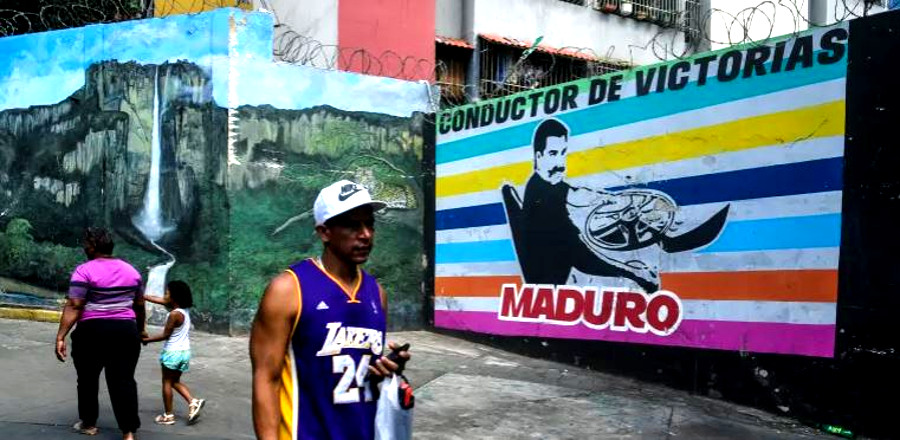
Life on the Ground in Venezuela After Maduro’s Abduction According to the New York Times, Trump plans to keep Maduro’s vice president, Delcy Rodríguez, in office, rather than installing María Corina Machado, the far-right leader of the opposition. How are Rodríguez and Machado viewed in Caracas? Yes, everything seems to indicate that the Trump administration would prefer a “transition,” in quotation marks, with Maduro’s vice president Delcy Rodríguez taking the helm. She is next in line to the presidency of the republic. And most analysts agree that Trump would prefer to work with her, since she is from Maduro’s camp and thus has more control over the various structures of the state, especially the armed forces. Trump pointed out that Machado has little support — in reality, he means that she does not have much influence in the state apparatus. She has some support among voters, as shown with her candidate in the last elections, Edmundo González. But voter support is one thing, and dealing with the command structures of the military is another. Since Machado has been calling for imperialist intervention and for revenge against all sectors of chavismo that has been governing, this far-right politician is in a difficult position. That’s why Trump is spurning Machado: she would be an accelerator of political chaos more than a leader of a stable transition, as she represents the most extreme right-wing sector. The Right says that Maduro was a brutal dictator and a narco-terrorist. Sectors of the Left say he was a socialist who supported workers and the poor. How do revolutionary socialists analyze his government? From our point of view, Maduro was obviously not a socialist. His government became repressive, authoritarian, and quasi-dictatorial. In recent times, it has been imposing economic plans that are in line with the interests of business sectors — even in line with the interests of foreign multinationals. If you don’t count his rhetoric, then Maduro is nothing like a socialist or a friend to the workers and the poor. Of course the Right says Maduro was a brutal dictator — but they say that with their own agenda. If the Right came to power, they would also form a repressive government defending capitalist interests. No, this government has kept the Venezuelan working class in a state of total submission, with dollarized wages — the minimum wage does not even reach US$0.20 per month. The term “narco-terrorist” is nothing more than a justification for U.S. intervention. Venezuela is not an important corridor for drug trafficking — and especially not for fentanyl, which doesn’t move through the Caribbean as much as through the Pacific. How could a truly free Venezuela be built, with the country’s natural resources benefiting all its inhabitants? The only path towards a truly independent Venezuela is to form a government of workers and poor people. Even under Chávez, chavismo was an attempt to build a kind of socialism in an alliance with capitalists — so nothing came of it. Under Maduro, it degenerated into a very repressive system. The Right has no ideas besides even worse colonialism. Thus the only social force capable of liberating Venezuela is the working class and the poor, who can kick out imperialism and put all natural resources to work for the benefit of the vast majority. https://www.filmsforaction.org/articles/life-on-the-ground-in-venezuela-after-maduros-abduction-interview-with-a-venezuelan-socialist/? Back Nathaniel Flakin: Nathaniel is a freelance journalist and historian from Berlin. He is on the editorial board of Left Voice and our German sister site Klasse Gegen Klasse. Nathaniel, also known by the nickname Wladek, has written a biography of Martin Monath, a Trotskyist resistance fighter in France during World War II, which has appeared in German, in English, and in French, and in Spanish. He has also written an anticapitalist guide book called Revolutionary Berlin. He is on the autism spectrum. Milton D'León: Editor of La Izquierda Diario (Venezuela) and member of the Editorial Board of the journal Estrategia Internacional. An internationalist and author of numerous articles and essays on politics, economics, social struggles, and culture in Latin America and the Caribbean, as well as other regions. They currently reside in Venezuela. |
|
||||||
|
|||||||