 |
|  |

|
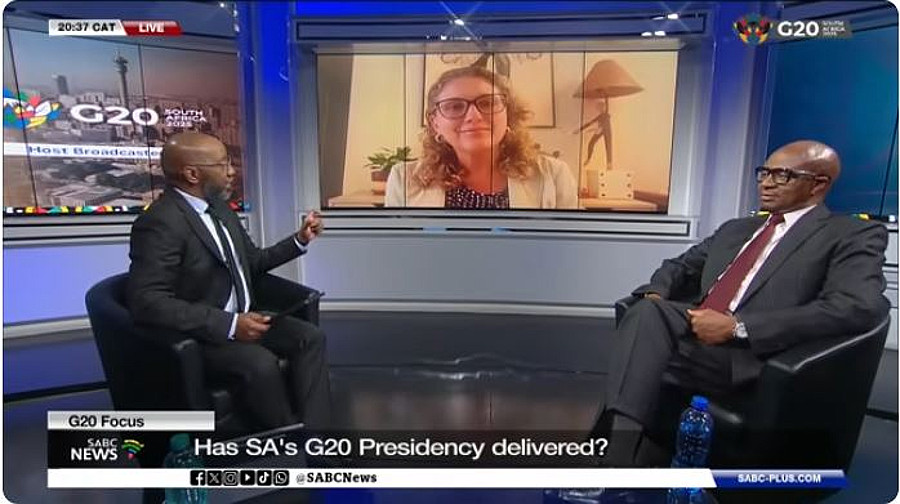
Has SA’s G20 Presidency Delivered for Africa and the Global South? SABC: Prof., so you heard there’s a lot to unpack as far as the climate resilience, disaster resilience and recovery conversation, and the content of the declaration. To what extent does it build on what Brazil had started during its presidency and speaks to the priorities for developing nations, small island countries for example? Ana: Yes. Brazil has put a lot of emphasis on climate issues because Brazil also took the presidency of COP 30, which is taking place concomitant to the G20 in South Africa. COP 30 is right now going on in the north of Brazil, and a lot of emphasis has been made, one, to fully implement the Paris Agreement, to leverage the commitments of all countries to put more resources from north to south in climate adaptation, not only climate change mitigation. And that is one of the main issues that is also being dealt with in COP 30. Two initiatives were key for Brazil this year. One of them is mentioned in the G20 declaration in South Africa. The first one is the road map from Baku—where we had COP 29—to Belém now this year, to reach the amount of $1.3 trillion a year for climate finance in the Global South. This has been delivered by Brazil this year—this road map—and unfortunately the road map was not mentioned in the G20 declaration. But there are a lot of issues around climate finance that point in that direction. And the other issue is the fight against desertification, the fight for reforestation, and Brazil has proposed the Tropical Forest Forever Facility, which is a fund for forestry, and this was mentioned in the G20 leaders’ declaration… SABC: Just on the language itself and the critique that is entailed therein as far as the mechanisms that already exist within the G20—the Common Framework for Debt Treatments and the Debt Service Suspension Initiative—and the recommitment and almost an acknowledgment that something needs to be done to fix it. But does it go far enough in terms of the language towards addressing the unsustainable debt that is squeezing out expenditure in the fiscus of many developing nations, such that a lot of them are spending more on debt service costs than they are spending on health, education, and the like? Ana: Yeah, that’s precisely the point. I think that first we have to say that the G20 is the main multilateral forum today to discuss the issue of debt because it includes the Paris Club—the traditional creditors—and China, which is a new creditor. So it’s the main multilateral space to deal with the debt issue as a whole and not case-by-case. The Debt Suspension Initiative was done during the COVID crisis for two years, but it did not really tackle the problem of debt. Even countries were more in debt afterwards because they had to spend so much money in trying to contain the pandemic. The Common Framework came about in that era trying to deal with the issue of debt treatment but not debt suspension, not debt reduction, and we need that. We need to really reduce debt. We need to release debt. You need to really make the fiscal space for these countries big enough for them to invest in climate and development issues. The Common Framework falls short in some aspects that the G20 needs to reform. The first one: it does not include all classes of creditors. So private bondholders, for instance, are not included there. Middle-income countries, which are also highly in debt stress—they’re not included. There’s a very flawed debt sustainability analysis that is the IMF’s, which does not include the necessity for countries to invest in climate issues. So it has to be reformed. Right now there are four countries under the Common Framework treatment—four African countries: Chad, Zambia, Ethiopia, and Ghana—and there are many, many difficulties still in dealing with these countries. So I think that the language has not gone far enough. I had hoped that South Africa could have done better because this is such a central problem for African countries. SABC: I don’t know if you want to weigh in on this before we move on and talk about critical minerals and how they featured. Ana: Yeah, I think the IMF reform has been really central to the G20. We have to remember the G20 was created in the 1990s to try to contain and manage financial crises. When it was elevated to a leaders’ group, it was precisely in the 2008 financial crisis, and the issue about the IMF not being able to preview and to monitor financial crises. The necessity of reforming the IMF governance to include and represent more emerging economies has always been there. But there are two issues that we need to look at. One is the IMF governance, which is the quota reform, which is mentioned in the declaration—the necessity of being more representative in terms of the countries there and their quotas and votes. And another issue is about the IMF lending policy. And there is one mention, one specific one, on the re-channeling or re-channeling of the SDRs—which is the Special Drawing Right, which is the IMF currency, the currency that the IMF uses to lend money to countries. And Brazil has last year already pointed in that direction of rechanneling SDRs to the IMF’s trusts—the Poverty and Resilience Trust and the Sustainability Trust. So this has been reinforced. So I think that is very positive. But there is no word and no mention around the surcharges, which is an extra charge that the IMF puts on countries which borrow more from the Fund, which is not logical because the countries borrow from the Fund because they need to. And when these countries borrow more, the IMF charges them more in a way of saying: don’t do that, don’t count so much on us. And that has caused even worse conditions for those countries; that has caused even more depression. SABC: Let me just end off this portion of the discussion with you. Part of your fascination has been to map the interlinkages between, you know, the G20 and the sub-country groupings that are also subsumed within the G20—your IBSA, your BRICS and the like. To what extent does the imprecise language that we’re talking about, some of the commitments that we are talking about sometimes being followed through and sometimes not necessarily being followed through—to what extent does it reflect the dynamics within those sub-country groupings, your IBSA, your BRICS, that also form part of G20? Ana: Yeah, the G20 is formed by the G7—the traditional main countries in the world, the main economies—now the Eastern powers: China, Russia, and BRICS countries Brazil, India, and those two, and Global South economies such as Argentina, etc. So this has been very interesting to notice. Brazil was the president of G20 last year, and right after that it took the presidency of BRICS. So there was a lot of fluidity between BRICS—sorry, between G20 and BRICS—this year. The BRICS Summit took place also in Rio de Janeiro in July, previous July, and it has really had, for the first time—I research and I do work on BRICS since its very beginning—I saw for the first time G20 language in the BRICS declarations. There was one specific declaration on the IMF reform, which we were just talking about. There’s one specific declaration on climate finance, and the language that was used was very much linked to the experience that Brazil had in the G20. And there was one specific BRICS declaration that was for the first time—that reflects the G20—on taxation, and this is very important because taxation was one of the key agendas for Brazil last year. This year South Africa has reinforced two agendas. One is the implementation—the continuous implementation—of the OECD Inclusive Framework, and particularly Pillar Two, which is the taxation on 20% of global revenues of multinational corporations. And another issue has been to strengthen and to monitor the implementation of the UN Convention on Tax Cooperation, which has been a major demand from developing countries which say that OECD does not really attend our interest, so we need to move taxation—the whole taxation discussion—to the UN. But there’s one missing point that I would like to stress here that really caused me a surprise. There was no mention about one specific proposition that Brazil had brought up last year, which is the taxation of ultra-high-net-worth individuals, which are the super-rich individuals with wealth over $1 billion. And the discussion about it in Brazil last year was: if you tax these individuals—there are only about 3,000 of them in the world—if you tax them 2% of their wealth, you can get almost $300 billion in revenues, for instance to invest in climate adaptation. So this is an important issue that was brought to BRICS, was very key in the G20 Brazil last year, but did not really resonate this year in South Africa. https://www.youtube.com/watch?v=XuMwTXA1Z6o Back |
|
||||||
|
|||||||