The worst summit in history!
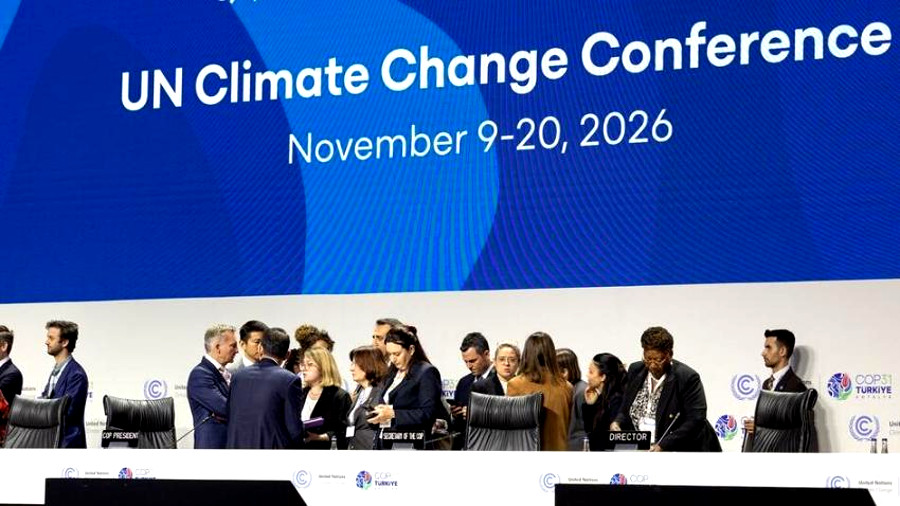
The world's leading climate conference ends in scandal, its participants were unable to agree on the text of a key document.
Meduza 22 November 2026
The world's leading climate summit, the 31st Conference of the Parties to the UN Framework Convention on Climate Change (COP31), has concluded in Turkey. The forum lasted two weeks, beginning on November 9. Delegations from nearly 200 countries participated. The event ended in failure: countries were unable to agree on the text of the Antalya Pact, the key agreement resulting from the summit that was supposed to set shared goals, according to The Guardian.
The draft document was rewritten several times in search of a compromise, but even the third version failed to satisfy some delegations. At the last minute, the European Union, the United Kingdom, and some developing countries objected to the final document. This group was primarily outraged by the absence of a mention of the goal of phasing out fossil fuels.
In turn, the inclusion of such a clause in the pact meant the risk of a veto from influential energy producers – primarily Saudi Arabia.
As Irish Environment Minister Darragh O'Brien, who voiced the EU's common position at the final meeting, noted , the proposed agreement "does not correspond to the spirit of the times":
We will not accept a decision that is not based on scientific evidence and that risks widening the gap between global commitments and necessary actions. [It] does not even mention fossil fuels, the key cause of climate change.
In addition to O'Brien, representatives of Panama, the Marshall Islands and Norway publicly spoke out against the agreement.
The Antalya Pact was supposed to be agreed upon on Friday, November 20. However, negotiations dragged on, and on Sunday afternoon, November 22, it became clear that the document drafted by the Turkish and Australian delegations co-chairing the summit would not find consensus among the forum participants.
The text, however, contained points that all countries were willing to agree to. For example, a call for governments around the world to electrify their economies and minimize the excess of global warming to the 1.5°C threshold set by the Paris Agreement , as well as a demand for financial support from wealthy countries for the poor to adapt to the consequences of the climate crisis.
However, the wording on “transition away from fossil fuels,” which was demanded by more than 130 countries, was never included in the pact.
Furthermore, the text contained controversial provisions on carbon capture and storage (CCS) technology, which activists argue perpetuates fossil fuel use. The Saudi Arabian delegation supported the inclusion of CCS in the agreement. Other countries, including a group of African states, China, and Pakistan, also did not object to this compromise.
According to the organizers, a complete collapse of COP31 was avoided thanks to individual agreements on narrow, non-controversial issues, such as the "just transition" of high-tech industries to a low-carbon economy.
But a major failure did occur. Turkish Environment Minister Murat Kurum, who chaired the summit, stated that the organizers "did everything possible," but ultimately "did not impose this text on anyone or issue an ultimatum of 'take it or leave it.'"
Australia's Climate Change Minister Chris Bowen admitted he hadn't slept for three days: "Unfortunately, we couldn't reach an agreement, and that's very disappointing."
Non-governmental organizations that also participated in the COP31 negotiations criticized the summit. For example, Mohamed Adow, director of the Power Shift Africa think tank, stated on November 20: "The chairs want to tell us it was a great conference. Well, I can say with complete confidence that it was the worst COP ever."
On November 22, Adov also criticized the EU: "The EU rejected the text, but cannot wash its hands of the destruction it itself helped create <…> For countries facing crop failures, destroyed homes, and mounting debt, [not signing the Antalya Pact] is tantamount to betrayal by the rich countries that bear the greatest responsibility for the crisis." According to the expert, "Europe's hypocrisy is astounding: its governments demand that others develop fossil fuel development strategies, while they themselves are increasing their production."
The failure of COP31 is particularly striking given that extreme weather conditions worldwide worsened in 2026, claiming tens of thousands of lives. Causes include heat waves, major disasters such as the glacier collapse in Nepal, and droughts and floods exacerbated by a severe El Niño phenomenon.
In this context, the stalled climate negotiations shocked even seasoned participants in such forums. For example, former Irish President and former UN Special Envoy for Climate Action Mary Robinson stated, "There's a lack of urgency in addressing these issues. I find that very frustrating."
https://meduza.io/feature/2026/11/22/hudshiy-sammit-v-istorii?
Back
|
|

|
Thanks for visting the G20 From Below Website. If you want something published here or other enquiries mailto:Brics-from-below@protonmail.com
Please Visit the BRICs from below website. The BRICs from below website was established in 2016 to news and analysis on worker and community protests in the BRICS countries and against the activities of BRICS based multinationals especially in Africa. The G20From Below website was set up in to 2025 to extened this work to the G20 countries.

Introducing BRICS from above, BRICS from the middle and BRICS from below
BRICS FROM ABOVE
Heads of state, Business Forum, elite allies
*BRICS as anti-imperialist (ANC & Pretoria rhetoric – “Talk Left, Walk Right”, e.g. national-liberation tradition, foreign ministry on global geopolitics, finance minister on IMF reform, sports minister on FIFA)
*BRICS as sub-imperialist (Pretoria relegitimising world capitalism, lubricating neoliberalism in - and exploiting - Africa, intensifying class war against SA’s poor/workers/women/nature on behalf of global/local capital, ensuring maximum greenhouse gas emissions alongside BASIC/US no matter local/continental/global consequences, and playing “deputy sheriff” role to imperialism)
*BRICS as inter-imperialist (Pretoria's potential support for a new internet delinked from US, promotion of Putin v Obama in September 2013 at G20, and mainly backing Russia in Crimea/Ukraine conflict - as well as earlier episodes where SA lined up with China in UN e.g. in relation to Burma)
BRICS FROM THE MIDDLE
Academic Forum, trade unions, NGOs
BRICS advocates (most of Academic Forum, Johannesburg & Pretoria “think tanks” and others who suffer persistent “failure of analytical nerve”)
*wait-and-see (most NGOs and trade unions - as well as “Third Worldist” intellectuals - who wish for BRICS to become “anti-impi” at UN, Bretton Woods Institutions, Development Bank, Contingent Reserve Arrangement, etc)
*critics (those associated with brics-from-below network who consider BRICS to be “sub-impis” and sometimes also “inter-impis”)
BRICS FROM BELOW
Grassroots activists whose visions run local to global
*localist (stuck within local or sectoral silos, including myriad “popcorn protests” - even some against BRICS corporations or projects - that are insurgent, unstrategic, momentary, at constant risk of becoming xenophobic, and prone to populist demagoguery)
*nationally-bound (most activists who are vaguely aware of - and hostile to - BRICS yet so overwhelmed by local, national and sectoral battles, they fail to link across borders - even BRICS hinterlands)
*solidaristic-internationalist (“global justice movement” allies aspiring for joint campaigning against common BRICS enemies such as Vale, China Development Bank, DBSA, Transnet/mega-shipping, fossil fuel corporations and other polluters, coming BRICS Development Bank)
JEALOUS PRO-WEST CAPITALISTS
Most white organic intellectuals of capital connected to Old Money, multinational-corporate branch plants, Business Day, northern-centric big biz, Democratic Alliance and their ilk.
|