 |
|  |


|
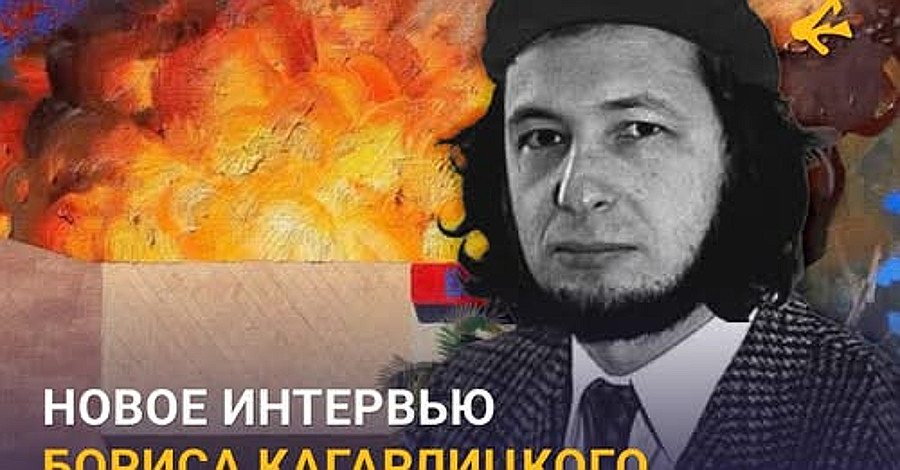
Interview with Boris Kagarlitsky Formally, the censorship requirements are quite modest and clear. It's forbidden to discuss escape plans, disclose personal information about employees, or send threats to people still at large. Naturally, censors interpret their responsibilities differently in different places. I've been told that in other institutions, even completely innocuous things were deleted from letters. But we don't have that. And in Zelenograd, the censor was an intelligent woman who came to me to discuss philosophical and historical issues raised in the correspondence. In an interview with the Russian channel Rabkor last year, you said that prisoners are often offered reduced sentences in exchange for participating in a "special military operation." How widespread was the response to such offers? Did a significant number of prisoners actually end up at the front in this manner? We publish statistics on the colony every month. As a sociologist, I find this extremely interesting. And when I was brought here in May 2024, 35-40 people a month were leaving for the SVO. They say it reached 200 in 2023. Last year, 8-12 people a month were leaving. And this year, the record is four people a month. Usually, one or two, and there are months when not a single person leaves. In recent years, two views of Russia have emerged in international leftist circles. Some consider Russia "the main authoritarian threat of our time" and even subscribe to the liberal narrative that Russia is behind Donald Trump. In the Global South, by contrast, the prevailing view is that Russia is a victim of NATO, and that the conflict in Ukraine was provoked by Western imperialism. You disagree with either interpretation. How would you explain your own understanding of what is happening? In fact, the debate over the nature of the war largely echoes the debates that took place in 1914-1918. Back then, as is well known, some on the left supported their imperialism. We remember well the role of German Social Democracy in those events. Georgi Plekhanov, on the contrary, supported tsarism. Others, like the leader of the Russian Mensheviks, Yuri Martov, essentially said, "A plague on both your houses!" But Lenin posed the question fundamentally differently. The point is not to decide which imperialism is more to blame for unleashing the war, but to decide how to exploit the current situation in the interests of the revolution. Clearly, the defeat of tsarism opened up opportunities for revolutionary change in Russia. And for this, Lenin was called a "defeatist." But he never supported the Kaiser's Germany, despite the slanderous attempts to accuse him of this. I find Lenin's position extremely relevant. Several years ago, you wrote a book, "Peripheral Empire." In it, you argue that although Russia has repeatedly followed an imperial logic throughout its history, this expansion was also conditioned by its economic weakness. In relation to Western Europe, Russia itself was a "victim" of imperialist policy, yet it pursued a colonial policy in Asia. Is this how you would summarize your position? You understood everything correctly. It's crucial to note here not only that, having lost first the Crimean War in the 19th century, then the Russo-Japanese War of 1904–1905, and finally the First World War, Russia each entered a period of sociopolitical transformation, but also that these wars themselves were by no means the result of the rulers' ill will. They reflected, on the one hand, the systemic contradictions of global capitalism, and on the other, the internal, also systemic, crisis of the regime that existed in Russia. This is entirely relevant to today's conflict. We are playing out the same scenario again and again, although our era, of course, has its own specific features. Could you offer us a contemporary analysis of imperialism? We understand that it's crucial for you not to abandon the materialistic foundation of the very concept of imperialism. What does this mean for today's Russia? In my book, "From Empires to Imperialism," I attempted to clarify the differences between these phenomena and concepts. Imperialism presupposes a specific capital structure and a corresponding accumulation regime, in which the state is closely tied to leading monopolistic corporations. This, in turn, determines the ruling circles' understanding of the national interest. But expansion, conquest, and domination have not always been tools for capital accumulation or the capture of markets for their corporations. Politics is determined by a kind of vector of interests of dominant groups. In this regard, Russia is a very interesting phenomenon. Its raw materials corporations are wealthy, but structurally, technologically, and organizationally weak. The state attempts to behave like a normal imperialist power, albeit more like a 19th-century one than a 20th-century one, occupying territories and defending its spheres of influence. But it lacks the resources to do so. The concept of failed imperialism can be applied to this situation. How are Russia's armed conflicts in Georgia and Ukraine related to the country's economic crises? In your work, you emphasize that the nature of Russia's dependent development has remained virtually unchanged, particularly its continued reliance on raw materials exports. To what extent is Russian geopolitics linked to this economic vulnerability? Russia's vulnerability isn't political, but economic. The ruling elite is parasitically consuming the resources left over from the USSR. Incidentally, the same thing happened in Ukraine. After the war began, some attempts were made at modernization and even reindustrialization, primarily, of course, in the defense sector, but not only. However, they stumbled not so much over the often-touted technological backwardness, but over the structure of interests of the ruling elite. It's impossible to modernize the country without removing these parasitic groups from power. But they themselves are the power. What remains relevant today in Lenin's concept of imperialism as "monopoly capitalism," where capital is concentrated, extends beyond national borders, and thus comes into conflict with other national powers? After all, the contemporary transnational interdependence of capital has very different characteristics than traditional monopoly capitalism. Transnational interdependence existed before World War I, although not on such a scale. Wallerstein convincingly demonstrated that capitalism first emerges as a world-economy, and only then do national capitalisms emerge on this foundation. And the current war has demonstrated both the inevitability of conflict and the scale of interdependence. Why has it lasted so long? Russian state ideologists in 2022–2023 loved to talk about the weakness of the West. Now the situation has changed, and Western Europe, at least from a Russian perspective, no longer appears weak. However, the West does not appear united. Why? It is perfectly clear that in 2022–2024, Western elites saw no need to fight their Russian neighbors. Despite all the rhetoric about the Putin regime, they were quite comfortable with it. It was a kind of policy of reasoning: you made a mistake by attacking Ukraine, we're not going to punish you severely for it, but we have to apply a little pressure to make you realize the absurdity of the situation. In Russia, this was interpreted as weakness. At the end of 2025, the EU and Britain moved from reasoning to more stringent measures, even taking into account that a possible regime change in Russia would be fraught with socioeconomic consequences that the ruling circles of Europe absolutely do not need. Meanwhile, the Trump administration in the US continues its policy of reasoning, partly because it sees its problem as Europe and China, while Russia can be used against them. But that won't work. Such respected Marxist authors as Costas Lapavitsas and William E. Robinson point out that today capital is being pooled internationally through foundations and the shadow banking system. In this sense, Russian, Arab, and even Chinese capital is present in American foundations. Why, then, do conflicts between states continue to intensify? William Robinson and I had many discussions about this. Of course, much has changed with regard to transnational capital. But transnational corporations lack the institutions that would allow them to control territories and populations. They lack their own armies, police, or courts. Nor do they control the development of fundamental science, without which their applied technological developments and so-called "innovations" would be impossible. Libertarians love to reproach the left for using the iPhone, created by Apple. But they forget that, according to economists, at least a third of the technologies used in it were created thanks to state-funded research (see, for example, Jonathan Haskell and Stian Westlake's book "Capitalism Without Capital: The Rise of the Immaterial Economy"). Without the state, there are no stable markets, nor indeed capitalism at all. And the slogan about the “impotence of the state,” popular in the 1990s and 2000s, largely concealed a deliberate state policy aimed at taking away the social gains of workers. Interestingly, Yanis Varoufakis's book "Technofeudalism" depicts the formation of large corporate communities tied to specific states and regions—the United States, China, and Western Europe (which, in his view, is much weaker). I just don't like the book's title. There's no "feudalism" in it. Technoimperialism would be more accurate. However, there is also a social dimension to the problem. Contrary to expectations, no unified transnational bourgeoisie has emerged. But national bourgeois institutions have weakened, lost their tight connections, and the interests of the ruling classes are less consolidated at the national level. Since the 1990s, and perhaps even earlier, a kind of declassification of the bourgeoisie has begun. André Günther Frank wrote about the lumpen bourgeoisie in relation to Latin America back in the 1960s. Now this phenomenon has become widespread. Russia is an extreme example, as our entire ruling class is lumpenized. How does Russian society perceive the West? Do people believe the narrative of a Western threat? Russian society, like any other, is heterogeneous. Opinions range widely, from idealizing the West to demonizing it. However, I haven't encountered anyone who considers the West a pressing threat. Rather, the widespread notion in nationalist circles is that the West holds unacceptable values and therefore should ideally be destroyed. Or, at the very least, we should strive to inflict maximum damage on it. A rational understanding of imperialism, however, is characteristic of leftist circles. However, the intellectual influence of the left has, of course, grown noticeably. How does Russian society view China? From the outside, it might seem like there's an alliance between Russia and China, but for many Russians, China is probably as distant and unfamiliar as it is for us Germans. Fear of Chinese expansion is widespread in Russian society. Sometimes it's rational (China is buying up resources for next to nothing, Chinese companies are encouraging barbaric deforestation, etc.), sometimes it's irrational. When I was working in Irkutsk, I encountered a lot of people who believed the Chinese were planning to take all the water from Lake Baikal and drink it. War readiness is growing worldwide, and authoritarian political projects are gaining ground. How do you explain this trend? The neoliberal model of capitalism has exhausted itself; this was already clear during the Great Recession of 2008-2010. But the ruling circles essentially refused to allow even a course correction. As a result, liberal-centrist policies inevitably went bankrupt, and with them, "moderate" social democracy. The problem, however, lies not in this, but in the weakness of the left-wing alternative (which those same liberals and right-wing social democrats actually managed to politically eliminate by the beginning of the 21st century). The resulting ideological and political vacuum is being filled by right-wing populists. In the absence of real, meaningful alternatives, the institutions of parliamentary democracy prove useless amid the crisis. And it's understandable why the average person is becoming disillusioned with democracy. Paradoxically, the situation is better in Russia: our average person has become disillusioned with authoritarianism. How do you perceive the confrontation between people from Ukraine and Russia? Is this a repetition of the tragedy of 1914, when the working classes allowed themselves to be carried away by nationalist hysteria, or do such historical parallels actually make it difficult to understand what's happening? The parallels between 1914 and our time are well-founded. But in Russia in 2022-23, there was no enthusiasm for war (as there was in Germany, France, or the Russian Empire after the outbreak of the First World War). Rather, there was bewilderment and fatalistic resignation to the state. "They said we must fight, so we will fight." But nothing more. A third of the population was initially opposed—hence the large number of political prisoners unaffiliated with any party or organization. Things are somewhat different in Ukraine. It's worth recalling the First World War. When the Germans were 70 kilometers from Paris, it was quite difficult to conduct anti-war propaganda; the imperialist nature of the war only became clear in France in retrospect. I believe something similar is happening with Ukrainian society. In the US, socialist ideas are gaining strength. In Europe, the centrist political order is in crisis. Do you have hope for political change in Russia? I follow the successes of the American left with admiration. While the Democratic Socialists of America (DSA) was long a semi-marginal organization, and leftist intellectuals from New York and Berkeley complained of a lack of public understanding, the DCA is now winning the primaries and has elected its own mayor in the Big Apple. I don't know how Mamdani's future career will unfold, but right now he's simply magnificent. Against this backdrop, the European left is faring much less well. Nevertheless, there's no fatal inevitability of a far-right victory. The main battle lies ahead. And in fact, the left is becoming the primary force defending democracy. However, far more serious (and radical) socioeconomic programs are needed. The left has abandoned public ownership, replacing the fight for structural reform with the protection of minority rights. Alas, this policy doesn't benefit even minorities and immigrants, who suffer en masse not only from discrimination but also from the economic crisis. How serious are the prospects for the left in Russia? We'll be able to judge that quite soon, when the failure of the current political course leads to an open political crisis. I can't say we're ready for it. It's impossible to prepare for such things in advance. And yet, we are more prepared than any other political tendency in Russia. https://rabkor.ru/columns/interview/2026/11/17/interview-for-nd/? Back |
|
||||||
Thanks for visting the G20 From Below Website. If you want something published here or other enquiries mailto:Brics-from-below@protonmail.com
|
|||||||