 |
|  |


|
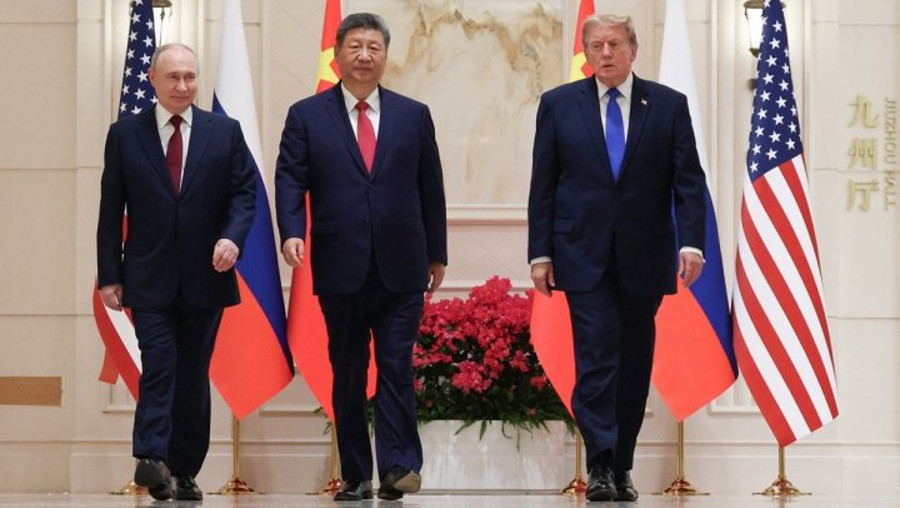
For Xi and Putin, the Trump trilateral was a win for a new world order “No problems were ever solved under the old school, refusing to talk about them,” said Trump. “Together, we are choosing a different course.” But for talks that ended with a handful of vaguely worded outcomes – and no evidence that the US president and commander-in-chief of the world’s most powerful military had tried to hold Putin to account for his illegal invasion of Ukraine – that “different course” appears to be one that plays to the objectives of Moscow and Beijing. Xi and Putin have long looked to push back against a world order they see as unfairly dominated by the US and its values. A brief exchange caught on camera in 2023 during a state visit by the Chinese leader to Moscow captures that ambition. There, as he shook Putin’s hand, Xi was heard saying: “Together, we should push forward these changes that have not happened for 100 years.” To that end, they have tightened their own partnership and built out non-Western international blocs engineered to help usher in a “multipolar” order that favors their interests. For Xi and Putin, all this is underpinned by a shared view: that the East is rising as the West declines – and the age of American superpower comes to an end. And what better illustration of that shift than sitting around a table in China’s futuristic tech hub of Shenzhen with a US president hailing them both as friends? A new world order Headlines across Chinese state media the day after the summit were in no doubt about its significance. The state’s lead news agency hailed the meeting as a “new starting point” for a “new model of relationship among major powers.” That new model, explained the article, is one based on “mutual respect, peaceful coexistence, win-win cooperation, dialogue and consultation.” For China’s leadership, those are buzzwords key to the country’s unimpeded rise on the global stage, essentially insurance that the US won’t look to meddle in what Beijing sees as its business – especially when it comes to its territorial claims on the self-ruling and democratic island of Taiwan. And during the summit, with Trump to his left and Putin to his right, Xi pressed that point, using that time, according to Chinese media, to spell out China’s conditions for the three to get along. At the top of that list? “Respect one another’s sovereignty and territorial integrity” – and stay out of one another’s internal affairs. For Putin, the meeting was yet another assurance that Trump is taking his concerns into consideration as the US president looks to end Moscow’s war in Ukraine. Speaking about Trump after the meeting, Putin said, “we have shared certain commonalities in our approaches regarding so-called civilizational values.” That too, is a buzzword embraced by Putin and Xi, whose vision for a new world order is not one of countries holding each other accountable to universal standards governing rights and political freedoms, but one where countries – and autocrats – are able to set their own rules for their people. The two leaders will of course be well aware of changing political tides in the US – and the potential that a new Congress in January and a new American president in 2029 could bring immense change to American foreign policy. Xi and Putin – both shrewd operators who have dominated their countries’ politics for years – will too have calculated they are unlikely to again see another American president as amenable to their interests as Trump. But that’s what is likely to give this moment even more momentum, as both sides play up the win – and continue their push to reshape global power. https://edition.cnn.com/2026/11/20/china/trump-meeting-china-russia-power-rebalance-intl-hnk? Back |
|
||||||
Thanks for visting the G20 From Below Website. If you want something published here or other enquiries mailto:Brics-from-below@protonmail.com
|
|||||||