 |
|  |


|
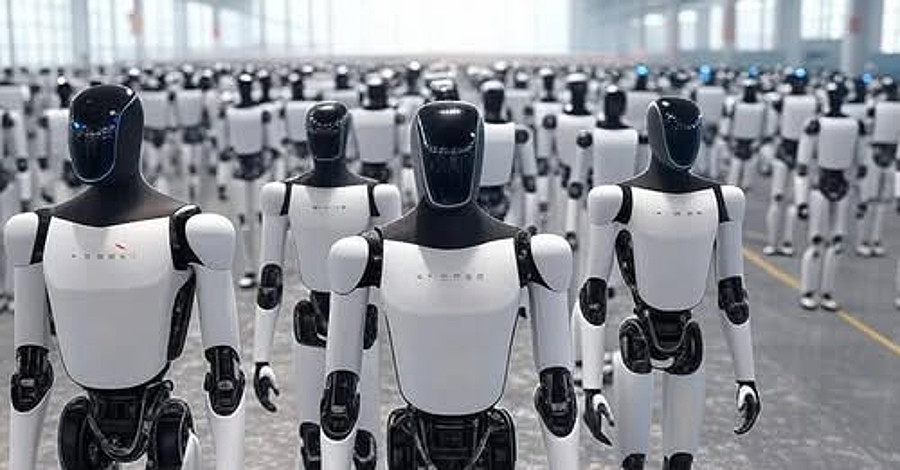
Humanoid robots: Is the future here, or just a facade? Even if robots achieve the so-called GPT moment breakthrough, enabling them to understand human commands and work autonomously, robots that "look like humans" are still machines, and their application will still be subject to the economic laws of capitalism. Creating a robot with a 99% grasping rate, capable of operating 24/7 and communicating in over 80 languages would undoubtedly be a tremendous technological achievement. However, under China's capitalist economy, profit-driven motives and the dire circumstances of the working class drastically limit the application of humanoid robots. As Marx stated in *Capital*, "For capital, machines will only be used if there is a difference between the value of the machine and the value of the labor power it replaces"—therefore, most stores would not choose to purchase such a robot; shop assistants are clearly cheaper than robots, and "for capitalists, machines actually make production more expensive." The CCP's economic miracle = the ultimate bursting bubble What truly fueled the humanoid robot craze was less confidence in the industry's long-term future and more the shared demand from financial markets, businesses, and governments to hype the concept. This stemmed from the Chinese Communist Party's inclusion of humanoid robots in its "15th Five-Year Plan," which gave local governments the green light to expand the industry. Local governments encouraged robot startups by providing subsidies, free land, and other incentives. Similar to the previous electric vehicle, battery, and solar energy industries, this trend triggered a "gold rush," spawning over 150 humanoid robot companies in a very short time—more than the total number of electric vehicle companies in China (129). Most of these companies will never be profitable, only generating more debt, price wars, and deflation (falling prices). This is the CCP-led capitalist model of the "new era," repeatedly playing out in industry after industry (real estate, steel, solar energy, electric vehicles, batteries). In this era of prolonged crisis, CCP capitalism can only lead to more involution throughout the economy, offering no prospects or economic security for the working class. Following its IPO on August 19th, Unitree Robotics' stock experienced unprecedented fervor, with an irrational financial frenzy even pushing its market capitalization to 444.9 billion yuan. However, this figure, far removed from fundamentals, does not represent the true valuation or future of the embodied intelligence industry. Rather than reflecting the capital market's optimism about the future development of embodied intelligence, it was more accurately described as a fast-paced financial speculation. A few top financial institutions and brokers profited, leaving retail investors who bought at the peak to bear the consequences of subsequent sharp declines—Unitree's market capitalization has fallen by as much as 50%, symbolizing the current state of China's entire technology industry—since July, the STAR50 stock index has fallen by 40%, wiping out 3.2 trillion yuan in market value. In October, the government panicked due to the potential for a vicious cycle in stock price declines, which could severely impact economic and social stability. The "national team," composed of government-led funds and state-owned enterprises, once again bought heavily into stocks to establish a "support floor" below the falling prices—reportedly spending 170 billion yuan in October. China has achieved a significant leading advantage in the field of industrial robots, with 2 million industrial robots installed in its factories, exceeding the total number in all other regions of the world. These are powerful non-humanoid machines, such as robotic arms, responsible for specific and repetitive tasks such as welding car bodies or electronic circuit boards. Therefore, the government's massive investment in humanoid robots is less about injecting momentum into a sunrise industry and more about colluding with robot companies to implement an extremely unsustainable development model—companies and local governments cooperate to establish data collection centers for training humanoid robots using government subsidies, and then engage in a "nepotistic" internal cycle of "government agencies, especially universities, buying robots for testing, and robot companies then buying back the data." As one industry insider put it, under this model, "local governments achieve success in attracting investment, robot manufacturers achieve shipments, and data collection centers generate profits by selling data." This win-win-win situation has only one flaw—it is a left-hand-to-right-hand internal circulation model, with the only source of profit being government subsidies and the only output being the fictitious revenue generated by the industry's idling. At this stage, there are almost no real customers. This model has become the standard for developing smart technology industries across various regions. According to statistics, as of the end of April this year, at least 90 data collection centers across the country were in use or under planning construction. We socialists are not "anti-technology." We believe that, under the democratic control of the working class, in a system that prioritizes the needs of the people rather than profits, and with a deeper understanding of technology and its potential dangers, certain artificial intelligence technologies can bring enormous benefits to humanity. The development of these technologies will be aimed at improving human well-being, not at profiting or winning wars. However, this is not the reality under contemporary capitalism, whether in so-called "democratic" capitalism or authoritarian capitalism. As a hyped-up craze, humanoid robots not only failed to initiate an industrial revolution or resolve the crisis of capitalism, but also quickly proved their inability to enter reality and replace humans as imagined in science fiction. They even sank into the mire after the hype subsided. The enthusiasm of a crisis-ridden capitalist China for an industry that boasts only the title of "globally leading in technological innovation" but is deeply mired in crisis and unable to drive genuine social change is akin to Trotsky's assessment of Labustin's rise to prominence before the Tsar: "This abandoned and dying dynasty has found a Christ made in its own image." https://chinaworker.info/2026/11/14/49714/ Back |
|
||||||
Thanks for visting the G20 From Below Website. If you want something published here or other enquiries mailto:Brics-from-below@protonmail.com
|
|||||||