 |
|  |


|
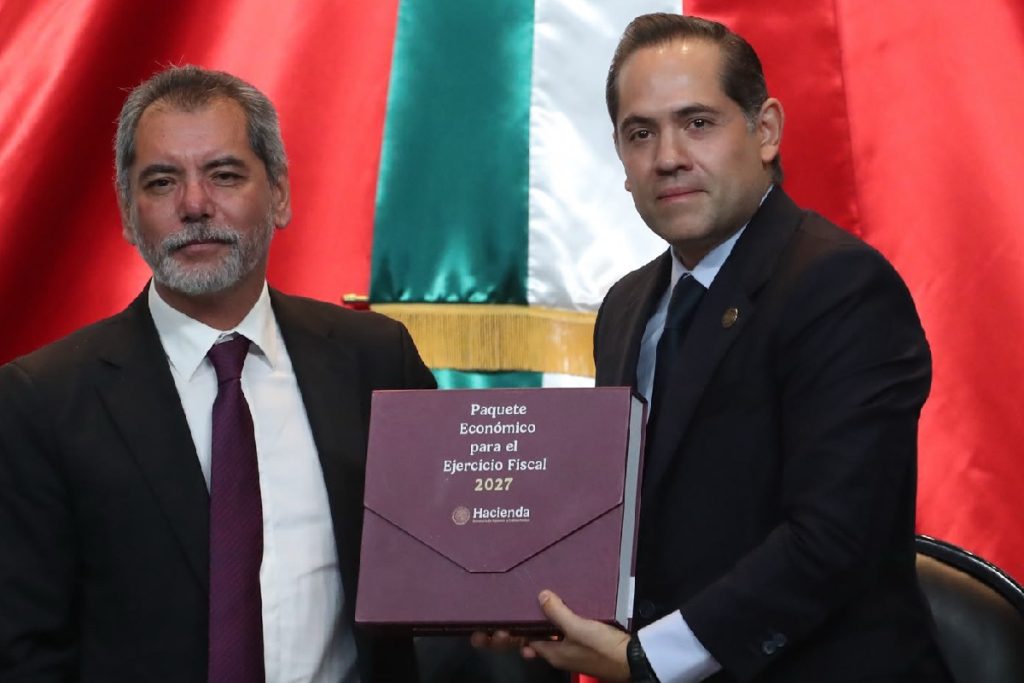
Mexico: Who does the 2027 budget serve? The oligarchy The dynamic sector of the economy is controlled by no more than 50 private companies; financial conglomerates that include banking, pension funds, industry, finance, communications, and transportation—these are dynamic, first-world enclaves that control 37% of the national GDP, 60% more than the government budget. Ownership of these conglomerates is shared among investment firms like BlackRock and individuals such as Carlos Slim Helú and family, Germán Larrea Mota Velasco and family, Ricardo Salinas Pliego and family, Alejandro Baillères Gual and family, María Asunción Aramburuzabala and family, Juan Domingo Beckmann Legorreta and family, Carlos Hank Rhon and family, and Antonio del Valle Ruiz . This explains why, despite overall growth of 2% and 7% growth in the export sector, wages are simply keeping pace with inflation. There's a lot of talk about minimum wage increases, but their impact on the economy isn't significant, unlike the government's wage policy, which has limited increases to between 3.5% and 4%—with the acquiescence of the union bureaucracies, of course! According to the Treasury document, private consumption in Mexico grew by 0.1% in one year, which is to say, nothing, which is logical given the dual dynamics of the Mexican economy. Global capitalism and the debt crisis Capitalism in general, with the exception of Southeast Asia, has entered a phase of stagnation, characterized by a severe public debt crisis. This denotes the technical bankruptcy of the capitalist countries we used to call advanced. Their way out, as always, is to cut social rights, take on even more debt, and excessively increase military spending, which, unless a global war breaks out, will ultimately lead to a deepening of the crisis. The time will come when debt interest payments will simply absorb the entire budget, rendering the system inoperative. Obviously, this will not be a linear process; the masses will rebel, and we will witness all kinds of revolutions and counter-revolutions. A prolonged boom like the one in the post-war era is out of the question; we will see deep crises and increasingly meager recoveries in which capitalism will threaten the lives of the working masses and the planet itself. Hence the importance of a revolutionary alternative, given that, as is well known, the bourgeoisie prefers to watch the world burn rather than accept its historical failure. In the process, some apparent lifelines emerge, such as artificial intelligence, which is currently receiving enormous influxes of speculative capital. In the long run, its widespread implementation will lead to increased productivity, and some will become wealthy, but only temporarily. Its medium-term effect will be a reduction in the rate of profit as constant capital increases relative to variable capital; the human labor employed in production falls, and so do profits. This, within the context of a global market that tends to contract, is a recipe for new crises of overproduction. For the moment, speculators are making a killing, and this is creating a bubble that, like others (computers, real estate market, cryptocurrencies, etc.), will burst with catastrophic effects. Mexico: growth at a snail's pace In the short term, we can expect the Mexican economy, as an economic complement to the United States, to maintain its moderate growth behavior throughout this year, remaining at the mercy of the agreements that China and the United States may or may not reach in their ongoing trade war. In previous years, indicators such as the exchange rate reflected the fragility of the Mexican economy in the face of fluctuations in the U.S. economy. The situation is different now. While the dollar is projected to be worth $18.43 in 2026, it is very likely that the United States will seek to maintain a weak dollar to avoid further exacerbating its $200 billion trade deficit with Mexico. A more important indicator of economic stagnation is tax revenue, which represents 67% of income and is currently 2% lower than at the same time last year. If the economy is growing but budget revenues are not , it is clear that some people are simply not paying taxes. Inflation is projected to be around 3.5%, again converging with that of the United States, which is estimated at 3.7% for this year. Interest rates will be set at 6.5%, which implies relatively expensive credit, but is consistent with the government's policy of maintaining a difference of at least 2 percentage points with respect to US benchmark rates, thus ensuring an exchange rate that does not exceed 18.5 pesos per dollar. As we have said, these convergence policies only demonstrate that Mexico's monetary policy is defined by the US Federal Reserve. Revenue and investment structure The budget's economic objective is to maintain a balanced budget, and last year tax revenue grew by 0.9%, in line with the projected growth. Despite stagnant revenue, a larger deficit was avoided thanks to a 3.4% reduction in public sector salaries. A 14% drop in oil revenues is expected, which is outrageous and will be offset by a 6.6% increase in taxes; of course, the wealthy and the conglomerates that control the economy are untouchable. To give an idea of the government's economic weight, public sector companies represent revenues of around 2.1 trillion pesos; this is only 5% of GDP, while private sector companies account for approximately 85% of GDP. Looking at investment figures, public sector investment represents 3% of GDP, while private sector investment represents approximately 18%, meaning the economic structure inherited from the Salinas era remains largely unchanged. The State, aside from its ability to collect taxes, has no economic leverage to steer the economy in any particular direction. This leaves the country vulnerable to a potential private sector investment strike. Gross fixed capital formation has fallen by 3% this year. Gross fixed capital formation is key to determining whether production will increase in the next period, and the bourgeois elite are saying they have no intention of doing so. Faced with this, the State has neither the means nor the will to counteract it. Social spending The budget proclaims that the main lever of well-being is social spending, which is divided into subsidies and investments; the former represent one trillion pesos, the latter a little over 560,000, although half of them correspond to Pemex. As we have pointed out, these amounts are not necessarily wrong. For example, 545 billion pesos will be allocated for senior citizens, which in many cases represents vital support. However, providing care for this population requires a significant investment in medical infrastructure, but this funding is simply not included in the investment priorities. For example, scholarships for young people total nearly 400 billion pesos, but there is nothing for schools, sports facilities, hospitals, etc. The "Our School" program, which could support school infrastructure, has a budget of 20 billion pesos, 5 billion less than in 2025. The country's schools are falling apart, and spending on maintenance simply isn't increasing . We could continue with other categories, but as they are designed, these subsidies will end up in the hands of Walmart, Home Depot, and Dr. Simi. The budget is emphatic in stepping aside from productive activity; spending for investment is reduced by 12.5%, in fact, with regard to energy spending viewed as a whole, the reduction is 69%. There are sectors that are “strategic” for the State. The Navy, for example, has a 19% increase, the highest in the entire budget, citizen security 4%, and the Army 5.4%, so it is clear what the budget spending priorities are. In the area of health, no significant budget increases are being offered, much less for the construction of new units or investment in hospital infrastructure, but an increase in coverage, care, and quality is proposed. Therefore, the call is to intensify working hours, to do more with less. Only the mobilization of IMSS (Mexican Social Security Institute) workers has prevented the meager 2.9% direct salary increase that had been allocated; up to the time of this writing, they had been offered a 4% direct increase and another 4% in benefits. In general terms, a real increase of 4.8% is proposed for the entire health system, which is not enough, although this shows that only mobilization can prevent the systematic deterioration of working conditions to which the austerity policy condemns workers. The same is true for education; there are demands to expand coverage and improve services without hardly any investment. While there is a noticeable response to teachers' mobilizations, such as those in basic education led by the CNTE or those by the National Polytechnic Institute community, education is slated for a 7.1% increase in real terms. This has led to a 6.6% increase in the real budget. Even so, the days when 8% of GDP was allocated to education as a goal are long gone. This budget represents only 3.4% of GDP . At the time of writing, students at the UAM (Autonomous Metropolitan University) have launched a collective struggle for better study conditions. They received a 3.5% increase in real terms, but material deficiencies such as libraries and laboratories are growing daily. Their struggle is just and deserves to succeed; the same should happen at the UNAM (National Autonomous University of Mexico), where the increase is even more meager, at 1%. Eternal debt Regarding debt, in general, it is one of the areas where money is directly transferred to creditor banks. Currently, it represents approximately 55% of GDP, of which 85% is domestic and 15% is external debt. By 2026, interest payments are projected to amount to approximately 1.6 trillion pesos, or 4% of GDP. It 's worth noting that Mexico's total public investment is only 3.1% of GDP. This clearly demonstrates that more is spent on interest payments than on investment for the country's development. A budget for the rich Economic policy expresses its priorities in the budget, and through these priorities, we can objectively analyze whom a given government serves. Specifically, for the year 2027, we can again conclude that its objective is to continue promoting the development of the external sector due to the stagnation of the domestic market, at the expense of postponing the urgent needs of the working population. A budget like the one being implemented, which is a copy of the one approved for 2026, explains the reasons why public sector workers, especially those in education and health, are taking to the streets, and also explains the reasons for the youth struggles of recent months. It also clearly reflects the subservience to the interests of the United States and large national and foreign banks. Of course, a budget that benefits the working masses is possible, but this can only be achieved by impacting the major interests of imperialism and the national bourgeoisie, in order to redirect all available resources to productive investment and to meet the needs of health, education, housing, work, and security for workers and their families. marxismo.mx/a-quien-sirve-el-presupuesto-2027/ Back |
|
||||||
Thanks for visting the G20 From Below Website. If you want something published here or other enquiries mailto:Brics-from-below@protonmail.com
|
|||||||