 |
|  |


|
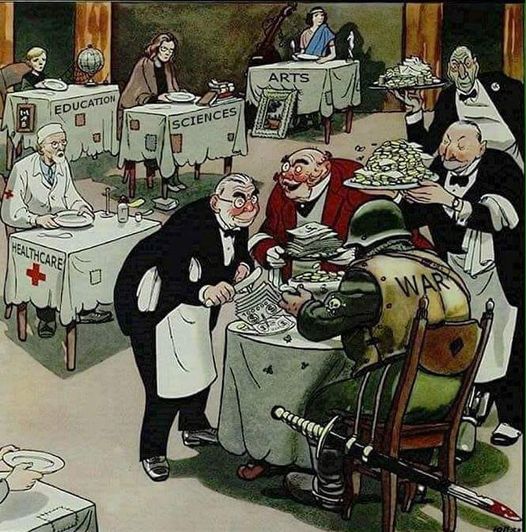
Armaments and repression How affected employees, works councils, and unions are experiencing this "reverse conversion" from cars to troop carriers was discussed in the foundation's discussion group . The conversion to arms production is primarily accepted when it is expected to preserve "good jobs," meaning collective bargaining agreements, co-determination, and job or location guarantees. Against the backdrop of tens of thousands of job losses in the automotive industry, workers threatened with job loss are pinning their last hope on the company's conversion to arms production. Trade unions are often involved in the aforementioned protests against militarization, but many workers in the factories are very hesitant, seeing arms production as an option for continued employment in highly uncertain times. In Berlin, for example, a press release from IG Metall, responding to the protest movement against a Rheinmetall plant in Wedding, states : "They [the employees] must not become pawns in political disputes"—failing to recognize that they are being instrumentalized precisely for this purpose by Rheinmetall with the argument of job security and by Pistorius with the argument of military capability. The reticence of leading trade unionists can be explained by shared positions and by the occasional revolving door effect. Oliver Burkhard, for example, after five years as district manager of IG Metall in North Rhine-Westphalia, first became head of human resources at ThyssenKrupp, and is now CEO of ThyssenKrupp Marine Systems (TKMS) in Kiel. Consequently, IG Metall is now demanding the construction of frigates and corvettes at TKMS in Kiel. What is delicate is that the arms industry, which discreetly cozys up to the AfD , is precisely the industry association with which IG Metall is vying for more contracts from the federal government. This raises the question: Can trade unions represent the interests of workers without opposing militarization? The immense costs of militarization are sorely missed in education, healthcare, pensions, and public transportation. Every euro is spent only once. But the nature of work is also changing in the workplace. Employees are subjected to a rigid security regime, works councils and unions face severe restrictions, and essential individual and collective rights are curtailed. Security checks take eight to twelve months A recent example – the planned conversion of the VW plant in Osnabrück to arms production – shows what awaits the employees in the affected companies: Volkswagen's overall works council chairwoman, Daniela Cavallo, confirmed in an interview with the NOZ (September 7, 2026) that individual security checks are conducted for each employee. Active, left-leaning, and outspoken trade unionists are just as unlikely to pass these checks as colleagues with family backgrounds in Russia, North Africa, or West Asia. Volkswagen Osnabrück workers are currently receiving a letter from their employer containing a questionnaire to prepare for security checks. The Neue Osnabrücker Zeitung (October 27, 2026) reports on this. "The VW Group is requesting private information from all 1,800 employees of Volkswagen Osnabrück GmbH in its questionnaire. This alone is a remarkable procedure, as it is usually none of an employer's business who an employee lives with or whether they occasionally travel abroad. VW is also asking about the employee's and their partner's origin and nationality, any criminal records, and their financial background. Who is susceptible to dubious offers? These are factors that security experts believe could make employees vulnerable to overtures from foreign intelligence services. If someone needs money, is susceptible to blackmail, has criminal experience, or is suspected of sympathizing with hostile forces, they could pose a threat to the security of the company or the Federal Republic of Germany. ... 1,400 of the current approximately 1,800 employees are to be taken on. "We will have a lot of explaining to do," says works council chairman Jürgen Placke." This voluntary, internal VW inquiry is just a taste of what will follow in the coming months: the actual security vetting, for which the Federal Ministry for Economic Affairs and Energy in Berlin is responsible. […] Applicants will be asked to list any personal websites and all their accounts on Facebook, TikTok, Instagram, LinkedIn, or other platforms. The comprehensive security check by the Federal Ministry for Economic Affairs and Energy could take eight to twelve months, estimates works council chairman Placke. So it will be months before it's clear who is allowed and willing to transfer to the new defense company. Only then will the employees find out which products they will be manufacturing. Is this still considered "good work"? The basis for this excessive control of private life is the Security Clearance Act (SÜG) of 1994. According to this law, every person who is to be entrusted with a security-sensitive activity must undergo a security clearance. This also includes spouses, registered partners, or, even more broadly, cohabiting partners. The co-determination rights of the works council in personnel matters, as stipulated by the Works Constitution Act, are effectively nullified in all relevant security sectors. Even if this approach succeeds in saving a (usually small) number of jobs in companies threatened with closure, the question remains whether this still constitutes "good work" in the union sense. The subsequent use of the manufactured goods hasn't even been considered. What if the weapons produced are used by Turkey to fight against the Kurdish population, fall into the hands of the military in Myanmar, or are used in the Israeli occupation of the West Bank and the destruction of homes and fields? If one takes everything together – the dismantling of social welfare, the reduction of co-determination, the authoritarian transformation of the state, and the strengthening of nationalist, divisive, and anti-emancipatory forces – then trade unions have every reason, in their own interest, to actively and loudly oppose the arms buildup and the militarization of society. https://www.rosalux.de/news/id/55411/aufruestung-und-repression? Back Stephan Krull coordinates the discussion group “ Future Car Environment Mobility ” (ZAUM) and is a board member of the Rosa Luxemburg Foundation. |
|
||||||
Thanks for visting the G20 From Below Website. If you want something published here or other enquiries mailto:Brics-from-below@protonmail.com
|
|||||||