 |
|  |


|
Local government and the cost-recovery trap *The operating costs of providing the services, such as technical staff and system repairs; and *An allowance for the maintenance of assets (over and above ad hoc repairs that may be required). National Treasury recommends that municipalities allocate 8% of asset value to maintenance expenditure each year, but national audit reports suggest that, in aggregate, less than half that amount is actually spent. A downward spiral of neglect Failure to allocate sufficient funding to infrastructure maintenance creates a downward spiral: Technical losses (such as water from leaking pipes) increase, so the municipality ends up paying for bulk services that it doesn’t earn any revenue from. In the City of Johannesburg, technical losses of water, due almost entirely to poorly maintained infrastructure, cost the municipality some 400 million litres per day. That means that nearly one litre in every four is physically lost before it reaches users. Increased costs (due to technical losses) mean that the municipality has even less money to spend on maintenance. Infrastructure deteriorates, and technical losses increase further. Within a few years, a municipality will end up in a situation where it has no reasonable prospect of ever funding a constantly increasing maintenance backlog. 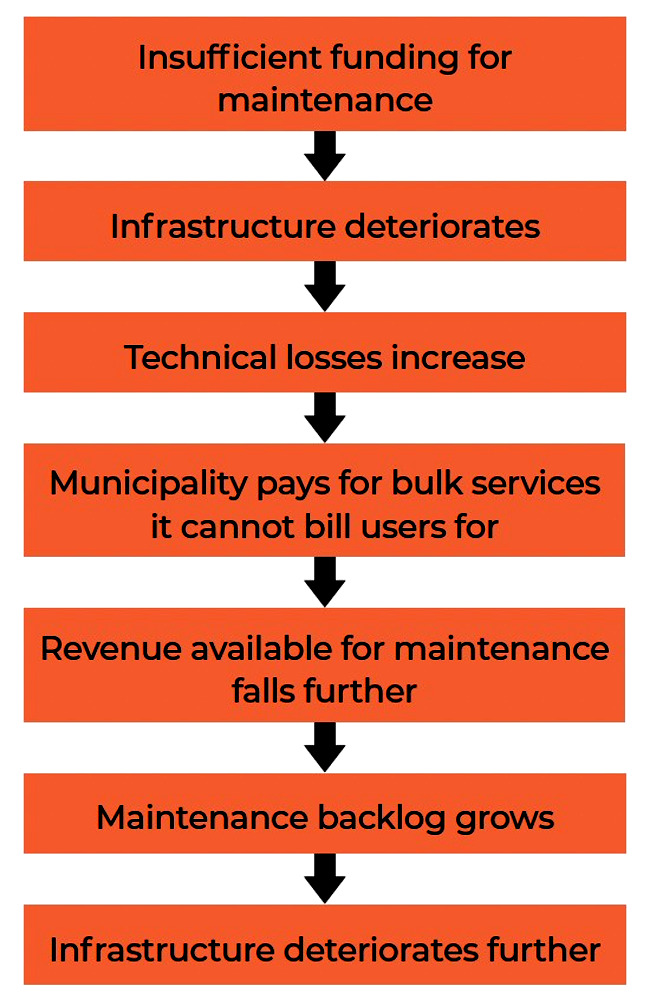 This is the situation that the majority of municipalities now find themselves in. It should be noted that underspending on infrastructure maintenance is not a new development: local government has consistently failed to allocate sufficient budget to this line item for the past 25 years. The Auditor General has raised this issue in the annual audit of municipalities for almost as long, but no remedial action has ever been taken to enforce this requirement. There is no denying that poor management in the past has contributed to the current situation—specifically, not allocating sufficient funding to maintenance when revenue was available. But by now the amount of the municipal infrastructure maintenance backlog means that the solution is no longer simply increasing maintenance budgets by a few percentage points. There simply isn’t enough money in the system to fund what is required. So the most likely outcome of a financial model that expects municipalities to finance this critical operating expenditure item out of their own revenue is that infrastructure will continue to deteriorate, technical losses will increase, and the delivery of basic services in many municipalities will continue to decline. Poor households carry the cost It is the poorest households that will carry the burden of this failure. Wealthier households will have the option to provide their own services (through alternatives such as power generation systems and boreholes), but poorer households will not. In addition, many low-income households are critically dependent on municipal services to operate micro-enterprises, such as food preparation, spaza shops and hairdressing. Many of these economic activities are undertaken by women who have few alternative livelihood strategies. Days and weeks without electricity or water services cripple these micro-enterprises. And intermittent water supplies greatly limit households’ ability to grow additional food. Through these impacts, infrastructure failures exacerbate both poverty and inequality. Basic services are unaffordable There is a second way in which the municipal financial model is contributing to poverty and inequality: the general unaffordability of services for a significant proportion of South African households. The use of electricity and piped water is critical to delivering a minimum standard of living, and universal access to these services is a priority development goal of the South African state. Delivering that universal access is (or should be) the single most important role of local government – its main contribution to the ideal of a developmental state. 40% of households live below the lower bound poverty line — roughly equivalent to one person in the household earning the monthly minimum wage. Research by the Public Affairs Research Institute (PARI) has demonstrated that these households cannot afford to spend anything on water and electricity at current average rates, without compromising household food security. Household food insecurity is already a serious problem in South Africa: some 28% of children under five are stunted due to poor nutrition. Diabetes is now the leading cause of death in Black women, a disease caused almost entirely by poor diet. The main reason for poor nutrition is the cost of a nutritionally sufficient basket of food, compared with available household income. Research has also shown that the main household expenditure item sacrificed to pay for municipal services (particularly electricity) is food. This outcome is the result of a combination of (i) the cost-reflective tariff model that has been implemented across local government and (ii) the failures of the free basic services policies. Cost-reflective tariff setting has resulted in tariffs that many households simply cannot afford to pay. The consistent failure to implement the free basic services policy as required has left millions of households with few choices, none of them good: starve themselves, do without the basic services necessary for the minimum standard of living, or steal those services. The original 1998 White Paper on Local Government assumed that the twin goals of affordable services and tariffs high enough to cover all the costs of providing those services were mutually compatible. Almost 30 years of above-inflation increases in the costs of providing water and electricity, coupled with an increase in the number of households living in poverty, have definitively proven that this assumption was incorrect. Finding a way out of the trap The recently-released revision of the White Paper has done little to present a workable solution for this impasse: while acknowledging that there is a “crisis of affordability”, no credible policy solutions have been proposed. The possibility of increasing national budget allocations to local government (including the free basic services allocations) is dismissed as fiscally impossible. A key policy recommendation is that municipalities “improve revenue collection”, which is hard to reconcile with the fact that the majority of households cannot afford to pay for services. The central—and largely invisible—problem is that the state has failed to prioritise universal access to basic services above all other policy goals, as is required by the Constitution. Instead, it is trying to balance multiple secondary goals at the same time. I would contend that the financial sustainability of municipalities is one of those secondary goals. But the current form and structure of local government is simply a means to an end; one possible way of delivering basic services. It clearly isn’t working. The policy solution isn’t to spend another 25 years trying to make it work (with limited chance of success), but rather to go back to the institutional drawing board, with one basic question: What delivery model including physical delivery, tariff setting and subsidies - will ensure that the state’s constitutional priority is achieved : that each household and business in South Africa has access to a sufficient quality of services that they can genuinely afford ? https://www.amandla.org.za/local-government-and-the-cost-recovery-trap? Back |
|
||||||
Thanks for visting the G20 From Below Website. If you want something published here or other enquiries mailto:Brics-from-below@protonmail.com
|
|||||||