 |
|  |


|
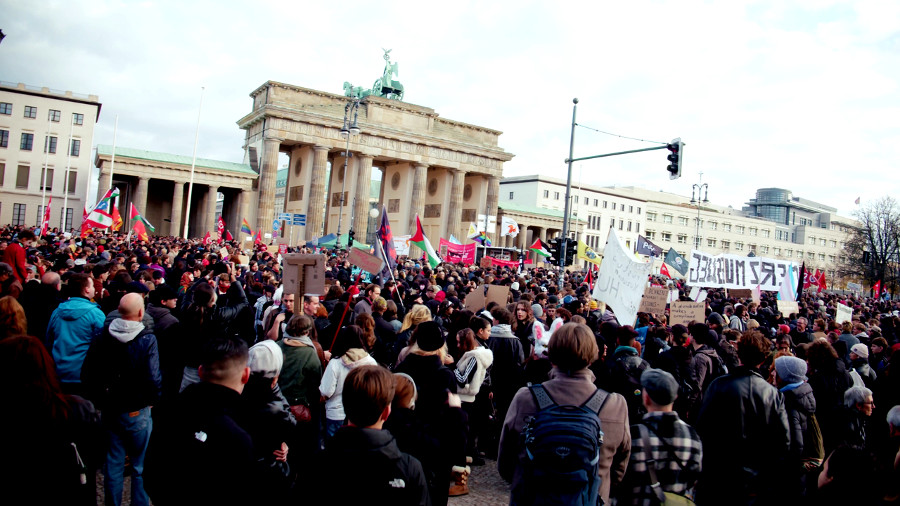
German youth join the global movement against austerity and war These statements reveal a growing recognition of the connection between deteriorating living conditions and the drive towards war. Young people are refusing to sacrifice their future for the military, banks and corporations. The demonstrations mark the entry of a new generation into political struggle and extend to Germany a movement that has already erupted in France, Italy, Spain, Greece, Portugal, Albania, Serbia and other countries. Across Europe, governments are imposing austerity, attacking democratic rights and diverting enormous resources into military spending. The same capitalist crisis threatens young people everywhere with poverty, authoritarianism and war. In Germany, this development has particular historical significance. More than eight decades after the crimes of German fascism and the Nazi war of annihilation against the Soviet Union, the German ruling class is once again pursuing massive militarization. The Merz-Klingbeil government has declared its intention to make Germany “ready for war,” expand the Bundeswehr and prepares for a direct confrontation with Russia. Germany has become the largest European military supporter of Ukraine and continues to back Israel politically and militarily amid its devastating assault on Gaza. The revival of conscription is bound up with preparing wars that would send masses of young soldiers to their deaths. While all the established parties promote military preparedness and national sacrifice, young people have begun to challenge this consensus. The absence of opposition within official politics does not reflect popular attitudes. The demonstrations are revealing the social and political tensions that have accumulated beneath the surface. The government, recognizing the danger, prepared their own response. Before the protests, politicians and media outlets spread warnings of extremism and riots. Massive police contingents, including water cannons and armored vehicles, were deployed. Although the demonstrations were overwhelmingly peaceful, police intervened aggressively in several cities. In Cologne, they halted a large march and fired water cannons. Subsequent incidents of rioting and looting, some unrelated to the demonstrations’ political objectives, have been used to discredit the movement. On Sunday, Interior Minister Alexander Dobrindt demanded harsh punishments and blamed “violent left-wing groups” and people from migrant backgrounds for the disturbances. The ruling class fears that the protests will grow into a broader struggle against war and austerity, drawing in the working class. Yet intimidation has not stopped the movement. Further demonstrations are already planned, including international protests on November 20. The decisive question is how this opposition can be developed into a conscious political movement capable of achieving its demands. The IYSSE and the Sozialistische Gleichheitspartei (SGP, Socialist Equality Party) intervened across Germany, distributing thousands of copies of their statement “Education instead of war! Mobilize the working class against austerity, conscription and the police state!” and discussing the way forward with protesters. In Stuttgart and Erfurt, IYSSE representatives addressed the demonstrations from the main platforms. Their intervention met with considerable interest. Discussions revealed young people increasingly questioning not just government policies but capitalism itself, and searching for a political alternative. Christoph Vandreier, chairman of the SGP, summarized the movement’s significance in a statement recorded in Berlin: The demonstrations are international, they are organized independently of the capitalist parties and trade unions, and they are on a collision course with capitalism. The Socialist Equality Party fights to consciously develop these questions and thereby develop the movement’s self-consciousness. He identified three interconnected tasks, stating: From simultaneous demonstrations in many countries, the movement must develop into a genuinely international movement. The problems are the same everywhere because they have the same cause: capitalism. We can only break the power of the international banks and corporations together. On the need for political independence, he explained: There is a reason why the demonstrations are organized independently of the capitalist parties and trade unions: they do not organize resistance, but suppress it. The Left Party is forming governments that impose social cuts and strengthen the state apparatus. It supported the trillion-euro rearmament program in the Bundesrat. The trade unions are not organizing resistance, but mass layoffs. Yet simply organizing independently is not enough. What is necessary is a conscious political break. The movement must orient itself towards the workers, Vandreier stressed: “The working class can confront capitalism, and young people must orient themselves towards it.” Finally, he explained: The movement must be developed into a conscious movement against capitalism. The fact that the ruling class responds to mass demonstrations with repression shows that it is not prepared to make concessions. Capitalism has nothing more to offer young people than barbarism, fascism and war. That is why the movement must turn to a socialist perspective. The SGP and the IYSSE propose to build democratically controlled rank-and-file action committees in schools, universities, workplaces and neighborhoods, independent of the capitalist parties and union bureaucracies. United internationally through the International Workers Alliance of Rank-and-File Committees (IWA-RFC), they can prepare a common struggle, including a European-wide general strike against war, dictatorship and social devastation. Ultimately, the struggle raises the question of who controls society’s wealth. Resources devoted to military expansion and enriching the financial oligarchy must instead serve social needs. This requires socialist policies, including public ownership of major banks and corporations under democratic workers’ control. The October 31 demonstrations mark an important step forward. A generation that the ruling class seeks to turn into cannon fodder for its wars is beginning to intervene independently in political life. Its opposition to militarism and social devastation expresses the emergence of powerful forces of resistance within society. The task now is to transform this growing rebellion into a conscious international socialist movement of the working class and youth. It is for this perspective that the IYSSE, the SGP and the International Committee of the Fourth International fight. https://www.wsws.org/en/articles/2026/11/02/wyxz-n02.html? Back |
|
||||||
Thanks for visting the G20 From Below Website. If you want something published here or other enquiries mailto:Brics-from-below@protonmail.com
|
|||||||