 |
|  |


|
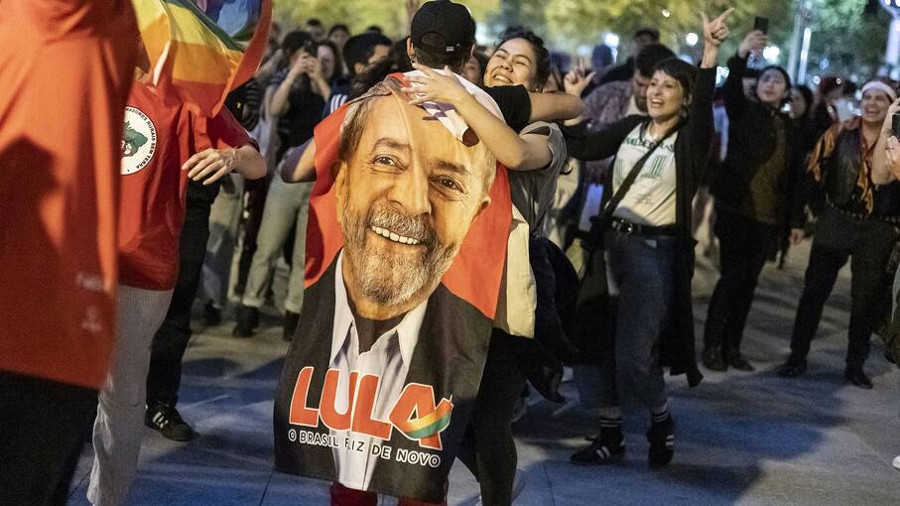
Lula wins The campaign's message was clear: Look at what Lula has just done for the poor, defend your rights and democracy. And don't be under any illusions about Bolsonaro – he stands for more injustice, for false promises, for deforestation in the Amazon, for discrimination of all kinds. Reasons for success The success of this mobilization is also demonstrated by the voter abstention figures, which fell to a historic low this Sunday. Compared to the first round of voting three weeks ago, Lula gained around four million votes. Non-voters had been the most important target group of the campaign in recent weeks. And not only in the major cities, but also in rural Bolsonaro strongholds in the south and west, where the powerful agribusiness sector holds sway, the left achieved surprising gains. Another crucial reason for the comeback was the presence on social media. With the help of influencers and targeted campaigns, Lula was repeatedly able to outmaneuver the right wing. Never before had it been possible to so clearly challenge the far-right's dominance online. Bolsonaro, with the help of right-leaning judges, attempted to have the sometimes new—and highly successful—channels banned. He failed. And when Mark Zuckerberg's meta-corporation manipulated its algorithms so that left-wing activity on Instagram and other platforms was demonstrably barely displayed anymore, only the legal threat of draconian penalties finally brought the right-wing tech world to its knees. For Brazil's democracy and its crucial social policies, the election result represents a profound sigh of relief. And more than that: all of Latin America had been watching the struggle in Brazil with bated breath, a struggle that has now managed to interrupt the rapid succession of right-wing electoral victories in Colombia, Peru, Bolivia, Chile, and Argentina. Lula's election victory is significant beyond this, as he was always the one who spoke out clearly on the international stage against the neo-imperialist policies of the US government or the brutal actions of the Israeli government in Gaza and the West Bank – in stark contrast to many of his counterparts in Europe. Furthermore, the parallels to recent US history have been eliminated: In both countries, a right-wing extremist came to power, both refused to acknowledge their election defeats after four years, and both supported violent coup attempts, in Washington as in Brasília. However, Brazil countered Trump's re-election first with the legally binding conviction of the coup leader and now with the re-election of the progressive president. Challenges of the fourth term But things won't be easy for Lula in his fourth term. Four weeks ago, right-wing candidates, and especially Bolsonaro's far-right Liberal Party (PL), were able to further expand their majorities in the Senate and Parliament. Business associations, most major media outlets, and especially the export-oriented agricultural sector are publicly supporting Bolsonaro. As in the past four years, Lula will need considerable skill and a willingness to compromise to govern effectively. This will likely soon lead to accusations – once again – that he is not consistently implementing his policies and promises – unless the mobilization of recent weeks continues and invigorates left-wing political approaches, which otherwise repeatedly get bogged down in the arduous routine of politics. A positive example was the abolition of the six-day workweek – which took place between the two elections – and enjoyed such broad public support that only a single dissenting vote was ultimately cast in the conservative Congress when the change to the working time regulations (with a five-day, forty-hour week) was enshrined in the constitution. An active and united left is also necessary to master another challenge in the next four years: Lula's succession. Undoubtedly, the PT would have lost the election without him, but it was Lula's last candidacy. Even apart from him, the PT and its allied left-wing parties must reorganize. There are already initial signs of this, such as the successful Black MPs Erika Hilton and Talíria Petrone from the Partido Socialismo e Liberdade (PSOL). But the PT's power center still has a long way to go. Flavio Bolsonaro declared on election night that he would not accept his defeat and demanded the annulment of the vote. Despite justified fears of coup-like tendencies, there are so far no indications of far-right mobilization. A chief justice appointed by Bolsonaro's father has also declared that the election was conducted correctly. Previously, another judge had postponed the closing of polling stations by two hours because numerous public buses remained out of service on Sunday – apparently to make it more difficult for poorer voters to reach the polling stations. The struggle for dominance on the right is likely to begin soon. The mere name Bolsonaro was apparently not enough to secure a majority. Nevertheless, this often ideologically driven spectrum unites a core electorate of at least 20 percent of eligible voters. Due to widespread rejection of the Bolsonaro clan, business circles in particular are focusing on less polarizing options, such as the governor of the state of São Paulo, Tarcisio de Freitas. The internal power struggle, as was the case after Lula's election victory four years ago, is likely to dampen the mobilization power of the far right for the time being. Parts of the far-right, so-called Centrão , centrist parties may soon turn back to the Lula government in order to share in the spoils of power for at least a few years. The daily grind of politics, which deters so many people, will then resume at full speed. But one thing is also certain: the conditions for democratic and social development in Brazil have improved significantly with Lula's election victory. https://www.rosalux.de/news/id/55365/lula-siegt Back |
|
||||||
Thanks for visting the G20 From Below Website. If you want something published here or other enquiries mailto:Brics-from-below@protonmail.com
|
|||||||