Trump Effect? Ramaphosa Prepares South Africa for Life After US Trade Deal
Patrick Bond and Alyson Le Grange (Firstpost) 20 October 2026
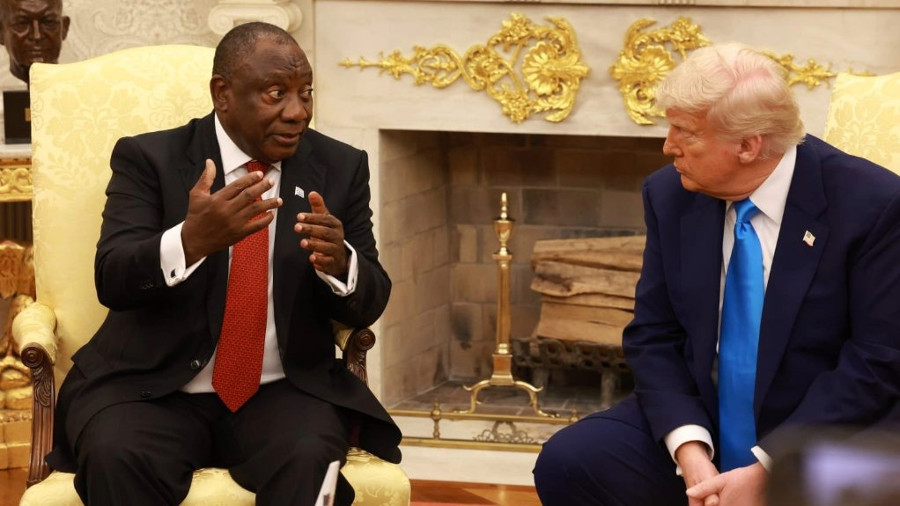
Firstpost explains how South Africa is facing a critical economic crossroads as President Cyril Ramaphosa warns the nation to prepare for potential exclusion from the African Growth and Opportunity Act (AGOA). The crucial US trade agreement provides duty-free access for key exports like automobiles and agricultural products, directly sustaining over 100,000 South African jobs. Ties between Pretoria and Washington have severely frayed due to political tensions – spurred by President Donald Trump’s allegations of Afrikaner persecution, US backlash over South Africa’s genocide case against Israel at the ICJ, and criticisms of Black empowerment policies. While Congress renewed the overall AGOA programme, final eligibility rests with President Trump. In response to rising economic threats, Ramaphosa is taking proactive steps to diversify trade towards Asian powerhouses like China and India.
Alyson Le Grange, Firstpost: Whether or not Washington officially cuts access to AGOA, Pretoria is already mapping out a future beyond it. Now, for more on this, we have with us Patrick Bond, political economist and distinguished professor at the University of Johannesburg, joining us live from Johannesburg, South Africa. Thank you for being with us again, Professor Bond.
Patrick Bond: Thanks, Alyson. Great to be with you.
Firstpost: Now, Patrick, President Cyril Ramaphosa has warned that South Africa must prepare for the possibility of losing preferential access to the American market under AGOA. Just how devastating could this be for South Africa’s economy? Particularly its automotive and agricultural, as well as manufacturing sectors.
Patrick: Well, Ramaphosa may have some good inside information coming to him from Roelf Meyer, the new South African ambassador to the US. However, don’t forget that last year we had so many false alarms.
First, a 50% tariff, and then that was pulled back to 10% after the bond markets and the stock market were very worried in April. And then we had the 30% tariff, but then the Supreme Court declared that illegal. Then we had AGOA completely turned off. And then again, it was turned on.
It’s been very chaotic, and I’m not sure if Ramaphosa is really reading it properly. For example, he might see that Donald Trump losing, on November 3 in the midterm elections, will start lashing out at anything and anybody he doesn’t like.
However, there are big lobbies, and the main ones would be the car companies, and they’re trying to make sure that AGOA stays, because that’s really where Mercedes, BMW, VW, Toyota, and to some extent even Ford here, have been quite lucrative in gaining some of the benefits. But don’t forget, we went from 26,000 cars in 2024 down to 6,000 cars exported to the US in 2025. So it’s a very volatile situation.
And maybe most interestingly, the volatility has hit Afrikaner farmers, and the vineyards in the Western Cape with both wine and grapes, they’ve been probably the single main agricultural victim of Donald Trump, even though Trump says, well, ‘we want to protect Afrikaner farmers’ from this alleged oppression and genocide. So it’s a completely chaotic world, and we’ll just have to see how, you know, moody Donald Trump is after November 3rd.
Firstpost: Right. Now, Pretoria is increasingly looking toward China and other markets as alternatives to the United States, markets such as India. Can China realistically absorb the exports that South Africa currently sends to America.
Patrick: Yeah, that’s a really important question because the exports of cars, which are, by the way, luxury cars and their diesel and petrol engines, they’re not electric vehicles. We make basically no EVs here.
And then China is just flooding the world. And their capacity is now 50 million autos a year. They’re only selling 25 million, so they have a huge excess capacity in automobiles. The same for iron and steel. In fact, Chinese steel has been dumped here, according to the government, and that means selling below the normal price that they sell in China, because they have, again, massive excess capacity.
So I think it’s probably in those areas like agriculture – citrus, and maybe the vineyards, the grapes, and the wines – that will open a market.
The other markets we’d want to see, like the rest of Africa, just haven’t grown. The African Continental Free Trade Agreement has been a terrible disappointment because the ratio of trade to GDP in intra-African trade is basically the same as it was five years ago when the free trade area began at about 15% inter-African trade. And it’s extremely low, there’s a lot of potential. But I think China’s really just undercutting, and I might add India as well. India and China together have taken about half of the domestic auto market.
So they’re not just not a very good market for selling into, but they are penetrating South Africa, and deindustrialization has followed: 55 out of 66 chrome smelters shut down just in the last year because of Chinese imports.
That’s the extremely competitive scene that we’re talking about.
Firstpost: Right. Patrick, thank you very much, as always. Great having you on the show. Thank you for being with us.
Patrick: Thank you.
https://www.youtube.com/watch?v=B0LPraSqUHA&t=284s
Back
|
|

|
Thanks for visting the G20 From Below Website. If you want something published here or other enquiries mailto:Brics-from-below@protonmail.com
Please Visit the BRICs from below website. The BRICs from below website was established in 2016 to news and analysis on worker and community protests in the BRICS countries and against the activities of BRICS based multinationals especially in Africa. The G20From Below website was set up in to 2025 to extened this work to the G20 countries.

Introducing BRICS from above, BRICS from the middle and BRICS from below
BRICS FROM ABOVE
Heads of state, Business Forum, elite allies
*BRICS as anti-imperialist (ANC & Pretoria rhetoric – “Talk Left, Walk Right”, e.g. national-liberation tradition, foreign ministry on global geopolitics, finance minister on IMF reform, sports minister on FIFA)
*BRICS as sub-imperialist (Pretoria relegitimising world capitalism, lubricating neoliberalism in - and exploiting - Africa, intensifying class war against SA’s poor/workers/women/nature on behalf of global/local capital, ensuring maximum greenhouse gas emissions alongside BASIC/US no matter local/continental/global consequences, and playing “deputy sheriff” role to imperialism)
*BRICS as inter-imperialist (Pretoria's potential support for a new internet delinked from US, promotion of Putin v Obama in September 2013 at G20, and mainly backing Russia in Crimea/Ukraine conflict - as well as earlier episodes where SA lined up with China in UN e.g. in relation to Burma)
BRICS FROM THE MIDDLE
Academic Forum, trade unions, NGOs
BRICS advocates (most of Academic Forum, Johannesburg & Pretoria “think tanks” and others who suffer persistent “failure of analytical nerve”)
*wait-and-see (most NGOs and trade unions - as well as “Third Worldist” intellectuals - who wish for BRICS to become “anti-impi” at UN, Bretton Woods Institutions, Development Bank, Contingent Reserve Arrangement, etc)
*critics (those associated with brics-from-below network who consider BRICS to be “sub-impis” and sometimes also “inter-impis”)
BRICS FROM BELOW
Grassroots activists whose visions run local to global
*localist (stuck within local or sectoral silos, including myriad “popcorn protests” - even some against BRICS corporations or projects - that are insurgent, unstrategic, momentary, at constant risk of becoming xenophobic, and prone to populist demagoguery)
*nationally-bound (most activists who are vaguely aware of - and hostile to - BRICS yet so overwhelmed by local, national and sectoral battles, they fail to link across borders - even BRICS hinterlands)
*solidaristic-internationalist (“global justice movement” allies aspiring for joint campaigning against common BRICS enemies such as Vale, China Development Bank, DBSA, Transnet/mega-shipping, fossil fuel corporations and other polluters, coming BRICS Development Bank)
JEALOUS PRO-WEST CAPITALISTS
Most white organic intellectuals of capital connected to Old Money, multinational-corporate branch plants, Business Day, northern-centric big biz, Democratic Alliance and their ilk.
|