 |
|  |


|
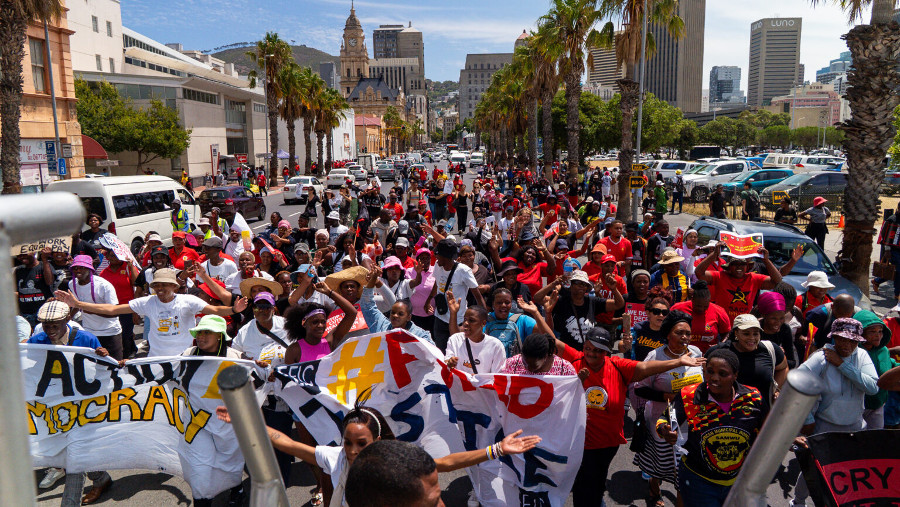
Fix the state, don’t sell it! The R370 Social Relief of Distress grant remains the only support for millions of unemployed working-age adults, but it is eroded by inflation and is worth less than half the food poverty line. Its reach has also been deliberately limited. There are 18 million people who should qualify, but fewer than 8 million get approved due to exclusions and punitive application procedures, several of which have now been found unconstitutional by the North Gauteng High Court. The fight against the national crisis of gender-based violence and femicide (GBVF) is also undermined by austerity. Of the 50 511 GBVF cases reported last year, only 30 736 led to an arrest or referral to the NPA. After inflation, spending on policing in 2025/26 is 1.2% lower than in 2016/17, spending on detective services has fallen by 5.1%, and the forensic science laboratory has been cut by a staggering 44%, even as the DNA backlog has grown from 143 000 samples in 2022 to more than 200 000 today. From policing to hospitals to food security, austerity is making the state dysfunctional and people’s lives intolerable. The National Treasury’s 2025 decision to lower the inflation target to 3%, with a narrow one percentage-point tolerance band, was always going to be paid for by working people. Today, the repo rate is now higher than before the inflation target was changed, and fuel prices have reached record levels. Inflation in South Africa is not caused by households spending too much. It is driven by administered electricity tariffs, by fuel prices pushed up by the war against Iran by the United States and Israel, and other supply-side issues. Higher interest levels raise the cost of every bond, car loan and overdraft, put pressure on small businesses that need credit to survive, and increase the cost of servicing public debt. With inflation projected at 4.4% this year, a level that would have sat comfortably inside the old 3-6% band, the SARB is now responding to external shocks it cannot control by strangling a stagnant economy. While households and small businesses struggle, banks are making record profits with little subsequent investment in the real economy. “Same aGAIN” Instead of government fulfilling its constitutional duties and fixing the state, it is selling it through the back door. The new Growth and Inclusion (GAIN) strategy is the most significant development since GEAR and the NDP, bundling together a range of reforms – from Operation Vulindlela to the Industrial Development Strategy – under one overarching framework. While GAIN itself does not represent any specific new policy, it places the Ramaphosa administration’s market-led reforms under a development plan with a specific direction and strategy. At its core, GAIN promises growth without increased public spending. It aims to do this by getting the private sector to invest in infrastructure through concessions, public-private partnerships and other forms of private sector participation; reforming network industries such as water, electricity, and freight rail to introduce competition and private service delivery; enforcing stronger “commercial” operating models for SOEs and municipalities; developing industries in new sectors where South Africa may have a competitive advantage, such as green hydrogen; and increasing business confidence by ensuring “fiscal discipline” and policy stability. The starting point of the GAIN strategy is that economic growth must come before structural transformation, and it therefore prioritises the removal of constraints to growth under the existing economic structure rather than changes to this structure itself. The assumption is that the resulting economic growth will create jobs at scale, while increasing tax revenues and creating space for greater spending on social protection, health, or education – the Presidency has described this approach as “pull-up” instead of “trickle-down”. Whether this growth will result in socio-economic or structural transformation is doubtful. Under the current economic structure, growth taking place in sectors like mining, heavy or high-tech industry, and financial services tends to be capital-intensive, generating relatively few jobs, with the benefits thereof accruing to a small minority. There is also a focus on export-oriented industries, both old and new, supported by a rapid expansion of the number and role of Special Economic Zones (SEZs). Manufacturing is an engine of growth, but it can only play this role if industries are integrated into the country’s economic structure and linkages are developed to other sectors of the economy. The production of high-value goods for foreign markets in enclave zones will not serve this role. Finally, it is also not clear how the “increased confidence” of financial markets will translate to productive investment and demand generation. These doubts are reflected by the current data. Unemployment is higher now than when Operation Vulindlela began, GDP growth is non-existent, and even business confidence is still falling. Gains in the performance of “network industries” like electricity, rail and ports have been due to improvements within SOEs and not private competition – in fact, the recent concession of Durban’s Pier Two terminal to a multinational accused of numerous labour rights violations abroad has resulted in a crisis with cargo volumes falling by 30 percent. Despite wasting no time in claiming Eskom and Transnet’s improvements as their own, the business press and Presidency-aligned think tanks have recently changed their tune to saying that it is simply too early for economic data to reflect the improvements of Operation Vulindlela and GAIN. There is very little critical engagement on whether pro-market reforms are actually working, nor on the potential for privatisation and PPPs to create platforms for corruption or mismanagement. Reforms to local government are not addressing underlying structural issues with the fiscal framework Two weeks after the MTBPS, we will be voting in local government elections. In an election season, one would expect a list of promises as an opportunistic attempt to gain votes. The leading parties are so detached and removed from the lives of ordinary South Africans that they have stopped pretending to care. Local government is often the site at which austerity and corruption are most harshly experienced. The local government system works under the assumption that municipalities can generate 90% of their budgets through their own revenue such as property rates and service charges, while only a tiny fraction is allocated from transfers from nationally raised revenue. This is proven to be a fallacy, given the high levels of poverty and unemployment in many municipalities. Cabinet has now approved the local government White Paper, but the underlying fiscal constraints remain and the White Paper does not make any meaningful and concrete recommendations to increase the allocation or coverage for free basic services. There are 11 million households who should receive free basic services, but only 2,8 million end up receiving some form of indigent support. One of the components of the White Paper on Local Government is the Metro Trading Services Reform (MTSR). It is a flagship of Operation Vulindlela Phase 2 and GAIN, and is co-financed by the World Bank through a Program-for-Results loan. The MTSR is a National Treasury programme that pays the eight metros a performance-based grant to professionalise and corporatise how they run electricity, water and wastewater, and solid waste services. It is a voluntary, metro-only incentive worth R54 billion over six years, which metros are expected to match with roughly R54 billion of their own revenue. It targets revenue from services like water and electricity that metros should be getting but are not, because of weak billing, metering and collection, and the under-investment that follows. In a way it will ring-fence revenue for services, so money can then be used to fix infrastructure. Grants from the National Treasury (derived from World Bank loans) will also be used for infrastructure costs. This is important as it will address severe undercollection in municipalities that are adding to financial distress. Infrastructure funding is also critical as most water losses stem from leaks. But there has not been a serious investigation as to whether residents in worse-off municipalities are actually able and willing to pay cost-reflective service charges. Most importantly, the MTSR will also not address the questions of whether poor households actually get free basic services, how many are covered, how they qualify, or how generous the allocation is. The Treasury and World Bank documents set targets for accountability, finances and operations, but not for free basic service coverage or indigent registration. Ultimately, it is about enforcing payment while completely ignoring unaffordable access to water, electricity, and sanitation. Even though it is an election year, fiscal constraints continue to be deployed and bar people from receiving rights and entitlements. Alternatives to Austerity and Privatisation Egregious human rights violations occur as a result of inadequate service delivery every day. Children die of hunger and in pit latrines, hospitals can’t treat patients, people are unsafe in their homes and in public, and wheelchair users cannot use toilets in informal settlements. Resources are finite, but limits are often construed politically and subjectively. Given South Africa’s extreme inequality, a lot more redistribution can and must occur. The government could begin to tap into the resources already on the public balance sheet, drawing further on the Gold and Foreign Exchange Contingency Reserve Account and putting the vast assets of the Government Employees Pension Fund to work for development rather than leaving them to chase returns. It could also make the tax system fairer. Abolishing the medical aid tax credit would end an annual subsidy of around R30 billion to the 16% of South Africans who can already afford private cover. Converting the retirement fund deduction into a credit is another way to make the tax system more fair. Dividends should be taxed at the same rates as wages, rather than at a preferential flat rate that rewards wealthy shareholders over working people. The Treasury should stop over-adjusting personal income tax brackets, indexing lower brackets to inflation and upper brackets by less, to reverse three decades of unjustified relief for high earners. Top tax brackets should rise by one percentage point, with the top threshold lowered from R1.82 million to R1.27 million. A wealth tax on the roughly 350,000 people with net wealth above R5.6 million would ask the most from those who have gained the most. Finally, the government must stop the money leaking out of the country: renegotiating tax treaties, giving SARS the funding it needs to fulfil its mandate, and backing the UN Framework Convention on International Tax Cooperation to build a fairer global tax system. When corruption, debt and failing services dominate the headlines, the case for privatisation and a shrinking state begins to sound like common sense, and the public is slowly persuaded to expect less of the state. This is not unique to South Africa. Around the world, austerity is deepening alongside a turn to the right, and the two feed each other, with anger over poor service delivery and economic conditions being easily directed towards migrants or marginalised groups by populist influencers and politicians, who point to them as the cause of scarcity or precarity. We cannot afford a hollowed-out state. We need to rebuild investment in the public sector to reverse the damage that austerity has caused. Join us outside parliament on Wednesday, 21 October at 09:00 as we demand an end to austerity and privatisation! For media enquiries, contact: Busi Mtabane Phone: 083 329 7844 Email: busi@aidc.org.za https://aidc.org.za/fix-the-state-dont-sell-it/ Back |
|
||||||
Thanks for visting the G20 From Below Website. If you want something published here or other enquiries mailto:Brics-from-below@protonmail.com
|
|||||||