 |
|  |


|
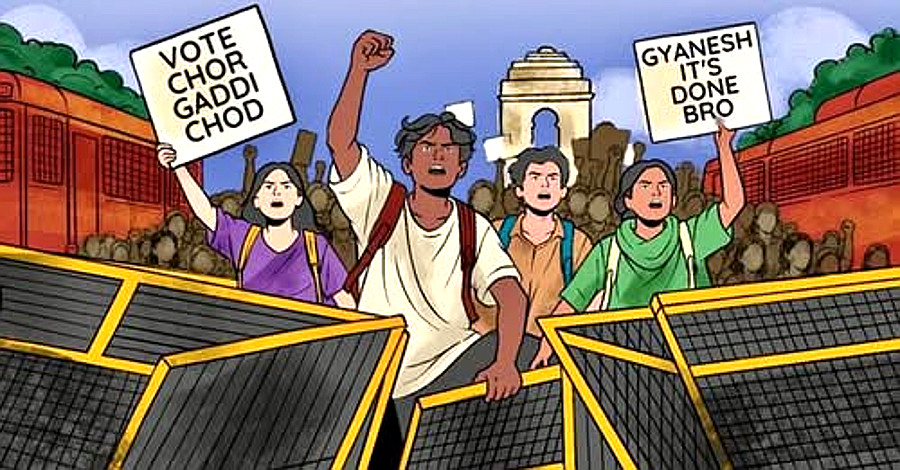
How the Modi government radicalised a generation to rise in revolt against it In the throes of the protest, Sahil said, he was beaten by the police and suffered some bruises. The police herded Sahil and protestors onto a bus, and drove them in circles for a few hours, before finally releasing them close to Delhi’s border with Haryana. “My hands were shaking throughout the bus ride even though I knew from beforehand that we were only going there to get detained,” said Sahil. From the border, Sahil took a bus and a metro and reached home around 9 pm. His parents had no idea that he had been detained or even taken part in the protest. “I had told them that I would be home late because of a cultural event at college,” he said. This was the second time in five months that Sahil stepped out to protest. In June, Sahil had joined thousands of other youth at Jantar Mantar in protests led by the Cockroach Janata Party pressure group to demand the resignation of the education minister Dharmendra Pradhan over irregularities in the national exam for medical college seats. Sahil has been participating in agitations even though he knows this family would probably disapprove of his actions. “Most of my relatives are teachers whose understanding of education has always been apolitical,” he said. “My parents believe politics exists outside of the domestic sphere. They think kids should not be involved in protests, as they will only be used by political parties for their own ends.” Despite this, Sahil said he had felt a growing sense of frustration and anger against the union government for several years. He decided to start giving vent to these emotions when he learnt about the Cockroach Janata Party’s protests in June against the leaks of the papers for the National Eligibility cum Entrance Test for medical colleges – this despite the fact that he is a student of a different discipline. “The starting point was indeed NEET,” he said. “But it’s the nature of protests that as more people join, the spectrum of issues also expands, and there are so many issues that people are angry about.” Sahil’s account of his decision to participate in the protests captures something of the present moment of tumult in the country, in which young “Gen Z” protestors have taken to the streets in huge numbers. Scroll spoke to ten young protestors in Delhi and Mumbai to understand how their worldviews were shaped and what had drawn them to the streets. Six of the ten said they had been manhandled or detained by police during the protests. Like Sahil, most said they had felt anger build up over time as a result of several crises. Apart from the NEET paper leaks and the contentious SIR, they also mentioned what they saw as the government’s mismanagement of the Covid-19 crisis and its decision to push through the Citizenship Amendment Act and to announce a National Register of Citizens. Many were also frustrated by the government’s ineffective education reforms and the damage these are doing to the education system, as well as rising unemployment, and an increasing dilution of personal and political freedoms. “A lot of people did come because of the education system and everything that's wrong with it,” said Vanessa, a political science student in Delhi. “But I went because of the larger issues that we have faced as a country in the past 12 years.” She added, “I recently turned 21, so these protests were the first time where I felt like I could participate in dissent and express my own dissatisfaction with the government.” While the young protestors have displayed great courage, they are also aware of the real risks they face by voicing their dissent on the streets. “I am really scared about it. I am not gonna lie,” said 18-year-old Shubhi Singh, a student of Hindu College. “But if I don’t stand up today, I am more scared of how things will only get worse in the future. What kind of world will we leave for the next generation?” Personal experiences and political consciousness Like with Sahil, three other students Scroll spoke to said their parents were also totally unaware about their involvement in the protests. Many of the students asked to be identified only by their first names. Some asked to remain anonymous. Eighteen-year-old Khiteesh said that his parents do not know that he was brutally lathi-charged on July 20, or that he has been detained by the police four times since July. On two of these occassions, he jumped out of the bus to escape detainment. Khiteesh who studies at Ambedkar University Delhi, belongs to a right-wing upper caste business family in eastern Delhi. “My parents are proper saffronised fascists,” he said. “We rarely talk about politics, but when they do talk about it, they are always like Modi is so great, he is a saviour of our religion.” He added, “They know that our economy is not doing that well, that prices are rising quite fast. But they don’t care about all that.” Vaishnavi Sonawane, a 26-year-old, lives in Mumbai, and has participated in protests in the city. She also travelled to Delhi for the protests in July, and again in October. On the latter visit, she said, she was manhandled by the police. Her parents, who live in Gujarat, do not know about her political activities. Despite this absence of political engagement in their families, many young people told Scroll that they grew interested in politics because of the various government policies and decisions that had hurt them over the years. Some of these played out before these young people became adults. In 2020, for instance, Vanessa was studying in school in Lucknow when the Covid-19 pandemic hit. When her father, who had a government job fell ill during this period, Vanessa remembers that her family desperately hunted for an oxygen cylinder. “My dad was in need of pretty serious medical help,” she said. “We finally managed to admit him in what was the last vacant hospital bed in Lucknow, I think after three days.” Vanessa added, “And this was for someone coming from substantial privilege. I can only imagine what the other people went through.” This experience and her wider conclusion that the government had mismanaged the pandemic “radicalised” her, she said. “I had always known there was something wrong with the government, but after that I was like this government has to go,” Vanessa said. “They had the resources to prepare, but they didn’t.” Khiteesh too said that the Covid-19 pandemic shaped his political ideology. Though he was not seriously impacted personally, he keenly remembers the struggles of his fellow citizens during that time. “I was horrified to see how common people were suffering on my socials,” he said. “Covid really exposed the inequality in our country.” During this time, he also noticed communal discrimination by the authorities in his own neighbourhood when it came to helping ordinary families. “I live in an area dominated by Jain and Brahmin families,” he said. “But just next door there is a Muslim majority community and I remember how they were struggling to dispose of their dead.” In some instances, earlier waves of protest sowed seeds of dissent in young people, who took to the streets in the recent agitations. “Before 2022, I wasn’t that interested in politics,” said 22-year-old Mohammed Akram, a resident of Loni, in Ghaziabad. But when the CAA-NRC protests played out in 2019, “I remember thinking that the government wants to remove minorities from living in the country and put them in camps where they won’t even have basic facilities”, he said. This sentiment stayed with Akram over the years, and earlier this year, he gave voice to it on Delhi’s streets. In fact, he went further than most. Akram used to work as a hairdresser until June, but quit his job then to participate in the Jantar Mantar protests and work as a full-time organiser for the All India Students Association. Some young people, from marginalised caste, religious and gender groups, explained that their political leanings were deeply entwined with their community identity. Vanessa, who is from an Adivasi community said, “Both my parents instilled a sense of community identity in me, as we were raised outside of our native place. So ever since the NDA [National Development Alliance] government came into power in 2014, I have known that it was bad for our people.” Twenty-year-old Karishma, a 20-year-old literature student who asked to be referred to by a pseudonym, explained that her Christian identity was crucial to her political development. “I don’t want to claim that Christians get the same kind of hatred that Muslims do,” she said. “But there is a lot of marginalisation toward Christians that often gets ignored and it is definitely one of the things that has politicised me.” She recounted occasions from her school days, when her classmates would scream “Jai Shri Ram” at minority students, egged on by their sports teachers. “There was a lot of anger toward Christians because my school had minority reservation for Christian students, as a lot of institutions do,” she said. Over the years, she grew to realise that these experiences were connected to a larger environment of intolerance perpetrated by the ruling dispensation’s Hindutva ideology. She also became aware of common prejudices and slurs that her community was at the receiving end of – for instance, the term “rice bag converts”. Her growing political consciousness was only sharpened by incidents in which she also experienced discrimination from people she did not know. She recalled that a few years ago, she was travelling in a general compartment of the Delhi metro, wearing a chain with a crucifix visible on her neck. “There was a pundit seated across me, and he kept staring at me, until I tucked the cross inside my top,” she said. “After that, he nodded at me and looked away.” Education crises Several students told Scroll about their concerns about the dilution of the quality of education, at both the school and higher levels. “I come from a small Muslim neighbourhood in Ghaziabad,” Akram said. “We have very basic facilities and the quality of our schools is terrible. There is not much scope for our youth.” Akram wanted to continue his studies after school, but had to stop because his father’s health deteriorated around then. “I wanted to attend college in Delhi but I had to earn money to keep my family running,” he said. “I still hope to study further someday.” He explained that he quit his job because he believed that individuals needed to organise and fight for a better future. “See, I might be able to get out of my neighbourhood,” he said. “But then I think of all the children in my neighbourhood. With the way things are going in this country, what kind of future awaits them?” Twenty-one-year-old Manav from Rajasthan is pursuing a master’s degree from Delhi University. He spoke of how he believed that working-class students who sought upward mobility were being failed by changes made to the education system, especially under the New Education Policy. “The quality of education has declined significantly,” he said. “In several colleges of Delhi University, regular classes are not being held and the recruitment process of professors is botched.” Manav observed that the policy had led to poorly planned increases in student course loads, which prevented many, like him, from preparing for their professional futures. “The NEP has been a major hindrance,” he said. “Earlier, our classes used to get over by the afternoon and we had time to prepare for government exams. But now our classes get over by 5 pm, so we are tired by then and we also have multiple assignments. So we can’t attend coaching classes.” He added, “Someone like me can’t afford to study until the age of 30. The entire ecosystem has become very repressive.” Sharanya, a 20-year-old student of Ambedkar University Delhi, and a member of the Student’s Federation of India, echoed these observations. “Students have been feeling the pressure,” she said. “They’ve realised that no matter how much they study, they still don’t qualify for NET or JRF. And then they find out that answer papers are being sold for Rs 3- 5 lakh.” She also noted that campus infrastructure and the quality of teaching had also suffered dramatically in the last decade. “In many campuses, the buildings are crumbling, and students don't get basic facilities, such as water coolers,” said Sharanya. “Meanwhile students are dying in paying guest homes.” She recounted that while her semester had started in August, they had no classes for two months because some faculty members were only appointed in early October. This was despite the fact that students paid fees of between Rs 40,000 and Rs 50,000 per semester. “So when all this happened to students, I think it caused enough anger and resentment among them to finally figure out what is wrong,” she said. In fact, apart from joining centralised protests, students have also been expressing frustration with the conditions in colleges and universities across Delhi – in addition to elsewhere in the country. In early October, protests were underway in at least three universities or colleges, and students I spoke to were also involved in these protests on their campuses. One of these was Ambedkar University Delhi. Khiteesh said that students had been protesting since late September over poor infrastructure, barricading that restricts student movement and a lack of water supply in water coolers, among other problems. Meanwhile, students from the Jawaharlal Nehru University Students Union have been on hunger strike since October 4 over rules by the proctor that impose penalties on those who hold protests, and over concerns with the renovation of campus infrastructure, as well as to demand the restoration of the university’s internal entrance exam system. Students from Hindu College said that they had been protesting along with their professors for three weeks over alleged admission irregularities and the authoritarian functioning of the governing body. “There are also many arbitrary rules such as students not being allowed to access the lawns,” said 18-year-old Shubhi Singh, a student of the college. “Even though our professors tell us that the lawns were easily available earlier and students used to sit and study there on sunny days during the winter.” Students also spoke of how the weakening of the education system had left them to fend for themselves when it came to employment. Sonawane, who earned a bachelor’s degree in technology from a small university in Gujarat, recalled how as a student she knew her curriculum was not training her for a well-paying job. “Engineering is meant to be a promising degree,” she said. “But as an engineering student, I understood how badly the system was failing us. There is virtually no employment opportunity.” Sonawane added, “I graduated two years ago, I remember companies coming on campus and offering annual packages of Rs 3.5 lakh, and my peers took it.” News media and the internet All ten young people I spoke to said either that they never watched television news channels, or that they only remembered watching them in their childhood, and now only consumed online sources of information. Most named internet content creators such as Dhruv Rathee, Meghnad, Kunal Kamra and Medusa among those whose work they followed. They also expressed a preference for print media, such as newspapers like The Hindu and the Indian Express, and independent media outlets like The Wire or Newslaundry, as sources of information, over television channels. Many developed these news diets despite having grown up in relatively conservative environments. Sonawane, for instance, recounted that her friends in Gujarat were largely pro BJP. At home, meanwhile, her parents either watched “hyperlocal news” or “godi media”. But Sonawane was exposed to liberal and left-wing views online. For instance, she recounted watching satirical American talk shows hosted by Jon Stewart, John Oliver and Jimmy Kimmel. “I was 19 when I watched these shows, and I was really enjoying it,” she said. “So I started reading up on geopolitics to know what’s happening in the Middle East, what's happening in the US. Eventually, I felt guilty that I should know what's happening in my own country, and then I started reading up on Indian politics.” Avanish, a 25-year-old from a conservative Hindu family in Assam, said that around 2019, he began to seek out reading material online in response to the social upheaval in the country around the CAA-NRC protests. He read Bhagat Singh’s Why I Am an Atheist and then To Young Political Workers, and then went on to learn about communism and figures such as Marx and Lenin. He also became a member of the branch of the Students Federation of India in Kota, where he was taking coaching classes for the Joint Entrance Exam. He also recalled an air of unease in Kota when the Babri Masjid judgement was about to be announced in 2019. “I remember our coaching class was shut for the day,” he said. “When I went out in the morning with my friends to drink some tea, the stall owners told us to drink quickly as they too wanted to shut shop soon.” Avanish also got a call from his father, warning him to stay indoors as he was expecting violence. “But when the verdict was basically declared in the favour of Hindus, no such rioting happened,” he said. “And everybody went about their day normally.” Emotional and political Despite their own politicisation over the years, many youth argued that one of the reasons the July protests had been successful was that the Cockroach Janata Party had maintained a somewhat ambiguous and apolitical ideology, and instead sought to tap into the broader emotional angst among youth. “The momentum they gained, I don't think anyone else could have achieved that,” Karishma said. “And that’s because they actually grew under this banner of being apolitical.” She added, “In a large part, it was because the NEET deaths were such an emotional issue. But it’s also because they systematically excluded a lot of overt politicisation too.” Mansi Usha, a 25-year-old from an informal settlement in Mumbai, noted that to many young people, the emotional appeal of the protests was itself political. She cited the example of 16- and 17-year-olds that she saw at the protests in Mumbai, who felt an emotional resonance with the movement despite not having clearly articulated political stances. “They weren’t necessarily aware of the Constitution or our fundamental rights,” she said. Rather, they “connected what was happening to anime shows like One Piece”. And yet, she observed that they felt moved by news they had heard about. “They spoke of how the parents of the dead NEET aspirants must have felt and were moved to protest,” she said. Later, when police began manhandling and detaining protestors, Usha said that many of these young people came forward in solidarity. “They saw what the police was doing to their friends and simply said this is wrong and joined the protests,” she said. A few protestors spoke of how Jantar Mantar had turned into a much needed “third space” where people coming from varying backgrounds could discuss politics and social matters. “The concept of a third space has been almost eliminated in India,” said Khiteesh. “Earlier there were many, where people could talk to each other, but most of them are gone.” Akram remembers being inspired by the speeches of left-wing student group leaders. “I was touched that despite being upper caste and Hindu, they were still speaking about caste and Muslim issues,” he said. “I began wondering why they were doing that and I realised that there’s something that lies outside my understanding. So, I decided I need to learn more from people.” As was well documented on social media, in July, the protest site also became a place for young people to take satirical digs at the government, through memes, placards and videos. “A new language of protests emerged. People saw that the language of protests doesn’t necessarily have to be sombre. Dissent can also be joyful and humorous,” said Karishma. “Many people came to the protests because they felt deeply for the cause, but a lot of people also came just to enjoy themselves.” But the risks that the young protestors faced were very real. Akram’s friends tried to dissuade him from going to the protests, reminding him that Muslims in the country have paid a higher cost for expressing dissent. While Akram saw reason in what they said, he felt that there was a sense of unity to the protests that had been missing earlier. “Agar ab nahi toh kab? Agar hum nahi toh kaun?” he said – if not now, then when, if not us, then who? https://scroll.in/article/1096458/how-the-modi-government-radicalised-a-generation-to-rise-in-revolt-against-it? Back |
|
||||||
Thanks for visting the G20 From Below Website. If you want something published here or other enquiries mailto:Brics-from-below@protonmail.com
|
|||||||