 |
|  |


|
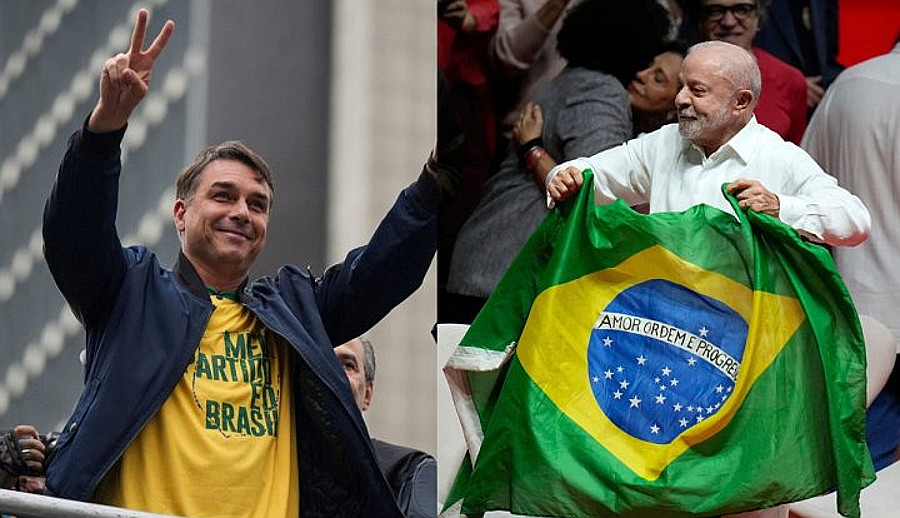
Latin America. Flávio Bolsonaro and Lula go to the second round in Brazil On the other hand, throughout all these years of the Workers' Party government, the structure of the nation, dependent on imperialism, remained unchanged, as did social inequality, racism, and the concentration of land in the hands of large landowners. Low wages and indebted families demonstrate this. It's not just the serious issue of online gambling; it's the ever-worsening income of families. You may be interested in: Brazil: how to defeat Flávio Bolsonaro, Trump and the far right 22:41 "Brazil wants change" After his first-round victory, opposition candidate Flavio Bolsonaro spoke from his bunker in Brasilia and asserted that "Brazil wants change," without mentioning his father's failed presidency. He also stated that this result shows the end of the PT (Workers' Party) and said he was very happy with the regional results. 22:25 An unexpected result Shortly after the official results were announced, Lula gave a speech saying that the result had surprised him and even claimed that he had been confident of winning in the first round. Looking ahead to the next round, he told his supporters that in the second round, "we will show the true picture of Brazil." He also stated that his campaign will focus on convincing all those who abstained from voting of the importance of going to the polls. 22:01 Second round confirmed With nearly 100% of the polling stations reporting, Flavio Bolsonaro is leading with 47.05% of the vote, totaling 56,082,216 votes. This result is not enough for him to win the presidency, so a runoff election will be held with current president Lula da Silva, who obtained 45.14% of the vote, equivalent to 53,799,870 votes. Far behind is the third candidate, Augusto Cury, with just under 3%. Cury has stated that he will not support any candidate in the second round. 8:30 PM The Liberal Party is accumulating governors According to projected results, Bolsonaro's party candidates were elected in Rio Grande do Sul, Rondônia, Roraima, and Santa Catarina, where he was re-elected. He also faces a runoff election in the states of Paraná and Rio de Janeiro, where he currently governs, for a possible total of six states. São Paulo, the country's most powerful electoral district and economic center, remains under the control of the same far-right governor, Tarcísio de Freitas, who is not from Bolsonaro's PL party, but from another right-wing party, República. Tarcísio had withdrawn his presidential candidacy in favor of Flávio, although he is the one who presents himself as the heir to the far-right's legacy beyond the Bolsonaro family. In contrast, the PT appears to be losing Rio Grande do Norte and retaining Bahia, Piauí and Ceará, northeastern states where its strongest support base is concentrated. 20:08 The Bolsonaro clan is making progress within the state With Jair Bolsonaro imprisoned for the attempted coup, the Bolsonaro clan is making progress in consolidating its power in the Brazilian state. Following the election of Michelle Bolsonaro, Jair's wife, as a national senator for the Federal District, two of his sons were elected to state positions in Santa Catarina: Carlos as a senator and Jair Renan as a representative. 19:55 Tarcisius retains the governorship of Saint Paul Right-wing candidate Tarcísio de Freitas, of the Republicanos party , was re-elected governor of São Paulo state, the country's most populous and economically important state, with over 62% of the vote. His opponent, Fernando Hadad of the PT party, trailed far behind with 36%. Over 90% of the polling stations have now been counted. 19:43 Former judge Moro is emerging as a candidate for governor of Paraná Former federal judge Sergio Moro, who led the Lava Jato operation that ended with Lula's imprisonment in 2018, swept the polls and was just 200,000 votes away from being elected governor of the state of Paraná. Moro had been Minister of Justice in Jair Bolsonaro's government and is part of the same party. 19:30 There is a second round According to Datafolha projections, there will be a runoff election between Flavio Bolsonaro and Lula da Silva. The surprise, for now, is Bolsonaro's lead, given that most previous polls predicted a virtual tie. 18:55 Bolsonarism expands its presence in the Senate According to official data from Brazil's Superior Electoral Court, the Bolsonaro family's Liberal Party (PL) already has 16 elected senators, which, added to the 9 previously elected, gives them a powerful bloc of 25 senators. The Senate has the constitutional power to remove judges and exert pressure on the Supreme Court, making it a very powerful lever of influence. https://www.laizquierdadiario.com/En-vivo-Segui-los-resultados-de-las-elecciones-generales-de-Brasil Back |
|
||||||
Thanks for visting the G20 From Below Website. If you want something published here or other enquiries mailto:Brics-from-below@protonmail.com
|
|||||||