 |
|  |


|
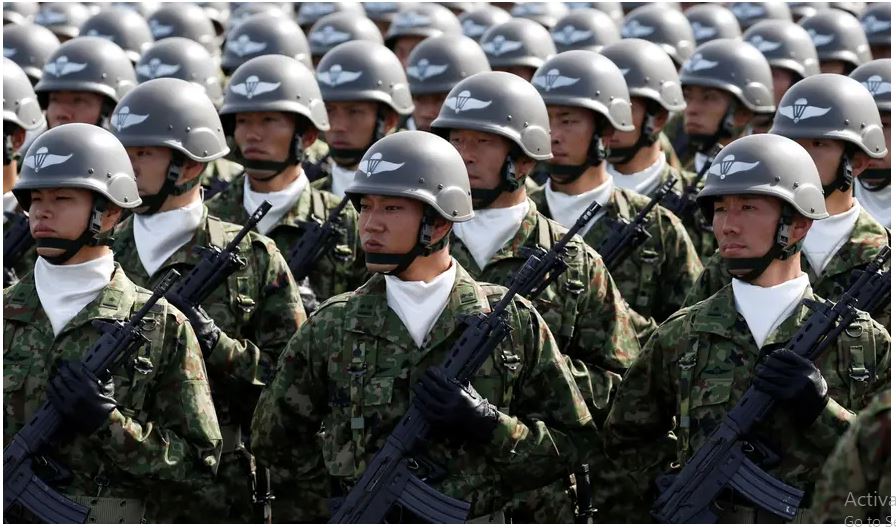
Japan: From pacifist to war power? The Japanese Constitution was promulgated on November 3, 1946, and came into force on May 3, 1947. It is also known as the "Peace Constitution," primarily because of Article 9, which states: “(1) In sincere pursuit of international peace based on justice and order, the Japanese people renounce forever war as a sovereign right of the nation and the threat or use of military force as a means of settling international disputes. (2) To achieve the purpose of paragraph 1, no land, sea, or air forces, nor any other means of warfare, shall be maintained. The State shall not recognize a right to wage war. However, it should not be overlooked that this constitutional article, even before its adoption, represented a compromise intended to save the imperial system. [i] From the outset, the US occupying forces intended to use the Japanese head of state for their own political purposes. The International Military Tribunal for the Far East in Tokyo neither indicted Hirohito nor summoned him as a witness. When Hideki Tojo and six other “Class A war criminals” were finally executed on December 23, 1948, the emperor himself was spared. That Hirohito was able to remain on the throne is the primary cause of the collective historical amnesia of the Japanese, as John W. Dower explains in "Embracing Defeat: Japan in the Wake of World War II." For "if the man in whose name imperial Japan had conducted foreign and military policy for twenty years was not held accountable for instigating or leading the war, why should anyone expect ordinary people to concern themselves with such questions or to seriously reflect on their own personal responsibility?" In Germany, National Socialism was banned, but the military was permitted. In Japan, conversely, the military was effectively banned, but the colonialist-ultranationalist ideology was not questioned. Furthermore, Hirohito played a key role in the formation of the Japanese-American military alliance. Shortly after the new constitution came into effect, he wrote to the US occupying power: "It is desirable that the military occupation of Okinawa take the form of a long-term transfer for a period of 25 to 50 years or more, with Japan retaining its sovereignty." On September 8, 1951, the United States and Japan signed a peace treaty and a security treaty in San Francisco. In 1954, the Japanese Self-Defense Forces were established. The government claimed that, due to Article 9 of the Constitution, these forces were not a regular army and therefore not authorized to exercise a collective right of defense. At this point, a significant difference between Japan and Germany after 1945 can be observed: In Germany, National Socialism was banned, but the military was permitted. In Japan, conversely, the military was effectively banned, but the colonialist-ultranationalist ideology was not questioned. A new form of historical revisionism After the end of the Cold War, Japan initially embarked, albeit hesitantly, on a path of reconciliation with its neighboring countries. However, a severe setback occurred in the mid-1990s, ultimately leading to the election of Shinzo Abe as Prime Minister in 2006. Abe was seen as a beacon of hope by militarists and historical revisionists, and not without reason. On December 26, 2012, Abe was elected Prime Minister of Japan for a second term. The era that began with this election and continues to this day is known in political science as the "2012 system." Abe did indeed represent a new form of historical revisionism, as demonstrated on December 26, 2013, when he visited the Yasukuni Shrine, the spiritual heart of Japanese militarism. The shrine was founded in 1869 to venerate as "heroic souls" those who had fought on the side of the Emperor in the civil war during the final phase of the Edo period (1868/69). Strictly speaking, however, the Yasukuni Shrine was not a religious site; therefore, it did not fall under the jurisdiction of the Ministry of the Interior, but rather the Ministry of the Army and the Ministry of the Navy. Today, in the hands of militarists, this war shrine is a tool of propaganda , used to justify and glorify all Japanese wars. Abe, however, had not anticipated that the US government would sharply criticize his Yasukuni visit: "The United States is disappointed that the Japanese leadership has taken a measure that will escalate tensions with Japan's neighbors." The US wanted to prevent Abe's revisionist historical stance from straining military cooperation between Japan and South Korea. Although Abe subsequently refrained from further visits to Yasukuni, in 2014 he launched the "historical war" against China and South Korea, based on Yasukuni ideology. The conservative politicians of the ruling LDP party are stirring up a nationalist and anti-science sentiment in the country. As a self-proclaimed "right-wing militarist," Abe systematically pushed forward the course of militarization. In 2014, his cabinet passed a resolution recognizing the right to collective self-defense. Abe employed a conceptual sleight of hand: " sekkyokuteki heiwa shugi " literally translates as "active pacifism"; however, the official English translation was "proactive contribution to peace," which implies military presence and intervention. Following Abe's resignation in 2020, his successors continued the course of militarization. For example, in December 2022, Fumio Kishida's cabinet passed three security documents intended to justify preemptive strikes. Since then, the government has been pushing ahead with rearmament and militarization. For example, the military use of civilian ports and airports is being promoted, and the headquarters of the armed forces are being moved underground. Local authorities are now submitting lists of names of all residents aged 18 and 22 to the self-defense forces. Under the 2012 system, the military budget was increased for 14 consecutive years; for the past twelve years, it has been setting new records. Most recently (2025), it stood at US$62.2 billion, 9.7 percent higher than the previous year. It is no coincidence that historical revisionism and remilitarization have gone hand in hand with an increasingly autocratic course. The rule of law and governance ethics have been increasingly undermined. Furthermore, the conservative politicians of the ruling LDP party are stoking a nationalist and anti-science sentiment in the country, resulting in hate speech against Korean, Chinese, and Kurdish people becoming commonplace. Sanae Takaichi's right-wing conservative agenda On October 21, 2025, Sanae Takaichi became Japan's first female Prime Minister. Many people appreciated that she wasn't a "hereditary politician" who had inherited the political base, support groups, and financial resources of her ancestors, but instead came from a perfectly ordinary family. Takaichi succeeded in the ruling Liberal Democratic Party (LDP) as a female version of Shinzō Abe, behaving even more patriarchally than the already deeply patriarchal party leaders. Indeed, like Abe, she tends toward authoritarianism. Takaichi's views are thus also rooted in Abe's tradition. When the Japanese lower house passed a half-hearted resolution in 1995 calling for a renunciation of war and a commitment to peace, Takaichi opposed the resolution. The young member of parliament from the New Progressive Party declared before the Foreign Affairs Committee: "At least I myself belong to a generation that did not experience war. Therefore, I see no reason to reflect critically [on the war] and demand self-criticism of myself." As Prime Minister, Takaichi focuses on setting appropriate themes and priorities. With her emphasis on nationalism and militarism, she aims to win back particularly chauvinistic voters for the LDP. At the same time, she seeks to distract from the fact that her government is simply ignoring the most pressing problem facing the people: the relentlessly rising prices. And so, under Takaichi, militarization and authoritarian transformation are proceeding at a rapid pace, as a glance at recent decisions demonstrates: On March 31, the deployment of long-range missiles in the Kumamoto and Shizuoka prefectures was enforced, and on April 21, restrictions on arms exports were lifted. Despite a reform of the Tenno House Law, only male heirs to the throne are still recognized. The establishment of a "National Intelligence Service" in July marks a fundamental restructuring of the security architecture; it also serves to expand surveillance of the population. And the enacted "Law Against Damage to the National Flag" provides for the punishment of those who willfully damage or remove the flag—an offense punishable by up to two years in prison. Furthermore, the already rigorous immigration policy is being further tightened. The government is now even considering a counter-espionage law as well as the possession of nuclear submarines and nuclear weapons. Takaichi's foreign policy In foreign policy, Takaichi focuses on tirelessly praising the "Japanese-American alliance." When US President Donald Trump gave a speech at the American naval base in Yokosuka in late October 2025 and called the Japanese Prime Minister a "victor," Takaichi raised her right hand in response to the cheers of the US soldiers. When she met Trump in front of the White House in March 2026, she went so far as to claim that only he could bring peace and prosperity to the entire world. When the US government imposed sanctions on the President of the International Criminal Court (ICC), Tomoko Akane, in August of this year, Takaichi merely described the move as "regrettable." Japanese-Chinese relations are at an all-time low. The Chinese government speaks of a Japanese 'new type of militarism ' . On November 7, 2025, Takaichi declared before parliament: "Should Taiwan be subjected to an armed attack, this could lead to an existential crisis for Japan." In plain terms, this means that the Japanese armed forces are authorized to use military force in such a case. In doing so, the Prime Minister ignored the 1972 joint Japanese-Chinese declaration, which states: "Japan fully understands the position of the People's Republic of China that Taiwan is an inseparable part of the territory of the People's Republic." Since then, Japanese-Chinese relations have been at an all-time low. The Chinese government speaks of a Japanese "new type of militarism." Of course, one can sharply criticize China's aggressive foreign and military policies, such as building artificial islands in the South China Sea and declaring them military bases – but one should not use them to justify one's own military buildup. On March 24, 2026, Akihiro Murata, a lieutenant in the ground forces, climbed over the wall of the Chinese embassy in Tokyo with a knife and entered the embassy grounds. Regarding this shocking incident, the Japanese government repeatedly expressed its "regret" but refused to apologize. Civil society resistance The LDP has systematically undermined the Japanese constitution and is also seeking to amend it. This requires a two-thirds majority in both houses of parliament and a simple majority in a referendum. In May of that year, the public broadcaster NHK published an opinion poll on the constitution. To the question, "Do you think the current constitution should be amended?", 38.5 percent answered in the affirmative, while only 17.2 percent were opposed. Regarding the amendment of Article 9, 33.7 percent voted in favor, compared to 27.7 percent against. However, 58.3 percent of respondents stated that they knew "little" or "no" about the principles and content enshrined in the constitution. This raises the risk that, in a referendum, people who are not sufficiently informed about the pacifism clause in the constitution might be misled into voting for a constitutional amendment. Following Takaichi's landslide victory in the lower house elections in February of this year, Japanese civil society is taking a stand. It is using creative methods to advocate for a policy of peace. Many ideas—such as penlight demonstrations, cosplay items, and banners for a fictitious citizens' initiative (for example, the "All-Japan Association for Low Stamina")—have been adopted from the South Korean civil rights movement. The website "Demo Calendar" shows users at a glance when, where, and by whom demonstrations against the war and constitutional amendments are being organized. Calls on social media are leading large numbers of young women to participate in demonstrations for the first time. Despite interference from the police and right-wing circles with ties to the Yakuza, the Japanese civil rights movement is gaining momentum and opposing remilitarization in light of the intensifying efforts to amend the constitution. It is hoped that they will succeed. [i] I avoid the term “Emperor” for the Japanese Tenno because the legitimacy of the Japanese monarchy is not based on the grace of God, but according to state Shintoist theory, the Tenno is a descendant of the gods and thus godlike himself. https://www.rosalux.de Back |
|
||||||
Thanks for visting the G20 From Below Website. If you want something published here or other enquiries mailto:Brics-from-below@protonmail.com
|
|||||||