 |
|  |


|
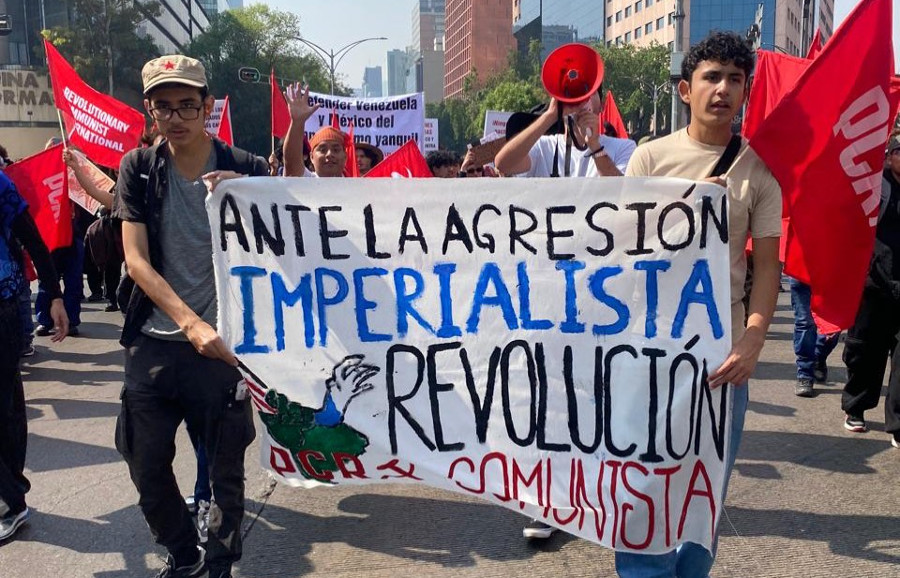
Right-wing populism, failures of “progressive” movements and imperialist onslaught in Latin America In its quest to reposition itself in the region, US imperialism has supported and promoted allied governments, pressuring each government to act in accordance with US interests. Even countries aligned with the US have not been spared tariffs, imposed to maintain a trade balance favorable to the US. Here too, the decline of US imperialism is evident. It's one thing to have a series of puppet governments, quite another to have the capacity to truly replace China economically in the region. For example, the US cannot absorb the Brazilian and Argentinian soybeans that go to the Asian country. But there is no doubt that the pressure against reformist governments is greater than that against their lackeys. Brazil, the South American country with the most trade relations with China, has been punished with tariffs, excluding goods that are key for the US, such as iron. The Trump administration wants to revitalize the US economy, and one example of this is its tariff policy on the North American automotive industry, where it has not backed down even amidst the renegotiation of the United States-Mexico-Canada Agreement (USMCA). The goal is for these tariffs to force new investments in the sector to remain in the US and encourage some industries to return to the country. Trump has gone so far as to say that the USMCA is irrelevant and doesn't need North America. The treaty was due for renewal on July 1st for a period of 16 years, but the US refused, so its validity will now have to be ratified every six years with annual reviews. This means there will be constant pressure, which implies that at any moment conditions could be renegotiated, becoming increasingly favorable to imperialism in this or another sector, in the treaty as a whole, or the treaty could even be broken. In one sense, the integration of North American economies and Trump's protectionist responses exemplify how productive forces have broken down national borders, which then become limitations on their development. The imperialists' response is to stifle global economic development due to competition among themselves. Enormous potential is squandered in the pursuit of private profit. Capitalist anarchy and competition also lead to massive industries failing to reach their full productive capacity. What capitalism truly offers us are wars, genocides, crises, unemployment, hunger, and barbaric violence. This is the expression of capitalism's decline, but also the necessity for a new society to emerge. If all those means of production were placed at the service of humanity, we would end hunger and the daily hardships faced by millions of workers around the world. Amid these pressures, Mexico seeks to portray itself as an ally of the US, attempting to convince the imperialists that it is better to fight together by strengthening North American economic integration to confront Asian competition. Following this logic, Mexico has imposed tariffs on Asian goods, positioned itself as a barrier preventing migrants from reaching the US, taken action against drug cartels under US pressure, accepted military advice and training, and now, the Mexican government is seeking investments within the country under the USMCA to create industries that will replace Chinese imports to the US. For example, by establishing microchip manufacturing plants in Mexico. In other words, what the current administration is seeking is greater integration (which does not occur between equals) but rather a situation of subordination that generates greater dependency. Even though the Mexican government makes all these concessions to the U.S., it's never enough for Trump. At best, and very rarely, he pats you on the back only to strangle you again. He wants total submission. He has to negotiate with Sheinbaum, but a subservient government would be preferable. Overthrowing a president with widespread popular support through violence would generate instability, not to mention a popular uprising. He maintains threats of military intervention against Mexico, has militarily ousted Maduro as president of Venezuela, and has tightened the blockade, pushing the Cuban economy to the brink of collapse. A military attack against Mexico is not out of the question, economic pressures will remain permanent, but the aim is to weaken the Sheinbaum government by first seizing its parliamentary majority in the 2027 midterm elections. The Latin American Mirror During Trump's second term, all elections held in Latin America have been won by the right: Argentina (parliamentary elections), Chile, Costa Rica, Bolivia, Peru, and Colombia. The defeat of the Historical Pact in the latter country leaves the Mexican government in a position of greater isolation. The large number of right-wing governments allowed Trump in March to hold a meeting he called the Shield of the Americas, attended by 11 Latin American leaders, where a pact was signed to confront drug cartels. This fight has served as a convenient pretext for the US government to justify its interference, attacks on Latin American countries, and reactionary measures. This partly expresses enormous pressure from the imperialist offensive and interference, to which we must add the failure of the so-called reformists or progressives (a term we do not like to use because many of them have ended up rescuing the system and the decadent bourgeois states, something that is not progressive at all, instead of proposing a revolutionary solution). We could go back to Argentina's midterm elections to discuss Trump's interference in these processes. The Kirchnerist left left behind a fiscal deficit, debt, and hyperinflation. After winning the election, Milei launched a series of attacks against workers. The elections could have expressed this discontent, but in a precarious economic situation, Trump declared that he would give Argentina his full support if Milei won the election, but not if he didn't. This had the effect of tipping the scales. This is not an isolated case. Imperialist interference in every election in the region has been a constant, relying on sectors of the local bourgeoisie and right wing. If any doubt remained, it was made clear with the leak of the audios known as the Hondurasgate scandal. During the elections, the leaders of the National Party worked to impose Nary Asfurra, strengthen the media smear campaign against leftist presidents in the region, and act in favor of the interests of imperialist capital. But we cannot attribute the defeat of left-wing governments entirely to imperialist interference in the region. It is primarily due to the inability of reformist policies to solve the problems of the working class and, on the contrary, to lead to problems of debt, inflation, and unemployment, as well as failing to address the violence that is a central issue in some countries. This prevents the strong and decisive support of the masses that could, despite imperialist interference, achieve electoral victories. There is a media battle underway, where national and imperialist bourgeoisies are discrediting their opponents, such as the Petro government in Colombia or Sheinbaum in Mexico. Sectors of the reformist left talk about winning the narrative as if it were a battle of messages. Of course, it's necessary to respond to the lies and distortions of the capitalist right, but above all, there must be a coherent program that doesn't hesitate to side with the exploited. Believing that the problem is the discourse leads to conclusions such as saying that criticizing a left-wing government is siding with the enemy. While not denying that the media and social networks are a battlefront, the central problem lies in the program, from which strategy and tactics are derived. Capitalism is a decaying system that will not solve the problems of the masses, even if reforms are attempted. Reformers are incapable of defending themselves against the capitalist offensive and, on the contrary, end up succumbing to it. The rise of the right Given the failure of the reformist left, we generally do not see a return of the old right, the old traditional parties of the local bourgeoisies and oligarchies, but rather populist right-wing demagogues who promise to solve the economic and security crisis. In El Salvador, after 12 years of civil war (1980-1992) and the catastrophe of the ARENA governments during the peace period (1989-2009), the masses finally succeeded in ousting these reactionaries and bringing the FMLN, the former guerrilla group, to power (2009-2019). However, the FMLN failed to meet the expectations of the masses and, on the contrary, shamelessly adapted to the system, personally enriching themselves through bureaucratic positions. It is in this context that Bukele emerges on the scene, capitalizing on the situation. This is a unique case because it manages to address one of the most pressing problems for the masses: insecurity, which has given it a base of support. However, in general, we see that these governments are unstable without a solid foundation of support. While right-wing sectors are developing, including a fascist minority within them, there is generally a search for an alternative that reformism fails to provide in the face of anti-establishment sentiment. The rise of right-wing populist governments was already evident, as seen in the cases of Novoa in Ecuador and Milei in Argentina. In this new Trump era, these right-wing governments, subservient to imperialism, are emboldened and launching attacks against workers. Foreign policy is a continuation of domestic policy. What we are seeing is a policy of adjustments with cuts to social spending and the elimination of subsidies; in Ecuador, for example, the VAT has been increased from 12% to 15%, and budgetary resources are being reallocated. In Chile, the National Reconstruction Law was promoted, reducing taxes while austerity measures were implemented, including an attempt to reduce the education budget by 3%. Similarly, labor reforms have been promoted that undermine workers' rights. Meanwhile, security spending increases, police and military forces are strengthened, and more than one country is considering building mega-prisons to combat crime. The U.S. government interferes, sending military personnel and advising local armed forces. The reaction of the masses If Milei inspired any hope, it vanished with his austerity policies and attacks on workers. The CGT has held three national strikes in defense of their rights. In Bolivia, the cut to the gasoline subsidy, in an economy on the verge of collapse, brought the masses to the streets, with participation quickly becoming radicalized. A leader of the protests in La Paz explained how they were overtaken by the rank and file, noting: "It is not my personal request, it is not a leader's request, (but) the entire population, the revolutionary cry because of what is happening in this crisis, demands the resignation of President Rodrigo Paz, we must be very clear." In Chile, students and teachers' unions took to the streets to protest education cuts. As Marx said, we must see the reality behind appearances. This is not a shift to the right; on the contrary, these defensive struggles are the first steps in a reactivation of the mass struggle, a process that will not be linear. But what is most urgent is that this anti-establishment, anti-system sentiment is leading to the underground development of a revolutionary consciousness, which is first expressed in the advanced strata of society. It is now clear that there has been illegal interference in Mexico by the CIA (Chihuahua) and the FBI (Mayo's arrest). Adding to this, Mexico is further isolated by its electoral defeat in Colombia. Sheinbaum has radicalized her rhetoric, rejecting interference. But her alternative is legal action and mobilizing her base to prepare for the 2027 elections. There is no way out but a revolutionary defense. Reformists have failed in Latin America, and this has allowed the right wing to temporarily capitalize on the situation. They have not managed to create sustainable and stable decent work, even though they would like to dream of returning to a time when capitalism was capable of providing meaningful opportunities for the masses. All governments, right and left, are grappling with the dispute and division between China and the US and are taking sides. Trump wields considerable influence to ensure there is no doubt about whose side they should be on in the Americas. The current administration has made its position clear: it wants them to be good neighbors and to form alliances to combat Asia. Speaking out against interference, taking legal action, preparing for elections—nothing will change the balance of power. Mexican history has shown not only that you can confront imperialism, but that you can push it back and defeat it, but only if the masses confront it with revolutionary action. What you need is a government that clearly defends the interests of the working class (something the 4T doesn't do because it tries to balance between the classes and ends up succumbing to the pressure of capital). "Progressive" movements have failed to correct and improve the system. What we have is this hostile imperialism and decadent capitalism. What we need is a total system change, an international socialist revolution. Workers have taken to the streets from Buenos Aires to Santiago, Chile, from La Paz to Minneapolis. It's like steam rising, capable of moving thousands of tons, like a train, as long as that force is channeled by a piston to become motion. Faced with the rise of right-wing populism and the failure of reformism, the only thing left is to build a revolutionary alternative; the driving force we need is the international revolutionary party, which is why we call on you to join the ranks of the Revolutionary Communist International. https://marxismo.mx/populismos-de-derecha-fracasos-de-los-progresismos-y-andanada-imperialista-en-latinoamerica/ Back |
|
||||||
Thanks for visting the G20 From Below Website. If you want something published here or other enquiries mailto:Brics-from-below@protonmail.com
|
|||||||