 |
|  |


|
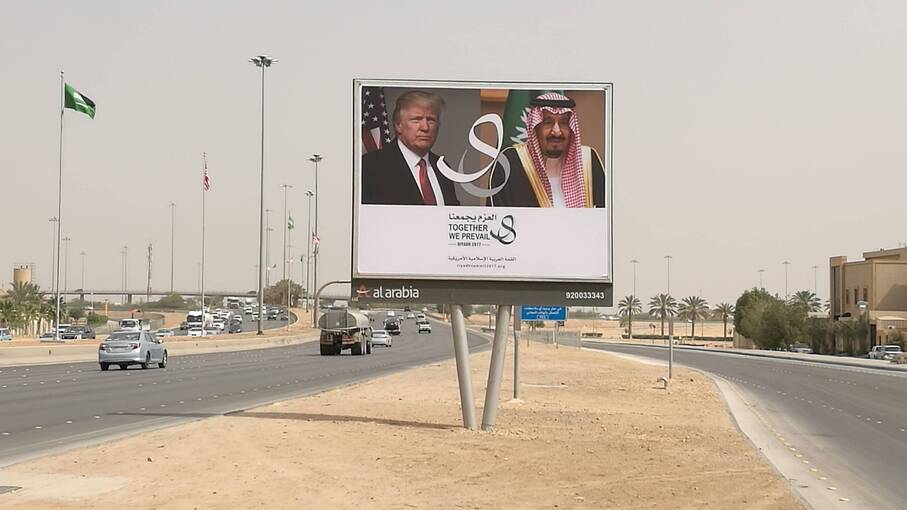
The Mecca Pact A scene straight out of a movie, in which the three heads of state looked like they were playing an evil trio striving for world domination. Twitter was flooded with comparisons to the three witches from "Macbeth." The chilling irony was that Trump and his companions were inaugurating a center to "combat extremist ideologies," even though all three of them, in their own way, promote extremist ideologies. With this appearance in Saudi Arabia, Trump effectively announced the end of the liberal international order. The new president wanted nothing to do with European liberals, Japanese Democrats, or Canadian moderates. He preferred the company of a military ruler from Egypt and a religious autocrat from Saudi Arabia. Their hands on the globe symbolized the desire to steer the world in a different direction. A decade later, Trump still allows himself to be judged by his inner circle. He is friends with war criminals like Russian President Vladimir Putin and Israeli Prime Minister Benjamin Netanyahu, and maintains close contact with autocrats such as Turkish President Recep Tayyip Erdoğan, Nayib Bukele of El Salvador, and Saudi Prince Mohammed bin Salman. But even the autocrats are increasingly suspicious of Trump. Sure, no one wants to upset Trump; after all, he controls both nuclear weapons and tariffs. But the US president is capricious and, frankly, unpredictable. In the 1970s, Richard Nixon more or less pretended to be insane so that the North Vietnamese couldn't predict his next move in the war and fear he might do the unthinkable. Trump is probably not just pretending. Other leaders are playing it safe by silently treating him like a lunatic. In 2017, autocrats were eager to visit Trump at Mar-a-Lago. They then reciprocated by inviting him to their clubs, such as the absurdly named "World Center for Combating Extremist Ideologies." But now, a decade later, some authoritarian countries, like India and Russia, are even refusing to join Trump's "Board of Peace." Even more worrying, at least from the perspective of proponents of American exceptionalism, are those clubs that were founded to exclude the United States. And it is here that the new "Mecca Defense Pact" enters the world stage. The purpose of the alliance On August 7, Turkey, Pakistan, and Saudi Arabia signed a mutual assistance pact, committing themselves to defend each other in the event of an attack. The new alliance builds upon a bilateral agreement signed last year by Islamabad and Riyadh. Two aspects of this announcement are significant. The first is that three US military allies have decided not to rely excessively on Washington on security matters. Instead, they will increasingly rely on each other. Secondly, this new pact will not remain limited to three members . Egypt is likely to be the next member. Discussions are already underway with the other three countries as part of an agreement known as "R4." Gulf states such as Qatar and Kuwait are also expected to join in the near future. This "Mecca Defense Pact" amounts to a strategic rapprochement between Sunni-majority countries. It also unites three largely authoritarian states: Turkey, which is subject to the whims of its leader; Pakistan, which is dominated by the military; and Saudi Arabia, which is a religious monarchy. The current tripartite alliance is not directed against any one specific adversary. Yet it is not difficult to guess who that adversary might be: the three "I's"—India, Israel, and Iran. These countries are a diverse mix—one predominantly Hindu, another predominantly Jewish, the third predominantly Shiite—and it seems unlikely that they will respond with their own military pact. Even if one includes the Houthis in Yemen, they do not constitute a unified threat. And none of these potential adversaries has labeled the new pact as hostile . It is therefore tempting to dismiss the Mecca Pact as a mere Sunni alliance of friendship, more declarative than substantive. If this were the case, however, the three countries would not be so eager to include a provision modeled on Article 5 in their pact, thereby challenging certain geopolitical realities. Turkey is a member of NATO—will it now commit to fighting in wars on multiple continents? Pakistan is currently trying to mediate in the conflict between the United States, Israel, and Iran—will it now commit to intervening against Tehran the next time Iranian missiles fly toward Saudi Arabia? Meanwhile, Saudi Arabia maintains close economic and military ties with India—is it now prepared to abandon these in favor of Israel ? All these entanglements lead to only one conclusion: While the three countries are prepared to make certain sacrifices to unite against their adversaries, their real goal is to protect themselves from their ally, the United States. Since his first term, Donald Trump has threatened to withdraw US security guarantees if NATO countries do not increase their financial resources for their own militaries, or if countries like Japan and South Korea fail to meet their alliance obligations, or even if they so much as look askance at the US president, as Canada and much of the rest of the world have done. Instead of just grumbling about the instability of the USA, the leaders of Türkiye, Pakistan and Saudi Arabia have decided to do something about it. Trump's version of globalism For someone who has so vehemently criticized internationalists and globalists, Trump seems to be devoteing considerable foreign policy energy to creating new multilateral security agreements. His 27-member "Peace Council," with its members willing to pay the $1 billion joining fee, is a rather weak version of the United Nations, but it is also clear evidence that Trump doesn't want to act unilaterally. He wants other countries to follow him like ducklings in a line. Then there are the alliances specifically created for this purpose. Trump launched "Pax Silica" to secure access to natural resources in friendly countries. This group has only 24 members, but they are powerful states, including the European Union, Japan, South Korea, Australia, and India. The US president continues to push forward with the "Abraham Accords" to integrate and strengthen Israel in the Middle East, and the "Quad"—comprising India, Australia, Japan, and the US—is intended to contain China's ambitions in the Indo-Pacific region. At the same time, Trump has sidelined other multilateral efforts. He withdrew the United States from a host of UN institutions, including UNESCO and the World Health Organization. He threatened the BRICS nations with economic ruin should they dare to issue a currency that would compete with the US dollar. And he pulled the US delegation from the last G20 summit in South Africa and simply ignored the last Asia-Pacific Economic Cooperation (APEC) meeting in South Korea. The message is clear: either multilateralism or no multilateralism at all. So far, the Trump administration appears to view the Mecca defense pact as a friendly alliance capable of implementing the burden-sharing that the president has been urging US allies to adopt. It is the same kind of tacit approval the administration has shown toward increased coordination between Japan and South Korea or efforts to expand the European Defence Fund. As so often happens, the Trump administration is failing to properly gauge public sentiment. While the US's allies aren't openly defying the Trump administration, its directives are falling on deaf ears. The behavior of these allies—from Europe to Asia to the Middle East—resembles that of family members telling a violent, dangerous, and mentally unstable father they're taking him on a nice vacation, when in reality they're having him committed to a psychiatric hospital. The father, still powerful in his old age, needs his ego bolstered and his suspicions reassured before he can be sidelined. In the global reorientation currently underway, everyone is forging their contingency plans. The Mecca Pact is merely the latest indication that the liberal international order is dying, the Pax Americana is coming to an end, and the rough outlines of what comes next are only just beginning to emerge. https://www.rosalux.de/news/id/55191/der-mekka-pakt? Back This text is the first German publication of an article that was originally published on the website Foreign Policy in Focus , a project of the Institute for Policy Studies (IPS) in Washington, D.C. We thank them for their kind permission. |
|
||||||
Thanks for visting the G20 From Below Website. If you want something published here or other enquiries mailto:Brics-from-below@protonmail.com
|
|||||||