 |
|  |


|
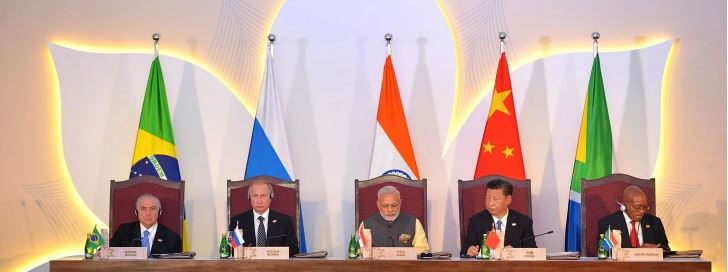
Talk Left Walk Right BRICS and the Anti-Imperialism From Triumphalism to Disillusionment Three attitudes dominate the debate about BRICS. The first is optimism, which often shades into triumphalism. Political economist Radhika Desai offers one of its more sophisticated versions. She sees BRICS as a potentially historic expression of the “world majority” and an emerging alternative to Western domination. To her credit, she also warns against boosters who mistake declarations of intent for accomplished facts and acknowledges that domestic ruling classes constrain the bloc’s progress. In cruder versions of this position, however, every summit, expansion and de-dollarization proposal becomes another hammer blow against Western empire. The second is disillusionment. Journalist Pepe Escobar, once among the bloc’s loudest champions, now describes BRICS as endless talk without decisions. The third is the more cautious position expressed by scholar Anuradha Chenoy at the People’s BRICS plenary. BRICS, she said, has the potential to challenge Western hegemony -- but “we have to wait and see” whether it will move beyond rhetoric. Triumphalism and despair share the same basic mistake. Both imagine BRICS as a single political actor: a would-be liberator that will either save the world or betray it. Escobar’s exhaustion is not really the opposite of his earlier enthusiasm. It is the hangover that followed it. He expected a coalition of semi-peripheral ruling classes—including monarchies, capitalist states, a theocracy and several openly competing states—to behave like a coalition of the oppressed. When they did not, his hope became exasperation. But BRICS was never a movement of the ruled. It is an alliance of states, and those states represent ruling classes with their own interests. Chenoy’s “wait and see” is more useful because it leaves open the question that actually matters: under what conditions can these governments be pushed, and what evidence would show that meaningful change is occurring? This echoes what Walden Bello told us in our discussion: BRICS is currently a project of its member states’ ruling classes. If it is to become a project for the ruled, working people across BRICS countries will have to organize and push it in that direction."""""""" Sub-Imperialism: Cooperation Without liberation The Brazilian Marxist theorist Ruy Mauro Marini offered a better way to understand formations like BRICS: antagonistic cooperation. The idea is simple. Powerful states outside the imperial core can cooperate with the Western-dominated global order while also fighting for a larger share of its rewards. They challenge the dominant powers in some areas, collaborate with them in others and seek more regional influence for themselves. They want a better seat at the table, not necessarily a new table. This is what theorists of sub-imperialism, including friend of BettBeat Media Prof. Patrick Bond, have identified within BRICS. Its member states seek greater autonomy from Washington while continuing to reproduce many of the same systems at home: extractivism, financialization, privatization, corporate concentration and deep inequality (a.k.a capitalism). The expansion of BRICS makes this contradiction impossible to ignore. What common emancipatory project binds Saudi Arabia to Iran, the UAE to Ethiopia or China to India, whose disputed border remains militarized? What holds them together is not socialism, democracy or even a shared foreign policy. It is a common desire to reduce vulnerability to the dollar-dominated system and gain greater bargaining power within the world economy. BRICS is eleven ruling classes optimizing their exposure to Western power. And calling the result South–South cooperation. This critique has also emerged from within BRICS societies themselves. At the People’s BRICS Summit -- a gathering of social movements, trade unionists, activists and other civil-society groups held alongside the official process -- participants issued a resolution challenging the governments’ claims to represent the Global South. It argued that BRICS member states continue to pursue extractivist and unequal models of development, neoliberal trade, privatization and financialization, with devastating consequences for ecosystems, livelihoods and human rights. This goes far beyond Pepe Escobar’s complaint that BRICS “talks too much.” It is a sobering diagnosis by working-class movements rooted in BRICS countries of the interests their governments serve. It is also precisely the kind of criticism that the triumphalist wing of the Western anti-imperialist media rarely acknowledges, let alone seriously engages. De-Dollarization: the Clearest Test The sharpest example of the gap between BRICS rhetoric and practice is its promise of monetary sovereignty. Supporters frequently repeat the claim that around 65 percent of trade between BRICS members has already moved away from the dollar. But compare that headline with the conduct of the institutions that would have to lead any serious break. The New Development Bank, BRICS’s own multilateral lender, has approved a little over $32 billion for 96 projects in a decade. That is tiny compared with the scale of the World Bank. Its president, Dilma Rousseff, has also stated that the bank does not pursue a policy of de-dollarization. India’s position is similarly cautious. As summit host, it has promoted linked payment systems and central-bank digital currencies. But Indian officials insist that this is not an attempt to replace the dollar and does not involve creating a common BRICS currency. The stated aim is simply to reduce transaction costs. Iran has pushed harder for a dedicated financial corridor and full membership in the New Development Bank. That is unsurprising: as a heavily sanctioned state, Iran has far more to gain from breaking with the dollar system and far less to lose. China is the only member with enough financial weight to underpin a serious alternative. Yet Beijing remains cautious because it is deeply entangled with the existing dollar-based system. Even Brazilian economist Paulo Nogueira Batista Jr., a founding director of the New Development Bank and a committed advocate of monetary reform, acknowledges the limits. Any new instrument, he argues, would not be a BRICS currency but at most a “BRICS-centric” one -- and such a project may be thirty or forty years away. https://bettbeat.substack.com/p/talk-left-walk-right-brics-and-the? Back |
|
||||||
Thanks for visting the G20 From Below Website. If you want something published here or other enquiries mailto:Brics-from-below@protonmail.com
|
|||||||