 |
|  |


|
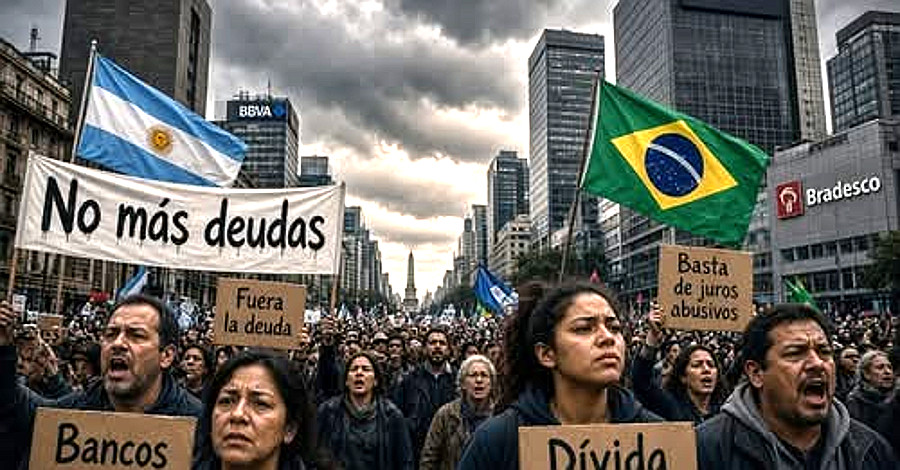
Indebted citizens in Argentina and Brazil two policies and only one fundamental solution Brazil has a population of over 200 million, and nearly 70% of adults (82 million) are in debt. Furthermore, the vast majority are in arrears (with late payments or overdrawn accounts), affecting approximately 80% of the country's households . The widespread use of credit cards is the leading cause of delinquency. Credit is largely used for basic necessities, but the diversion of resources to online gaming, and even worse, the encouragement of gambling addiction, is severely straining household budgets. We already know the Argentine government's response: "tough luck," or perhaps, "Did someone put a gun to their heads to make them do it?" Very different is the "Desenrola Brasil" plan promoted by the government of Luiz Inácio "Lula" da Silva, which addresses the situation of families with debts, especially those who are unable to pay. However, one has to wonder if it really solves the problem. Logically, if wages were sufficient, there would be no need to resort to credit to buy food or pay for basic household services. Credit would be used for the consumption of durable goods, for example, household appliances, cars, and even housing. In Argentina, several projects were presented to be discussed in Congress. There is one in particular that we want to highlight and compare with the one that has been applied since May in the most important country in Latin America and where progressivism governs. This is the project of the deputies' caucus of the Left and Workers' Front-Unity (FITU) in Argentina, headed by deputies Myriam Bregman and Nicolás del Caño, which addresses the crisis of family over-indebtedness, but they start from totally opposite ideological conceptions and financing mechanisms. What are the main differences? 1. An anti-capitalist position and the role of the State Desenrola Brasil: This is a state-run mediation program based on regulated capitalism. Its goal is to reintegrate debtors into the consumer market and "clean up" their financial reputations. The state acts as a facilitator, providing public guarantees so that debtors and creditors (banks, fintechs, and service companies) can voluntarily renegotiate their debts with interest reductions. The FITU Project (Argentina): This proposal represents a direct confrontation with financial capital . It considers household debt to be a "usurious scam" caused by the real decline in wages and pensions. It does not seek to have debtors negotiate with banks, but rather to impose legal penalties on financial institutions. 2. Debt forgiveness vs. Refinancing with write-offs Desenrola Brasil: Offers refinancing with significant discounts (averaging 65% and up to 90%) and caps on new interest rates (set at around 1.99% per month). The borrower continues to pay their refinanced balance in long-term installments (up to 48 months). FITU Project (Argentina): Proposes 100% debt forgiveness for those with incomes below the Basic Food Basket and 50% for those earning up to $5 million. 3. Who absorbs the financial cost? Brazil's Deserolla program: The cost of the risk is assumed by the State through public guarantee funds (such as the Operations Guarantee Fund or FGO). If the consolidated debtor defaults, the state fund covers a portion, protecting the liquidity of the cooperating banks. FITU Project (Argentina): The cost is absorbed exclusively by banks and usurious companies. It prohibits the bailout from generating fiscal costs for the State or the use of pension funds (criticizing projects from other Argentine blocs that propose using the ANSES Sustainability Guarantee Fund). 4. Limits on future interest rates Desrola Brasil: Sets a government-regulated interest cap for payment plans agreed upon on the program platform (1.99% monthly). FITU Project (Argentina): Proposes mandatory and generalized indexing of credit card, fintech and loan rates to the Wage Index, preventing by law financial interest rates from exceeding salary increases. The fundamental difference stems from a class perspective. Those who defend the capitalist system, even in its most benevolent form, will not bear the costs of the aid given to capital, and even less so to the financial sector, which, in its monopolistic form, pulls the strings of the economy. An anti-capitalist stance targets those who charge usurious interest rates, namely banks and digital wallets, and therefore they shouldn't receive state subsidies. Debt is not a free transaction between private parties; it's a social problem. This is the argument presented by Nicolás del Caño, a deputy from the PTS-FITU party, in television interviews, based on the premise that "70% of the increase in debt is due to the decline in wages and pensions. And as everyone knows, this directly impacts people's ability to afford food, pay rent, and pay the electricity bill." He also pointed out that it was the Milei administration that allowed banks and digital wallets to charge usurious interest rates. In this context, the proposed bill caps interest rates, linking them to a wage index that combines formal, informal, and public sector wages. This approach aims to end the current situation while simultaneously increasing wages and pensions to prevent this problem from recurring. Back |
|
||||||
Thanks for visting the G20 From Below Website. If you want something published here or other enquiries mailto:Brics-from-below@protonmail.com
|
|||||||