 |
|  |


|
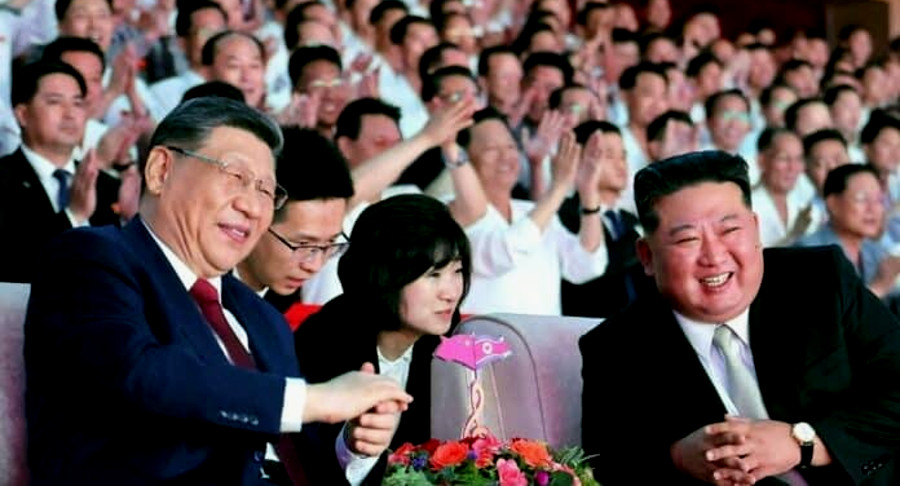
North Korea and China: What drives this "unbreakable friendship"? Secondly, the economic recession exacerbated factional tensions within China's capitalist class and the regime. These processes are largely unknown to the general public, but can be seen in the endless military purges and waves of mysterious disappearances, which are unprecedented in the 99-year history of the Chinese People's Liberation Army. The CCP is in deep trouble The flawed analysis that "Xi Jinping is more powerful than ever before" fails to consider that the power struggles within the CCP and the People's Liberation Army may be a significant factor preventing Xi from traveling abroad—fears of a coup d'état during his trips, a distrust of anyone and a preference for "hands-on" action, or perhaps both. Another point worth noting is that even domestically, Xi has only left Beijing four times for short visits since November 2025. Despite the predicament of China's main adversary, U.S. imperialism, embroiled in a seemingly endless war with Iran and jeopardizing the fate of the global capitalist economy, this year has also been a year of significant setbacks for Xi Jinping and Chinese imperialism. China's ability to project power, openly challenge the U.S., and defend its allies in key regions such as Latin America and the Middle East has revealed its limitations. While China's economic strength remains formidable, particularly its export advantages, the constraints on its geopolitical power are evident in places like Venezuela, Panama, Iran, and Cuba. The CCP's economic strategy requires clinging tightly to the remnants of waning capitalist globalization to absorb Chinese exports and sustain its frail economy. This also means that, under the current circumstances, the CCP must adopt a de facto subservient stance towards Trump to avoid escalating the US-China conflict. Xi Jinping last visited North Korea in 2019, the same year he also visited Brazil, France, Greece, India, Italy, Japan, Kazakhstan, Nepal, and Russia. During this series of diplomatic activities, he welcomed Italy as the first member of the G7 to join China's Belt and Road Initiative (Italy later withdrew in 2023). In 2019, Xi attended the China-led BRICS forum in Brazil, which was widely seen as a potential alternative to challenge Western imperialist hegemony. Now, due to restrictions within the BRICS countries and internal strife, Xi Jinping appears to have lost interest in attending the BRICS summit. Iran is a member of both BRICS and the Chinese-led Shanghai Cooperation Organisation (SCO), but it's difficult to find any record of either organization (BRICS and SCO) expressing any protest, let alone taking any action, regarding the US attack on Iran. The SCO, ostensibly a forum for regional security, calls for "restraint" and urges the UN to "maintain peace." The BRICS countries haven't even managed verbal protests: the BRICS summit in New Delhi in May failed to reach an agreement on a final communiqué—another BRICS member, the UAE, whose regime is among the most pro-war and pro-Israel in the Gulf region, opposed any statements supporting Iran. This stalemate confirms the International Socialist Path (ISA) assessment of the BRICS nations as nothing more than a "paper tiger." It is neither a genuine trade bloc nor united around any plan or vision to challenge U.S. hegemony, a far cry from the illusions held by some left-wing groups. Therefore, the fact that Xi Jinping's only overseas trip since 2026 has been to North Korea is not only symbolic, as North Korea has long been a vassal state of China, and Beijing is now worried that North Korea is going too far under Russian influence. nuclear weapons program Historically, U.S. imperialism is the primary reason for the North Korean regime's relentless pursuit of nuclear weapons. Since the Korean War and the U.S.-led invasion of the Korean Peninsula in 1950-53, the United States has never signed any peace agreement with North Korea. In 2017, Trump wavered between escalating threats and hopes for a historic nuclear deal. During his first term, Trump threatened to "completely destroy" North Korea—a phrase now frequently used to refer to Iran. Iran, which currently does not possess nuclear weapons, has suffered unprecedented airstrikes from the United States and Israel. The war against Iran, the kidnapping of Venezuelan President Maduro, and Trump's escalating attacks on Cuba have all been seen by Pyongyang as justifications for its nuclear weapons program. Despite decades of harsh international sanctions, the Kim Jong-un regime continues to use its nuclear weapons program as a strategic tool to maintain its rule, reinforcing the notion that only the "supreme leader" can defend the country from military attack and consolidating its brutal totalitarian rule. In the past two or three years, Kim Jong-un has forged a highly profitable alliance with Putin-led Russia, resulting in further consolidation of his regime and a strengthening of repression, surveillance, forced labor, and intrusive personal control to stifle any dissent. Outside the relatively prosperous capital of Pyongyang, half of North Korea's population lives in extreme poverty, and 11 million of its 26 million inhabitants are malnourished. The war in Ukraine and Russia's dependence on North Korean arms and manpower prompted a strategic shift in the Kim Jong-un regime, departing from its previous stances: Korean reunification, "Sunshine Policy" talks with South Korea, and attempts to extract economic concessions and sanctions relief from Western imperialism. In March of this year, the regime removed long-standing articles advocating "Korean reunification" from its constitution and removed the word "socialism" from its title. This is significant, marking a further departure from "ideology" for the regime, even though its constitution and government have never truly adhered to socialism. These latest amendments formally establish the dramatic shift in direction that began two years ago, a shift that tore apart more than a decade of efforts by Kim Jong Un and his father, Kim Jong Il, to reach a compromise with U.S. imperialism and its allies. In 2024, the North Korean regime demolished several unification monuments, including a famous one built by Kim Jong-un's father, and destroyed roads and railways leading to South Korea. The new policy's propaganda emphasizes that the Kim Jong-un regime is now strong, independent, and "possesses nuclear weapons," rendering agreements with Seoul or Washington meaningless. Accelerated nuclear weapons development has been incorporated into this new policy. Four days before Xi Jinping's arrival in Pyongyang, Kim Jong-un announced the opening of a new nuclear materials processing plant, claiming it would increase the production of weapons-grade nuclear materials by 75%. He also boasted that North Korea's nuclear forces would grow "exponentially." In late May, the North Korean military test-fired its copy of the American HIMARS rocket, as well as a cruise missile that was allegedly "artificial intelligence guided." Whether these achievements are exaggerated or not, the message conveyed on the eve of Xi Jinping's visit was very clear: North Korea is now playing an increasingly important role in the anti-Western camp, including China and Russia, and therefore its value is constantly rising. Despite the jubilation at the scene, the purpose of Xi's trip was clearly to remind the Kim Jong-un regime that in the complex triangular relationship between China and Russia, it is China, not Russia, that truly holds the dominant position. North Korea, on the other hand, welcomes a bidding war between Beijing and Moscow. For three decades, China has been the dominant force and benefactor of the North Korean regime. During this period following Stalinism and the collapse of the Soviet Union, the North Korean regime teetered on the brink of collapse several times. China accounts for over 90% of North Korea's total trade. However, since the outbreak of the Ukraine war, the ties established between Kim Jong-un and Putin have significantly enhanced Kim's influence within North Korea and in the geopolitical games of Northeast Asia. This has weakened China's previously exclusive influence over North Korea, raising growing concerns in Beijing. Russian factor Clearly, Xi Jinping's trip was not aimed at forging major economic cooperation. China's economy is roughly a thousand times the size of North Korea's. His mission was to stabilize this historically fraught, yet crucial, geopolitical alliance. In the power struggle between imperialist powers, Trump's aggressive militarism, though suffering a major setback in the Middle East, has not yet completely lost momentum. In this context, what the CCP needs is a Russia that is neither too powerful nor too weak. Putin's growing influence over North Korea displeases Beijing, but Russia's recent worrying setbacks in the Ukraine war are a greater concern, although the most likely outcome at present remains the military stalemate that has persisted for the past few years. Despite the CCP's deliberately ambiguous and evasive diplomatic stance, it does not oppose North Korea's participation in Putin's war efforts. Behind its feigned "neutrality" lies the real bottom line: Russia cannot afford to lose this war. At the same time, Beijing is quite uneasy about Kim Jong-un's use of support for Putin as a pretext to secure a large-scale transfer of sensitive Russian military technology. Since 2022, Russia's oil exports to North Korea have increased nearly tenfold, reaching approximately 1.5 million barrels per year. This figure far exceeds the level permitted by UN sanctions, but since Russia is already one of the most heavily sanctioned countries in the world, international sanctions against Pyongyang are now largely irrelevant to it. For Kim Jong-un's regime, the more important factor is gaining access to advanced military technology that had been previously blocked. North Korea has supplied Putin's war effort with 9 to 12 million artillery shells, as well as up to 20,000 soldiers serving as "cannon fodder." South Korean sources indicate that North Korean casualties have reached 6,000. In return, Russia provided North Korea with air defense systems, advanced satellite and space technology, GPS jamming and electronic warfare equipment, and improved missile launch technology. Pyongyang may even have acquired nuclear propulsion systems to upgrade its submarine fleet. For a long time, Beijing and Moscow have refused to transfer such military technology to Pyongyang, fearing the consequences of allowing such an unpredictable and unstable regime to acquire advanced weapons systems. However, this latest Russian military support has completely changed the situation, greatly increasing Kim Jong-un's leverage and expanding his regime's geopolitical maneuvering space. Historical Roots Looking back at history, even when these three neighboring countries were still under Stalinist regimes (non-capitalist dictatorships that called themselves "socialist"), there was never any genuine trust or camaraderie among them. Every Stalinist dictatorship was essentially nationalist. They pursued narrow, self-sufficient domestic economic plans and were committed to defending the privileges and power of their own bureaucratic elites. Kim Jong-un's grandfather, Kim Il-sung, was the first to develop this sophisticated yet ruthless approach, maneuvering and creating competition between his two vast "socialist" neighbors. He repeatedly imprisoned or even executed pro-China and pro-Soviet factions within North Korea's ruling elite. Even after the process of capitalist restoration, relations between these countries remained transactional, and beneath the mask of "unity" lay deep-seated tensions. During Trump's first administration, then-Secretary of State Mike Pompeo visited North Korea in 2018 and met with Kim Jong-un. His recently published memoir reveals a glimpse into this reality. Pompeo recalls telling Kim Jong-un, "The Chinese Communist Party always tells the United States that Chairman Kim will be very happy if US troops withdraw from South Korea." Pompeo stated that Kim Jong-un slammed his fist on the table and shouted, "The Chinese are liars!" According to Pompeo, "Kim Jong-un said he needs US troops stationed in South Korea to protect him from the threat of the Chinese Communist Party, and that the Chinese Communist Party wants US troops to withdraw so that it can treat the Korean Peninsula like Tibet and Xinjiang." While Pompeo, harboring ambitions to become the next right-wing US president, has his reasons for presenting this dialogue in this way, there is nothing shocking or unbelievable about it. Kim Jong-un's remarks about US troops stationed in South Korea and China's ambitions reflect his policy direction at the time—seeking an agreement with US imperialism—and his regime's aversion and distrust of China is nothing new. In 2013, Kim Jong-un executed his uncle-in-law Jang Song-thaek, who was long considered a middleman in Beijing. This move served as both a warning to the Xi Jinping regime and a deterrent to other "pro-China" forces within North Korea's ruling circle. On the surface, the Pyongyang summit reaffirmed the rock-solid "unbreakable friendship" between the Chinese and North Korean regimes. However, a closer reading reveals that North Korea is well aware that it now faces a weakened Chinese leader—who failed to counter Trump on issues such as Venezuela, Panama, and Cuba—and a Chinese regime with an even more unstable domestic foundation. During his two-day visit, North Korean hosts repeatedly displayed diplomatic sullenness and subtle belittling. The scale of the crowds mobilized to welcome Xi Jinping was only one-tenth of that during his last visit in 2019. On a monument commemorating the 1961 treaty between the two countries, Kim Jong-un's name was written in larger font than Xi Jinping's. This scene is reminiscent of a scene in Chaplin's film "The Great Dictator," where German Führer Schinger and his Italian ally Napoleon take turns adjusting their barber chairs to sit higher. For authoritarian regimes like those of Kim Jong-un and Xi Jinping, state visits and high-level diplomatic exchanges are meticulously planned and executed according to a strict hierarchical order, down to the smallest detail. In contrast, the diplomatic activities of other countries appear casual and unrehearsed. Therefore, these seemingly trivial details often carry profound meaning and are rarely unintentional mistakes. Another example is a series of photos taken by Pyongyang showing Xi Jinping wearing glasses while watching a musical performance. These photos were broadcast by North Korean state media, but such images were never released in China. Chinese media and the internet quickly censored and deleted all these North Korean photos of Xi Jinping wearing glasses to maintain his "strongman" image and the officially claimed "flawless" eyesight. Regional perspective The Kim Jong-un regime has achieved a degree of stability and room for maneuver, but this should not be exaggerated. Once the war in Ukraine finally ends, many situations will change. Nevertheless, Xi Jinping was forced to break his previous travel ban, personally bringing Kim Jong-un "back on track" and addressing a series of new and serious problems facing Chinese imperialism and the CCP state—problems that foreshadow an increasingly unstable and dangerous global situation. These include pressure from remilitarized Japanese imperialism, which is actively pursuing alliances with South Korea, Australia, and other regional countries, while the role of the United States in the region remains uncertain. Historically and today, the Chinese regime has needed North Korea as a buffer against American influence and the 28,000 troops stationed in South Korea. In the past, the CCP has consistently opposed North Korea's nuclear weapons program, officially supporting "denuclearization" because it fears this could trigger a chain reaction, prompting Japan and other Chinese imperialist rivals to also develop nuclear weapons. Technically, Japan could actually manufacture them quite quickly, within weeks, which is why it is considered a "quasi-nuclear" or "potential nuclear" state. However, under the new circumstances, the Takashi government, a right-wing nationalist group in Japan, and its large-scale militarization have openly indicated that their primary target is China, with North Korea being only a secondary consideration. Therefore, the CCP has begun to gradually soften its stance and make concessions on the issue of "denuclearization" of the Korean Peninsula. If U.S. imperialism were to one day abandon its decades-long East Asia strategy, withdraw from the Taiwan issue, and withdraw its troops from Japan and South Korea—replicating the trend already emerging in Europe—the likely outcome would be that many of today's U.S. allies develop nuclear weapons, triggering a more intense arms race throughout the region. https://chinaworker.info/en/2026/07/26/49335/ Back |
|
||||||
Thanks for visting the G20 From Below Website. If you want something published here or other enquiries mailto:Brics-from-below@protonmail.com
|
|||||||