 |
|  |


|
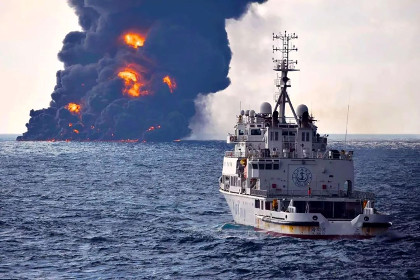
Decline in Bab al-Mandeb Strait traffic drives energy price spike The Suez Canal is the other major part, the northern part of that Red Sea. And the logic of having a huge Israeli port there suddenly ends because its only function was to take goods that were coming through the south side. And so that's really had an extraordinary impact on the Israeli economy. But it showed that a small group, the Houthis, with both their own helicopters and speedboats, with short-range missiles, with drones, could actually close down 12% of the world trade. And we, of course, got a great deal of it coming then through the south side of Africa, the Indian Ocean, and up the Atlantic, taking a few more weeks of sailing and a lot more cost to world shipping. SAfm: Fast forward to 2026, the conflict between Iran and the United States has seen disruption to oil supplies, as we all know. Saudi Arabia, though, has turned its Red Sea port of Yanbu to ship crude out through the Bab al-Mandeb Strait. In the event it does close, what does this tell us about the already fragile relations between Gulf nations? Irreparable damage here being done? Patrick: Yes, but also irreparable to the United States. And I think that's a major factor in Donald Trump putting a pause on bombing. Many would say it's also because he's run out of weapons and he's worried about drawing down stocks that he needs elsewhere in the world where U.S. imperialism is very ambitious. But I think the main thing is, if you're looking at oil, suddenly going about $100 and then futures at $114 at the end of last week, then comes this extraordinary moment where the Houthis enter the fray and Donald Trump does a U-turn. So even though it seems very scary that this small group that is a sort of partially legitimate government in the west side of Yemen, where there's a sort of U.N.-recognized government on the east side, but they are actually able, as are others, Iranians in the Strait of Hormuz, and maybe the Strait of Malacca. That's the other very crucial waterway. And it just shows that if you put too much emphasis on world shipping as a way to get your goods in and out, if you're very exposed to international trade, you may be in trouble if these geopolitical hotspots blow up. SAfm: Absolutely. What opportunity does this present for the African continent, if at all? And I ask this very particularly because we maybe let me just step back. And when COVID came around, we said, oh, what opportunity does this present for the African continent when there was fighting between or still is fighting between Russia and Ukraine? What opportunity does this present for the African continent more so when ships have to reroute? Maybe the question again, here we are in 2026. What opportunity does this present and are we ready to catch that opportunity or realize that opportunity? Patrick: I doubt it because our ports are so congested with container traffic, especially the major port of Durban, but also Cape Town, which ends up listed as the world's worst, least efficient port, not because of any natural fault there. It's very difficult weather and the congestion in that city helps explain why you couldn't really expect Cape Town to suddenly become a beneficiary of this shipping that goes around. I think instead, the show of force by the Houthis and the Iranians' capabilities of withstanding constant bombing then put Africa at great risk with higher petrol prices, again, up to $100 per barrel and then shortages of fertilizers coming from the Gulf. And also then the knock-on effect on food: disaster. And major threats of inflation and then higher interest rates and then more debt defaults. And these are all of the knock-on effects that we would expect if the war continues. But what we're really seeing is a show of strength from the underdogs here, the Iranians and Houthis. And of course, the Houthis themselves say, well, we're also attacking Saudi Arabia because they attacked us. And that means I think we might see a realisation from the U.S. and Israel that they can't actually defeat them, and that the costs to the world economy are too high. And that when Trump goes into his election in November with a world recession, with high inflation, with the Fed probably putting up interest rates at some point between now and the election. Well, I think actually these Houthis have made a decisive intervention and the Iranians' capabilities, hidden away as they are in those mountains above that thin little Strait of Hormuz, it's formidable. SAfm: There must be an indicator that tracks volatility. I have not seen it, but I can only assume that it is at its highest level, especially given what has been happening in the past two years or over the past two years. Donald Trump has made it known that he will run until 2028. And so can we expect more of the same, this volatility, this disruption? And how do we adjust? Because some would argue that this is we're feeling the birthing planes of a new world order. All of this is to cement the U.S.'s hegemony in the world. Patrick: Yes, they certainly want to control oil and taking Nicolas Maduro, the president of Venezuela, just kidnapping him with about 120 fatalities of the people around Maduro on January 3rd was just one indication. And Donald Trump said we are pirates. He actually said that this is now the modus operandi. I think the Cubans would have probably been invaded quite a bit earlier had Trump and Netanyahu succeeded in Iran. They're holding on, but they're under terrible conditions of a blockade by especially Marco Rubio, the U.S. secretary of state, whose family is right-wing Cuban. And then we look at maybe other sites where there is potential oil and especially the rare earth minerals. And if I were Danish and especially if I were in Greenland, I'd be very worried that Donald Trump isn't joking around when he repeatedly brings up the need and his desire, especially as a lame duck president in the last two years of his regime. And with probably a hostile Congress, depending on what happens on November 3rd this year. But I think what we can expect is this. We have the brutality, the bullying and also Donald Trump as the world's greatest ever con man, because you can never expect him to actually follow through with what he says. You can't trust him in a negotiation. And you know that the U.S. is using its last remaining part of military power because it can't get consensus and a general hegemony based upon respect. That's gone. SAfm: Thank you very much, Prof, as always, for your contribution. Professor Patrick Bond is distinguished professor at the University of Johannesburg. https://www.moneyweb.co.za/moneyweb-radio/safm-market-update/decline-in-bab-al-mandeb-strait-traffic-drives-energy-price-spike/ Back |
|
||||||
Thanks for visting the G20 From Below Website. If you want something published here or other enquiries mailto:Brics-from-below@protonmail.com
|
|||||||