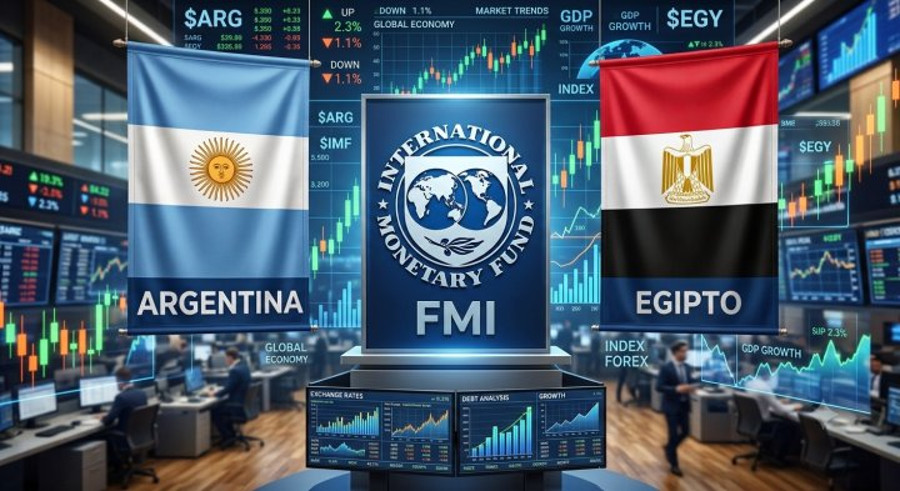
Debt and plunder. The match between Argentina and Egypt against the IMF
The Left Daily 20 July 2026
The two countries hold nearly US$69 billion in debt to the IMF, close to 40% of all its outstanding loans. While the Argentine national team defeated Egypt 3-2 in the World Cup round of 16, both countries share decades of indebtedness, austerity measures, and IMF-backed reforms that place the burden of crises on workers, retirees, and the poor.
Argentina defeated Egypt 3-2 on Tuesday in the World Cup round of 16, but off the field, the two countries have been involved in a different story for decades: they are two of the largest debtors to the International Monetary Fund (IMF). Between them, they account for nearly 40% of all outstanding loans from the organization and are clear examples of the serious consequences for the majority of the population of implementing the Fund's austerity programs.
According to the latest IMF data, Argentina has a debt of approximately US$57.8 billion, while Egypt owes around US$10.85 billion, following the latest expansion of its program. Together, they owe almost US$69 billion, out of a total of approximately US$167 billion currently lent by the organization.
The recurring acute economic crises in both countries and their political and economic structures, subservient to imperialist powers, opened the door to IMF intervention. Behind the rhetoric of guaranteeing the international debt repayment chain, the IMF promotes programs to impose reforms that shift the burden of these crises onto workers, retirees, students, and the general population.
The trajectories of Argentina and Egypt illustrate this pattern. Argentina has signed 23 programs with the IMF since joining the organization, while Egypt has turned to the Fund 12 times. In both cases, the successive agreements were accompanied by demands for reductions in public spending, privatizations, tariff increases, and labor and pension reforms.
The social consequences were similar: deteriorating wages, increased poverty, limited access to public education and health, while commitments to external creditors grew.
Argentina: debt to finance capital flight
In Argentina, the origin of the current debt lies in the extraordinary loan granted to Mauricio Macri's government in 2018, the largest in the Fund's history. The agreement provided for up to US$57 billion, of which approximately US$45 billion was ultimately disbursed.
Several studies, including one by the Central Bank itself, showed that these resources did not finance productive investments but instead coincided with a massive capital flight and the repayment of private debt. While the country was making a historic commitment, a small group of large companies and economic groups were intensifying the capital flight.
Far from investigating the destination of those funds or disregarding a loan widely criticized for violating even the IMF's own statutes, the government of Alberto Fernández and Cristina Fernández de Kirchner decided to renegotiate it in 2022 through a new Extended Fund Facility program. This agreement refinanced the inherited debt in exchange for new fiscal, monetary, and exchange rate targets that implied a continuation of austerity measures. During those years, the outflow of foreign currency also continued through various financial mechanisms and private debt payments.
Under Javier Milei and Luis Caputo, the relationship with the IMF deepened once again. In 2025, the government signed a new US$20 billion program, presented as a tool to strengthen reserves and sustain the exchange rate system. As in previous agreements, the financing was tied to new structural reforms, reductions in public spending, and changes to pension, labor, and tax laws.
Egypt: Support for the counter-revolution
In Egypt, the relationship with the IMF since the 1990s, through successive programs, promoted privatizations, reductions in food and fuel subsidies, and economic liberalization. These policies deepened social inequalities and fueled the discontent that culminated in the 2011 revolution against Hosni Mubarak.
However, following the coup led by Abdel Fattah al-Sisi in 2013, the military regime resumed and deepened its agreements with the IMF. These new lines of credit were accompanied by sharp devaluations, the elimination of subsidies, tariff increases, and reforms aimed at reducing social spending, while the state maintained high levels of military expenditure and consolidated a highly repressive regime.
Al Sisi even went so far as to propose twelve-hour workdays as part of his speech to increase productivity and meet financial commitments to the Fund, while millions of Egyptians suffered the deterioration of their living conditions.
An international campaign against the IMF's adjustment plans
In Argentina, indebtedness was closely linked to capital flight and financial speculation. In Egypt, external financing coexisted with the strengthening of the military apparatus and a regime allied with the major Western powers. In both cases, the result was similar: austerity programs that shift the burden of the crisis onto those who live by their labor.
Cuts to pensions, healthcare, education, subsidies, public sector wages, and social programs repeatedly appear as conditions for guaranteeing debt repayment, the origin and use of which were far from addressing the needs of the majority.
The experiences of Argentina and Egypt demonstrate that the problem transcends national borders. The IMF continues to act as one of the primary instruments through which major powers dictate the economic policies of numerous dependent countries.
Therefore, faced with new agreements that perpetuate the cycle of indebtedness and austerity, the need to launch an international campaign to repudiate illegitimate debts to the IMF is paramount, coordinating the resistance of workers and the people of countries subjected to its programs. Only by breaking free from this subjugation will it be possible to allocate the resources currently absorbed by external debt to wages, pensions, healthcare, education, and housing, prioritizing social needs over the demands of international finance capital.
https://www.laizquierdadiario.com/El-partido-de-Argentina-y-Egipto-contra-el-FMI?
Back
|
|

|
Thanks for visting the G20 From Below Website. If you want something published here or other enquiries mailto:Brics-from-below@protonmail.com
Please Visit the BRICs from below website. The BRICs from below website was established in 2016 to news and analysis on worker and community protests in the BRICS countries and against the activities of BRICS based multinationals especially in Africa. The G20From Below website was set up in to 2025 to extened this work to the G20 countries.

Introducing BRICS from above, BRICS from the middle and BRICS from below
BRICS FROM ABOVE
Heads of state, Business Forum, elite allies
*BRICS as anti-imperialist (ANC & Pretoria rhetoric – “Talk Left, Walk Right”, e.g. national-liberation tradition, foreign ministry on global geopolitics, finance minister on IMF reform, sports minister on FIFA)
*BRICS as sub-imperialist (Pretoria relegitimising world capitalism, lubricating neoliberalism in - and exploiting - Africa, intensifying class war against SA’s poor/workers/women/nature on behalf of global/local capital, ensuring maximum greenhouse gas emissions alongside BASIC/US no matter local/continental/global consequences, and playing “deputy sheriff” role to imperialism)
*BRICS as inter-imperialist (Pretoria's potential support for a new internet delinked from US, promotion of Putin v Obama in September 2013 at G20, and mainly backing Russia in Crimea/Ukraine conflict - as well as earlier episodes where SA lined up with China in UN e.g. in relation to Burma)
BRICS FROM THE MIDDLE
Academic Forum, trade unions, NGOs
BRICS advocates (most of Academic Forum, Johannesburg & Pretoria “think tanks” and others who suffer persistent “failure of analytical nerve”)
*wait-and-see (most NGOs and trade unions - as well as “Third Worldist” intellectuals - who wish for BRICS to become “anti-impi” at UN, Bretton Woods Institutions, Development Bank, Contingent Reserve Arrangement, etc)
*critics (those associated with brics-from-below network who consider BRICS to be “sub-impis” and sometimes also “inter-impis”)
BRICS FROM BELOW
Grassroots activists whose visions run local to global
*localist (stuck within local or sectoral silos, including myriad “popcorn protests” - even some against BRICS corporations or projects - that are insurgent, unstrategic, momentary, at constant risk of becoming xenophobic, and prone to populist demagoguery)
*nationally-bound (most activists who are vaguely aware of - and hostile to - BRICS yet so overwhelmed by local, national and sectoral battles, they fail to link across borders - even BRICS hinterlands)
*solidaristic-internationalist (“global justice movement” allies aspiring for joint campaigning against common BRICS enemies such as Vale, China Development Bank, DBSA, Transnet/mega-shipping, fossil fuel corporations and other polluters, coming BRICS Development Bank)
JEALOUS PRO-WEST CAPITALISTS
Most white organic intellectuals of capital connected to Old Money, multinational-corporate branch plants, Business Day, northern-centric big biz, Democratic Alliance and their ilk.
|