 |
|  |


|
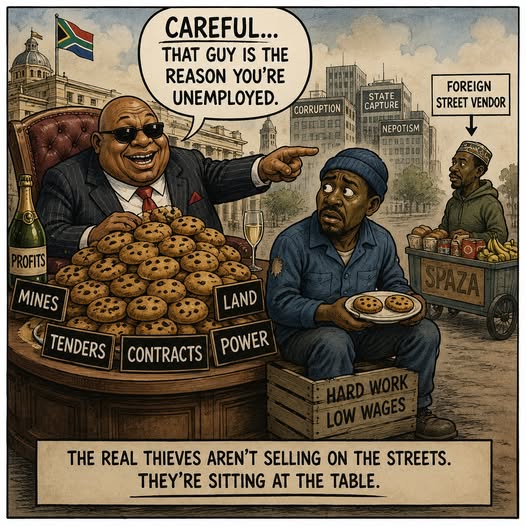
How South Africa Manufactures Xenophobia Mechanism One: Labour May Move. People May Not. The system welcomes labour while controlling people. Labour is allowed to move when it is useful to capital. Workers may cross borders, provinces and cities when their labour is needed elsewhere, but their freedom to move as human beings, with dignity, security and rights, is another matter entirely. Capital faces no such restriction. Investments move freely. Executives, professionals, investors and people with scarce skills move relatively freely because their movement serves accumulation. It keeps business moving. It keeps deals moving. It keeps profit moving. Poor people experience a different world. Workers displaced by poverty, war, climate disaster, regional inequality or economic collapse meet borders, permits, detention centres, deportations and militarised enforcement. Even when people move for the most human reasons - because they have fallen in love, want to reunite with family, care for children, or live near those they love - their movement is treated with suspicion unless it serves the interests of capital. For poor people, love, family and belonging are made conditional on paperwork, income thresholds, marriage rules and documentation systems that can separate partners, parents and children. This is especially dishonest in Southern Africa because South Africa's economy was built on migration. Johannesburg was built by workers from Lesotho, Mozambique, Zimbabwe, Eswatini, Botswana and beyond. Colonial borders were never neutral lines on a map. They controlled whose labour belonged to which territory, employer and colonial power. African workers could move when mines, farms and industry needed them. They could not move freely according to their own needs. That logic has not disappeared. It has been modernised. What this demands from us: We must defend freedom of movement as a working-class right. Poor people must be able to move for work, family, love, safety and survival - within cities, across provinces, across the region and across the African continent. A democratic South Africa cannot defend freedom while treating poor people's movement as a crime. Mechanism Two: Survival Is Being Criminalised. Across our cities, people trying to survive outside the formal economy are increasingly labelled as criminals. Informal traders become illegal traders. Migrants become illegal immigrants. Zama-zamas become illegal miners. Waste pickers become nuisances. Homeless people become trespassers. The language matters. The question is no longer whether people are hungry, unemployed or excluded. The question becomes whether they have the correct permit, licence, visa, registration or document. Poverty itself becomes regulated. Survival itself becomes criminalised. This is why the slogan “No One is Illegal” matters. It does not mean that states have no laws. It means that no human being’s existence should be turned into a crime. A person may be undocumented. A trader may lack a permit. A worker may be pushed into an abandoned mine. A family may be sleeping on the street. But people themselves are not illegal. When we call human beings illegal, we make it easier to deny their dignity, remove their rights, and justify violence against them. A woman selling tomatoes on a street corner without a permit is treated as a law-enforcement problem. But what is her real offence? She is trying to escape poverty without permission. The language of illegality allows us to stop seeing people. The informal trader is no longer a mother feeding her children. The refugee is no longer a person fleeing violence. The homeless man is no longer somebody's son. The undocumented worker is no longer a neighbour. Human beings become categories, and categories are easier to fear than people. This is why raids against informal traders in Johannesburg matter. Confiscation is presented as enforcement. Removal is presented as urban management. City raids are presented as clean governance, even when names like Operation Clean Sweep suggest something more disturbing: that poor people are urban dirt to be cleared away so the city can look acceptable to those with power. The issue is not simply public order. It is economic order. Informal traders create alternative circuits of survival. Spaza shops compete with large retail chains. Street vendors keep money circulating locally. Small migrant-owned shops offer a path into economic participation when formal employment has failed. They are not only competing with local businesses. They are competing with concentrated retail systems. Large supermarket chains and discount retailers organise how workers buy food, where they buy it and who profits from their wages. Informal traders and spaza shops interrupt that concentration of power. They create small spaces of independence outside the monopoly retail system. Informal trade is one of the few remaining pathways through which poor people can accumulate capital from below. Many South Africans remember Portuguese corner shops from the apartheid years. Those families used small business as a route into stability and upward mobility. Today, Somali, Bangladeshi, Ethiopian, Pakistani, Zimbabwean and other African traders use similar mechanisms. But now these pathways are increasingly restricted, raided and criminalised. The message is clear: you may work, you may consume, you may provide cheap labour, but you may not easily escape the position assigned to you. What this demands from us: We must stop criminalising survival and direct our anger upward. The real criminals are not tomato sellers, waste pickers, street traders or migrant shopkeepers. They are those who loot healthcare, collapse education, capture the state, corrupt tenders and leave communities without water, electricity, sanitation, safety or work. We must reclaim our cities and public goods for the people who live in them. Mechanism Three: The Democratic Revolution Left Wealth Untouched. The Freedom Charter declared that South Africa belongs to all who live in it. It imagined land, work, education, housing and dignity as the foundation of a free society. The Constitution carried part of that democratic vision into law. It gave us powerful language about equality, dignity and human rights. But the democratic settlement was also the place where the revolution was stopped in its tracks. In the name of democracy, political rights were secured while the deeper transformation of land, wealth and capital was contained. It was not only an unfinished settlement. It was, in important ways, a democratic counter-revolution: a compromise that allowed apartheid’s economic structure to survive beneath a new constitutional language. Section 25 protected property in a way that left the central economic structure of apartheid largely intact. Political rights were democratised, but economic power was not. The racial composition of elites slowly changed, but the class structure remained. A limited transfer of wealth was allowed, while the deeper architecture of ownership, landlessness and corporate control survived. Education shows the same struggle. The Freedom Charter said the doors of learning and culture would be opened. Fees Must Fall forced the state to expand access for working-class students through NSFAS. For many families, this was not symbolic. It meant that the child of a domestic worker, a security guard, an informal trader or an unemployed parent could enter university and begin to break the cycle of poverty. But even that gain is now under threat. As NSFAS falters, students face shortfalls, debt, delayed payments, accommodation crises and exclusion from registration. Without organised pressure from students, workers and civil society, even the limited doors that were forced open begin to close again. This is not merely administrative failure. It is part of the same class logic. The system cannot easily allow poor people's children to escape poverty in large numbers because the economy depends on reproducing a working class that remains available, desperate and cheap. What this demands from us: We must stop pretending that political freedom can survive while wealth remains untouched. A society with billionaires on one side and hungry children on the other is not yet free. Land, wealth, education and opportunity must be redistributed so working-class children can break out of poverty. NSFAS, public schools, universities and public infrastructure must be defended as instruments of liberation, not left to collapse until only the rich move forward. Mechanism Four: Poverty Is Being Turned Into a Security Threat. When a state cannot or will not deliver land, work, housing, education and dignity, it often turns social questions into security questions. Poverty becomes disorder. Migration becomes invasion. Informal trade becomes illegality. Homelessness becomes urban decay. Mining by the excluded becomes criminal syndication. Protest becomes instability. Zama-zamas are a clear example. There are real dangers, criminal networks and violence around abandoned mines. But the public story rarely begins with the mining houses that extracted wealth, abandoned shafts, left ecological devastation and walked away from communities with no sustainable economy. Instead, the story begins with illegal miners. The worker at the bottom of the abandoned shaft becomes the face of the crisis while the structure that created abandoned mining towns remains hidden. The same happens with informal traders. The woman selling tomatoes, the man selling sweets, the migrant running a spaza shop and the street vendor feeding a family are framed as threats to law and order. Beneath the language of compliance is a deeper political choice: the city is being shaped for property owners, formal business and corporate retail, not for the poor who actually live, work and survive in it. This is also how migration policy has shifted. The earlier post-apartheid vision of migration still recognised migration within a broader developmental framework of regional integration, African solidarity and economic cooperation. Migrants were not only imagined as threats. They were participants in regional development and in the shared life of Southern Africa. That vision has narrowed. Today, migration is increasingly discussed through sovereignty, enforcement, border management, risk, control and national security. The migrant is transformed from a participant in development into an object of surveillance. Human beings become threats. Movement becomes danger. Documentation becomes a weapon. And while the poor are policed with intensity, corruption, price-fixing, illicit financial flows, corporate misconduct and elite impunity are treated with far less urgency. The full force of enforcement is directed downward. What this demands from us: We must reject the lie that poor people are the security threat. The real threat is corruption, state capture, corporate profiteering, abandoned mines, stolen public money and an economy that discards human beings. Safety must be rebuilt as a public good, not bought behind walls. The state must pursue the powerful who destroy lives, not raid the poor to create the appearance of order. Mechanism Five: The State Produces Undocumentedness. We often speak as if South Africa has a documentation crisis. That is too soft. What we have is the production of undocumentedness. The rapid improvement of systems serving citizens, investors, business travellers and skilled migrants demonstrates that administrative capacity exists when political will exists. The persistence of dysfunction in refugee and asylum systems therefore raises a different question: not whether the state can solve these problems, but whether it wishes to. If the system works better for passports than for asylum papers, if it works better for business visas than for poor migrants, then we are not looking only at administrative failure. We are looking at a political choice about whose mobility matters. People wait years for decisions. Claims are rejected at enormous rates. Files disappear. Offices close. Permits expire because the state cannot renew them properly. People who try to regularise their status are pushed into uncertainty, and then that uncertainty is used against them. The state first creates undocumentedness and then punishes people for being undocumented. That vulnerability serves many interests. Employers benefit from workers who are afraid to report exploitation. Politicians benefit from scapegoats. Security agencies benefit from expanded enforcement powers. Communities facing unemployment, hunger and collapsing services are given a convenient enemy. The migrant becomes the explanation for everything. The system disappears from view. What this demands from us: We need a documentation system built around dignity, not punishment. Home Affairs must document people instead of manufacturing vulnerability. People must be able to regularise status, renew papers, register births, marry, study, work and care for children without endless uncertainty. A state that makes people undocumented and then punishes them for it is not protecting democracy; it is disciplining the poor. Mechanism Six: Apartheid Geography Still Organises Our Lives. Thirty years after democracy, South Africa still carries the geography of apartheid. The poor remain concentrated in townships, informal settlements and neglected inner-city spaces. Wealth remains concentrated in suburbs, business districts and gated enclaves. Workers travel long distances to clean, build, guard, cook, deliver and serve while remaining excluded from the wealth their labour creates. This is the neoliberal vision of post-apartheid South Africa: not the abolition of apartheid's class structure, but its modernisation. The townships continue to supply labour. The suburbs continue to consume labour. The inner city is policed as disorder. The poor are moved around, raided, documented, undocumented, evicted, licensed, refused licences, arrested, deported or displaced depending on what the economy requires. The majority of migration affecting South African communities is not international migration but internal migration as people move in search of work and opportunity. People moving from Limpopo to Gauteng, or from the Eastern Cape to Cape Town, are South Africans moving in search of work, housing, education and survival. Yet even this movement is increasingly spoken of as a burden, a pressure, a threat to service delivery. That should warn us. The same logic used against foreign nationals can easily be turned against poor South Africans. Once poverty is securitised, every poor person becomes a potential problem to be managed. What this demands from us: We must radically transform apartheid geography. That means inclusive cities, public housing, affordable transport, safe trading spaces, schools, clinics, libraries, parks, water, electricity and sanitation where people actually live. We must stop building cities for property owners while treating the poor as dirt to be removed. A free South Africa must let people live close to work, family, school, worship, care and community. The Democratic Project Is at Stake. South Africa's democratic project was never meant to end at our borders. Our struggle against apartheid taught us that freedom is either shared or it is fragile. The same world that once isolated apartheid South Africa through international solidarity now watches whether we will defend the dignity of others with the same seriousness we demanded for ourselves. That is why our stand at the International Court of Justice matters. It says that international law must protect the weak from the powerful, that no state may place itself above accountability, and that no people may be treated as disposable. But that witness becomes hollow if, at home, we allow migrants, refugees, informal traders, waste pickers and the poor to be treated as disposable too. Global solidarity cannot be a slogan we use in The Hague while abandoning people in Hillbrow, Musina, Marabastad, Bellville or the inner city of Johannesburg. The struggle for Palestine, the struggle against xenophobia, the struggle for land, the struggle for decent work, and the struggle for public services all ask the same moral question: whose humanity is allowed to count? This politics of division undermines South Africa's democratic project itself. The promise of the Freedom Charter was never only about South Africa. It was part of a broader anti-colonial vision that understood freedom as indivisible. The same democratic settlement that declared that South Africa belongs to all who live in it also helped shape a foreign policy rooted in human rights, international law and solidarity with oppressed peoples. South Africa's decision to approach the International Court of Justice regarding Palestine reflects that tradition. At its heart lies a simple principle: that all human beings possess equal dignity, that no nation stands above the law, and that power alone cannot determine whose lives matter. The same principle must apply within South Africa's borders. That moral vision is weakened when we fail to uphold those same principles at home. Every act of xenophobic violence, every campaign that dehumanises migrants, every effort to divide working-class communities against one another erodes the credibility of the democratic ideals we claim to defend internationally. The struggle against xenophobia is therefore not separate from the struggle for a more just world. It is part of the same struggle. A South Africa trapped in fear, exclusion and division cannot effectively champion equality, dignity and justice beyond its borders. Conclusion: Redirect the Anger. The anger is real. The target is wrong. South African workers and migrant workers are not enemies. They occupy the same position in an economic order that depends on scarcity, insecurity and competition among the poor. Xenophobia does not only injure its victims. It injures those who participate in it. Every time we are persuaded to fear the poor, despise the vulnerable or blame the outsider, something is diminished within us. We become less capable of solidarity. Less capable of compassion. Less capable of imagining a society rooted in our shared humanity. Under apartheid, black labour was permitted to move when required by the economy while black people themselves remained controlled. Today labour mobility remains welcome when it serves capital, while poor people's mobility is increasingly criminalised. If we accept this lie, we will become a country that polices the poor while protecting the powerful. We will become a country that raids tomato sellers while corruption survives, that blames refugees while wealth remains untouched, that speaks of human rights at the International Court of Justice while denying dignity to people at home. Migration is not the crisis. The deeper crisis is a social order that regulates poverty rather than overcoming it: a system that protects property more fiercely than people, moves capital more freely than workers, criminalises survival, manufactures undocumentedness, securitises poverty, reproduces apartheid geography, and then persuades the victims of that system to blame one another. The alternative is not open borders versus closed borders. The alternative is a society organised around human dignity rather than profit, around belonging rather than exclusion, around solidarity rather than fear. It is the unfinished democratic revolution contained in the Freedom Charter: that South Africa belongs to all who live in it, and that no person's humanity should depend on their wealth, nationality, documentation status or usefulness to the market. That is not the promise of the Freedom Charter. That is not the dream of liberation. That is not a society in which South Africa belongs to all who live in it. The unfinished challenge of our democracy is not to decide who belongs. It is to build a society that finally honours that promise. https://www.facebook.com/nigel.branken.2025 Back |
|
||||||
Thanks for visting the G20 From Below Website. If you want something published here or other enquiries mailto:Brics-from-below@protonmail.com
|
|||||||